
At its core, a custom-designed vacuum furnace provides unparalleled control over your manufacturing environment, moving beyond the limitations of standard equipment to achieve superior material properties, process repeatability, and operational efficiency. These furnaces are not just tools but precision instruments, engineered specifically to solve complex challenges in advanced sectors like aerospace, medical, and electronics by tailoring every aspect of the thermal process—from chamber geometry and vacuum levels to thermal cycling and automation.
A standard furnace is a versatile tool for many jobs. A custom-designed furnace is a master instrument built for one specific, critical purpose, enabling breakthroughs in material science and production that are impossible with off-the-shelf solutions.
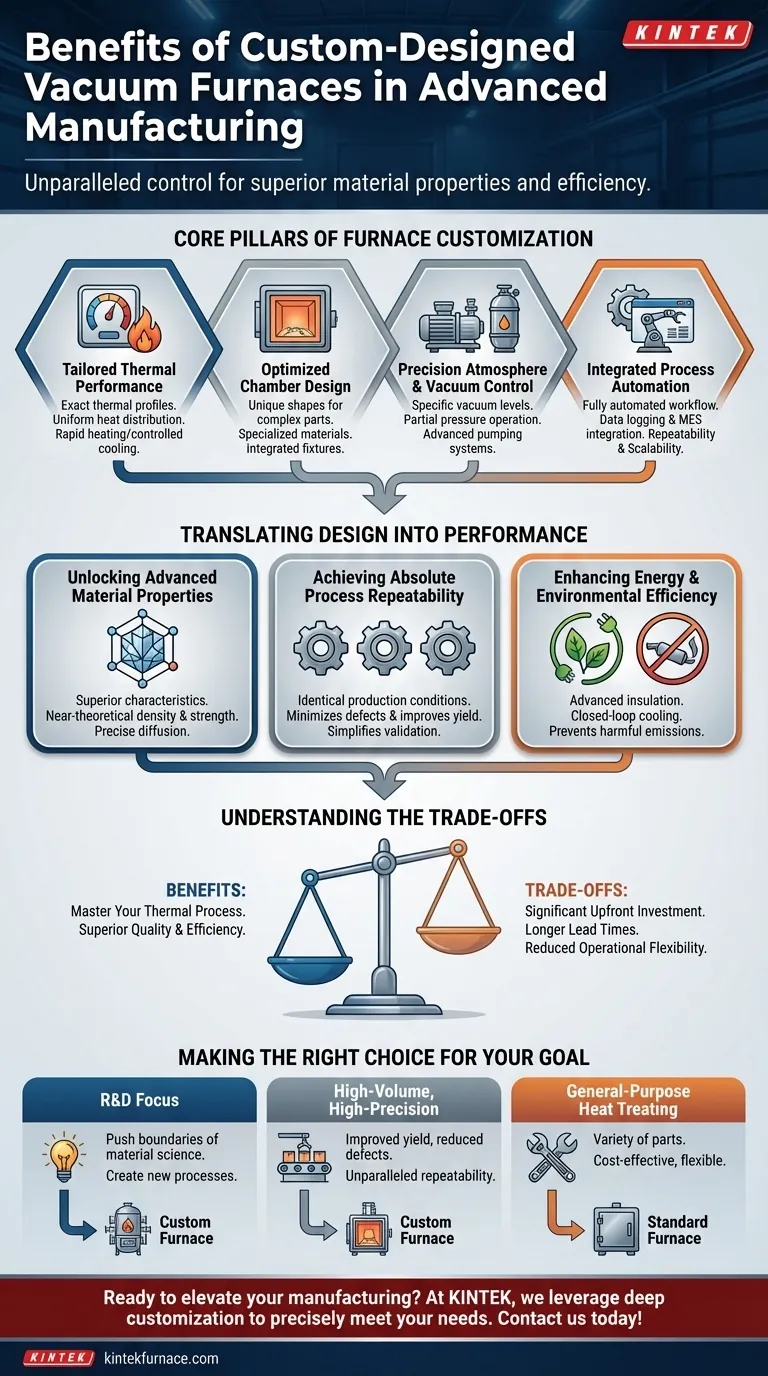
The Core Pillars of Furnace Customization
Investing in a custom furnace means moving beyond generic specifications. It involves a deep analysis of your process to engineer a solution that precisely matches your material, component geometry, and production goals.
Tailored Thermal Performance
Standard furnaces offer a general range of temperatures and ramp rates. Customization allows you to define the exact thermal profile your process requires, ensuring uniform heat distribution across complex parts and achieving specific microstructures. This includes designing for extremely rapid heating or controlled, multi-stage cooling cycles (quenching).
Optimized Chamber Design
The physical chamber is engineered around your specific product. This can mean a unique shape to accommodate unconventional parts, specialized materials to prevent contamination, or integrated fixtures to maximize batch size and ensure consistent part orientation. This is critical for processes like vacuum arc melting, where material purity is paramount.
Precision Atmosphere and Vacuum Control
Customization enables precise control over the furnace environment. You can specify the ultimate vacuum level required, design for partial pressure operation with specific gases, or integrate advanced pumping systems to remove impurities more effectively. This is essential for sensitive processes like vacuum sintering, where even trace amounts of oxygen can compromise the final product's density and strength.
Integrated Process Automation
A custom furnace can be fully automated to your exact workflow. This goes beyond simple temperature programming to include automated loading/unloading, data logging for quality assurance, and integration with your facility's manufacturing execution system (MES). The result is a dramatic increase in repeatability and scalability, removing operator variability from the equation.
Translating Design into Performance
The decision to customize is driven by the need for tangible results that standard equipment cannot deliver. These benefits directly impact product quality, operational efficiency, and your bottom line.
Unlocking Advanced Material Properties
Customization is the key to producing materials with superior characteristics. Processes like vacuum hot pressing, which combine heat, vacuum, and mechanical pressure, can be fine-tuned to create components with near-theoretical density and exceptional strength. Similarly, in electronics, custom furnaces enable the precise diffusion and oxidation steps needed for high-performance semiconductor wafers.
Achieving Absolute Process Repeatability
In regulated industries like aerospace and medical device manufacturing, every part must be identical. The combination of precision thermal control, a stable vacuum environment, and full automation ensures that every production run replicates the exact same conditions. This minimizes defects, improves yield, and simplifies process validation.
Enhancing Energy and Environmental Efficiency
Modern custom furnaces are designed with efficiency in mind. They incorporate advanced insulation materials, high-efficiency heating elements, and closed-loop cooling systems to minimize energy consumption. Furthermore, because the process is contained within a sealed vacuum environment, it prevents the release of harmful exhaust gases, helping to meet stringent environmental standards.
Understanding the Trade-offs
While powerful, a custom-designed furnace is a specialized investment. Objectively weighing the downsides against the benefits is critical for making an informed decision.
Significant Upfront Investment
The most apparent trade-off is cost. The engineering, specialized materials, and unique fabrication required for a custom solution result in a substantially higher initial investment compared to a standard, off-the-shelf furnace.
Longer Lead Times
Designing, building, and commissioning a custom furnace is a lengthy process. It requires close collaboration between your team and the manufacturer, and lead times can extend for many months, potentially impacting project timelines.
Reduced Operational Flexibility
A furnace optimized for one specific task is, by its nature, less suited for others. This specialization can become a limitation if your production needs change or you need to process a wider variety of parts in the future. A general-purpose standard furnace offers more flexibility in this regard.
Making the Right Choice for Your Goal
The decision to invest in a custom furnace should be driven by a clear understanding of your primary objective.
- If your primary focus is research and development: A custom furnace is often necessary to push the boundaries of material science and create entirely new processes.
- If your primary focus is high-volume, high-precision manufacturing: The initial cost of a custom furnace is often justified by improved yield, reduced defects, and unparalleled repeatability.
- If your primary focus is general-purpose heat treating for a variety of parts: A standard, off-the-shelf furnace will likely provide a more cost-effective and flexible solution.
Ultimately, choosing a custom furnace is a strategic decision to master your thermal process, not just perform it.
Summary Table:
| Benefit | Description |
|---|---|
| Tailored Thermal Performance | Custom thermal profiles for uniform heating and specific microstructures, ideal for rapid heating or controlled cooling cycles. |
| Optimized Chamber Design | Engineered chamber shapes and materials to accommodate unique parts, prevent contamination, and maximize batch size. |
| Precision Atmosphere and Vacuum Control | Exact vacuum levels and gas environments to ensure purity, crucial for processes like vacuum sintering. |
| Integrated Process Automation | Full automation for loading, data logging, and MES integration, boosting repeatability and scalability. |
| Unlocking Advanced Material Properties | Fine-tuned processes for superior density and strength in materials, e.g., in vacuum hot pressing. |
| Achieving Absolute Process Repeatability | Ensures identical conditions for every run, reducing defects and aiding validation in regulated industries. |
| Enhancing Energy and Environmental Efficiency | Advanced insulation and sealed environments lower energy use and prevent harmful emissions. |
Ready to elevate your manufacturing with a custom-designed vacuum furnace? At KINTEK, we leverage exceptional R&D and in-house manufacturing to provide advanced high-temperature furnace solutions, including Muffle, Tube, Rotary Furnaces, Vacuum & Atmosphere Furnaces, and CVD/PECVD Systems. Our strong deep customization capability ensures we precisely meet your unique experimental and production needs, delivering superior material properties, process repeatability, and operational efficiency. Contact us today to discuss how we can tailor a solution for your advanced manufacturing challenges—Get in touch now!
Visual Guide
Related Products
- Custom Made Versatile CVD Tube Furnace Chemical Vapor Deposition CVD Equipment Machine
- Small Vacuum Heat Treat and Tungsten Wire Sintering Furnace
- Vacuum Hot Press Furnace Machine Heated Vacuum Press Tube Furnace
- Molybdenum Vacuum Heat Treat Furnace
- 600T Vacuum Induction Hot Press Vacuum Heat Treat and Sintering Furnace
People Also Ask
- What is a CVD tube furnace and what is its primary function? Discover Precision Thin-Film Deposition
- Why are CVD tube furnace sintering systems indispensable for 2D material research and production? Unlock Atomic-Scale Precision
- Which industries and research fields benefit from CVD tube furnace sintering systems for 2D materials? Unlock Next-Gen Tech Innovations
- How does CVD tube furnace sintering enhance graphene growth? Achieve Superior Crystallinity and High Electron Mobility
- What are the key features of CVD tube furnaces for 2D material processing? Unlock Precision Synthesis for Superior Materials



















