
In essence, a muffle furnace is used for high-temperature processes that demand a clean, controlled, and uniform heating environment. Its most common applications fall into three main categories: analyzing the composition of materials (ashing), altering the physical properties of metals (heat treatment), and creating new materials from powders (sintering) or other components.
A muffle furnace's core value lies in its design, which separates the material being heated from the direct radiation and contaminants of the heating elements. This creates a highly uniform and clean heat zone, making it the definitive tool for processes where precision and sample purity are paramount.
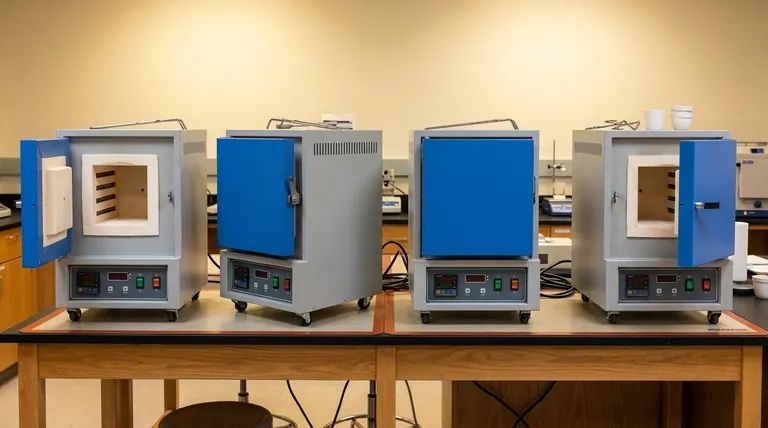
The Core Principle: A Contamination-Free Environment
A muffle furnace's versatility stems from its unique construction. Understanding this design is key to understanding its applications.
What is a "Muffle"?
The term "muffle" refers to the furnace's inner chamber, which encloses the sample and separates it from the heating elements. Think of it as a high-temperature oven-within-an-oven.
This separation prevents combustion by-products, flue gases, or particles from the heating elements from contaminating the sample. This is critical for analytical work and creating pure materials.
Why Uniform Heating Matters
By heating the exterior of the muffle chamber, the furnace provides incredibly uniform radiant heat to the sample inside.
This eliminates hot spots and ensures the entire sample experiences the same temperature, which is essential for repeatable scientific results and consistent industrial production.
Key Applications in Material Analysis
One of the most common uses for a muffle furnace is to determine what a material is made of by burning off or chemically changing specific parts of it.
Ashing and Loss-on-Ignition (LOI)
Ashing is a process that burns away all organic or combustible material in a sample at a high temperature. What remains is the inorganic, non-combustible "ash."
This is a fundamental technique in fields like food science, pharmaceuticals, and environmental testing to determine the ash content or mineral composition of a sample. Loss-on-ignition (LOI) is a similar method used to measure weight loss upon heating.
Chemical Analysis and Sample Preparation
Muffle furnaces are used to prepare materials for further analysis. This can involve drying samples at high temperatures or initiating a specific chemical reaction to isolate a substance of interest.
Industries from pharmaceuticals to water quality testing rely on this for sample pretreatment.
Transforming Materials with Heat Treatment
Muffle furnaces provide the precise temperature control needed to intentionally alter the internal structure and physical properties of materials.
Annealing, Hardening, and Tempering Metals
These are core metallurgical processes. Annealing involves heating and slowly cooling a metal to soften it and relieve internal stress.
Hardening and tempering are multi-step processes used to increase the strength and durability of steel and other alloys, crucial for making tools and structural components.
Sintering Ceramics and Powders
Sintering is the process of heating powdered materials to a high temperature—below their melting point—until their particles fuse together into a solid, dense object.
This is the primary method for manufacturing high-performance ceramics, from dental crowns to electronic components.
Manufacturing and Joining
Muffle furnaces are also used for creating enamel coatings, fusing glass, and for high-temperature joining processes like brazing and soldering, where a clean environment is essential for a strong bond.
Understanding the Trade-offs
While powerful, muffle furnaces are not the solution for every heating task. Their design creates specific limitations.
Slower Heating and Cooling Rates
The muffle chamber itself has significant thermal mass. This means muffle furnaces generally heat up and cool down more slowly than direct-heating furnaces or ovens.
Temperature Range Defines Application
Not all muffle furnaces are the same. Standard models (up to 1100°C) are used for ashing, while high-temperature models (up to 1800°C) are required for advanced metallurgy and firing technical ceramics.
Atmosphere Control Adds Complexity
While the muffle design is ideal for controlled atmospheres (like nitrogen or argon), this feature is typically found on more specialized and expensive models. A standard furnace simply operates in ambient air.
Making the Right Choice for Your Goal
To apply this knowledge, match the furnace's capability to your end goal.
- If your primary focus is quantitative analysis: Use ashing or loss-on-ignition to precisely determine the inorganic content of your samples.
- If your primary focus is improving material properties: Use heat treatment cycles like annealing or hardening to modify the microstructure of metals.
- If your primary focus is creating new materials: Use sintering to form dense ceramics or fusing to create glass and enamel objects.
Ultimately, a muffle furnace is the tool of choice whenever you need to subject a material to precise, uniform, and uncontaminated high temperatures.
Summary Table:
| Application Category | Key Processes | Common Industries |
|---|---|---|
| Material Analysis | Ashing, Loss-on-Ignition (LOI) | Food Science, Pharmaceuticals, Environmental Testing |
| Heat Treatment | Annealing, Hardening, Tempering | Metallurgy, Manufacturing |
| Material Creation | Sintering, Brazing, Glass Fusing | Ceramics, Electronics, Dental |
Upgrade your high-temperature processes with KINTEK's advanced furnace solutions! Leveraging exceptional R&D and in-house manufacturing, we provide diverse laboratories with precision tools like Muffle, Tube, Rotary Furnaces, Vacuum & Atmosphere Furnaces, and CVD/PECVD Systems. Our strong deep customization capability ensures we meet your unique experimental needs for superior results. Contact us today to discuss how we can enhance your efficiency and outcomes!
Visual Guide

Related Products
- 1400℃ Muffle Oven Furnace for Laboratory
- 1700℃ High Temperature Muffle Oven Furnace for Laboratory
- 1800℃ High Temperature Muffle Oven Furnace for Laboratory
- 1200℃ Muffle Oven Furnace for Laboratory
- High Temperature Muffle Oven Furnace for Laboratory Debinding and Pre Sintering
People Also Ask
- What is the primary function of a high-temperature laboratory muffle furnace in chemical synthesis? Achieve Precision.
- How does a high-temperature laboratory muffle furnace affect material properties? Transform Anodic Oxide Films Fast
- What is the purpose of using a laboratory high-temperature muffle furnace for drying Fe-Ni-Co catalysts? Boost Purity
- What function does a muffle furnace perform in perovskite formation? Optimize Your Thermal Synthesis
- How is a laboratory high-temperature muffle furnace utilized in g-C3N4 synthesis? Optimize Your Thermal Polycondensation



















