At the heart of liquid-phase sintering lies a delicate balance of interfacial forces—one that can be dramatically reshaped by a furnace’s atmosphere and thermal history. Even when the theoretical dihedral angle suggests complete wetting, precise pre‑annealing in a reducing atmosphere below the eutectic temperature can prevent liquid‑film penetration along grain boundaries during subsequent high‑temperature sintering. High‑temperature laboratory furnaces with full atmosphere and thermal‑profile control allow researchers to modulate grain‑boundary energy, suppress unwanted nanoscale films, and preserve low‑energy interfaces for superior microstructural integrity.
The path to the sintering temperature matters more than the endpoint itself. By pre‑annealing compacts in a controlled reducing atmosphere below the eutectic point, operators can lock in low‑energy grain boundaries and inhibit liquid penetration—even when the nominal dihedral angle approaches zero. Precise ramp rates, gas purity, and thermal uniformity are the master variables that turn this fundamental principle into a repeatable engineering advantage.
The Origins of Grain‑Boundary Liquid Penetration
The Role of Interfacial Tensions and Dihedral Angles
Liquid‑phase sintering relies on a liquid that wets the solid grains. The dihedral angle and the balance of solid‑vapor, liquid‑vapor, and solid‑liquid interfacial energies dictate whether the liquid will penetrate grain boundaries or remain in isolated pockets.
When the dihedral angle is very small, liquid tends to infiltrate along grain boundaries as a continuous film. This penetration can dramatically weaken the grain‑boundary cohesion and alter final properties if not controlled.
Nanoscale Films and Impurity Segregation
At high temperatures, liquid penetration often starts as nanoscale films only a few nanometers thick. These films form from liquid that wets grain boundaries from triple‑junction reservoirs, aided by impurity segregation.
Even when the bulk dihedral angle predicts limited wetting, such films can spontaneously thicken once formed. This behavior is strongly influenced by the chemical environment—specifically, the furnace atmosphere and the thermal path the compact has experienced.
How Thermal History and Atmosphere Redefine Wetting
Pre‑Annealing Below the Eutectic Temperature
The most powerful lever to control liquid penetration is thermal pre‑treatment. Pre‑annealing the powder compact in a reducing atmosphere at a temperature just below the eutectic point transforms the grain‑boundary character.
During this step, low‑energy boundaries are kinetically frozen and become resistant to liquid attack. When the temperature later rises above the eutectic, the liquid phase does not penetrate these stabilized boundaries, even if the dihedral angle would otherwise favor complete wetting.
The Interplay of Reducing vs. Oxidizing Atmospheres
Atmosphere chemistry directly modifies the surface energy of the solid grains and the liquid's wetting behavior. A hydrogen or other reducing atmosphere can maintain the metallic surface state of heavy‑alloy constituents or control the oxygen partial pressure over oxide ceramics.
In oxide systems like strontium titanate, adjusting the oxygen partial pressure in a high‑temperature atmosphere furnace can shift the solid‑liquid interfacial energy and induce surface roughening, altering the wetting angle. A reducing atmosphere often preserves the stoichiometry of sintering aids, preventing oxidation that would otherwise change the liquid’s surface tension and promote penetration.
Precision Control in the Laboratory Furnace
Thermal Uniformity and Ramp‑Rate Effects
Liquid formation is not an instantaneous event across a whole compact; it follows the thermal wave. High‑temperature laboratory furnaces provide the uniform heating that ensures this wave propagates evenly.
Controlled ramp rates allow the liquid to form gradually and distribute uniformly via capillary forces. Rapid localized melting would cause uneven penetration and component distortion. The precise hold time at temperature then governs how much solution‑reprecipitation occurs, influencing the final grain‑boundary film thickness.
Preserving Additive Integrity through Gas Purity
Atmosphere furnaces must maintain extremely pure, stable gas flows to prevent the evaporation or oxidation of liquid‑forming additives. If an oxide liquid phase oxidizes further, its surface tension changes, undermining the delicate dihedral‑angle balance.
In tungsten‑heavy alloys processed under hydrogen, a stable reducing atmosphere keeps the liquid phase in the correct chemical state, ensuring it wets grains as designed but does not penetrate grain boundaries where it would cause brittleness.
Understanding the Trade‑offs
The Risk of Over‑Stabilizing Grain Boundaries
While pre‑annealing can prevent penetration, excessive pre‑treatment may coarsen grains before liquid forms, reducing the driving force for densification. The process designer must balance boundary stabilization against the need for sufficient sintering activity.
Atmosphere‑Induced Phase Transformations
Tuning the atmosphere to roughen faceted grain boundaries suppresses abnormal grain growth, but it also changes the densification mechanism from interface‑reaction control to diffusion control. This shift can affect the final grain shape and porosity distribution.
If the atmosphere is made too reducing, some oxide ceramics may lose stoichiometry, introducing defects that harm functional properties like dielectric performance. The atmosphere must be matched carefully to the material system.
The Challenge of Uniform Penetration Suppression
Achieving identical grain‑boundary behavior throughout a large sample load demands exceptional furnace temperature uniformity. Hot spots can locally exceed the eutectic before low‑energy boundaries are fully set, causing sporadic penetration that undermines overall reliability.
Making the Right Choice for Your Process
Your specific material system and performance goals will dictate the optimal atmosphere and thermal history. Apply these decision principles when programming your high‑temperature laboratory furnace:
- If your primary focus is preventing grain‑boundary liquid‑film penetration: Incorporate a pre‑annealing hold below the eutectic temperature under a carefully controlled reducing atmosphere before ramping to the sintering peak.
- If your primary focus is suppressing abnormal grain growth and achieving uniform microstructure: Use atmosphere‑controlled furnace capabilities to adjust oxygen partial pressure and promote boundary roughening, shifting growth kinetics to a diffusion‑controlled regime.
- If your primary focus is maintaining additive chemistry and interfacial tensions: Prioritize gas purity and stability throughout the entire thermal cycle to prevent oxidation or volatilization of the liquid‑forming phase.
- If your primary focus is consistent densification across large or complex loads: Select a furnace with proven thermal uniformity and use moderate ramp rates that allow the liquid to form evenly without thermal gradients damaging grain‑boundary integrity.
By treating atmosphere and thermal history as design variables rather than process constraints, you transform liquid‑phase sintering from a recipe into a powerful microstructural engineering tool.
Summary Table:
| Processing Factor | Key Mechanism | Impact on Microstructure | Furnace Capability Required |
|---|---|---|---|
| Pre-Annealing (Below Eutectic) | Stabilizes low-energy grain boundaries | Prevents liquid film penetration along boundaries | Multi-stage thermal programming & precise ramp rates |
| Reducing Atmosphere Control | Modulates surface energy & oxygen partial pressure | Preserves additive stoichiometry; prevents oxidation | Ultra-pure atmosphere control & sealed vacuum/gas seals |
| Thermal Uniformity | Avoids localized hot spots and premature melting | Ensures uniform capillary liquid flow and densification | Advanced heating element design & tight zone control |
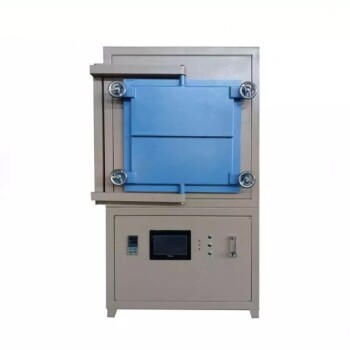
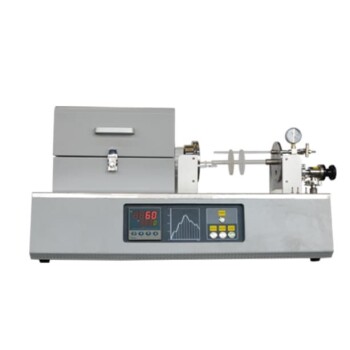
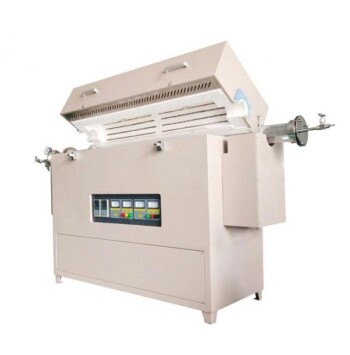
Master your liquid-phase sintering process with KINTEK high-temperature laboratory furnaces. Designed for advanced material research and production, our customizable high-temp furnaces—including atmosphere, vacuum, tube, and muffle furnaces—deliver superior thermal uniformity, ultra-pure gas control, and precise multi-stage heating profiles to prevent grain boundary liquid penetration. Contact KINTEK experts today to customize your high-temperature furnace.
Related Products
- 1400℃ High Temperature Laboratory Tube Furnace with Alumina Tube
- 1700℃ High Temperature Laboratory Tube Furnace with Alumina Tube
- 1800℃ High Temperature Muffle Oven Furnace for Laboratory
- 1700℃ High Temperature Muffle Oven Furnace for Laboratory
- 1200℃ Muffle Oven Furnace for Laboratory
People Also Ask
- How does zone-melting in tube furnaces synthesize bismuth micro-wires? Master Single-Crystal Thermoelectric Growth
- How are high-temp tube furnaces used to measure diffusion coefficients per Fick's law? Master Precision Annealing
- How do high-temperature laboratory tube furnaces ensure environmental stability? Precision Thermal Reduction Tips
- How are high-temperature laboratory tube furnaces applied in long-term vacuum homogenization heat treatments for intermetallic samples?
- How are high-temperature tube furnaces applied in testing ceramic-supported alloy membranes? Insights