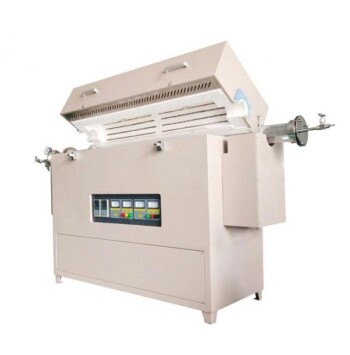
The defining difference between thermal post-processing in a high-temperature laboratory furnace and localized laser curing is the scale and uniformity of the transformation. Furnace-based processing exposes an entire additively manufactured superalloy component to prolonged, uniform heat—often exceeding two hours—which systematically converts the as-built porous, metastable microstructure into a fully dense, recrystallized, and isotropic material. In contrast, localized laser curing delivers rapid, surface-level or track-specific heating that can sinter conductive traces or surface layers in minutes but cannot replicate the volumetric densification and stress relief achieved by a high-temperature furnace.
To achieve the full potential of a nickel-based superalloy—eliminating internal porosity, relieving residual stresses, and creating uniform grain growth—a controlled high-temperature furnace is essential. Localized laser curing, while fast and geometrically selective, produces a spatially shallow and microstructurally inhomogeneous result that leaves the bulk interior largely unimproved.
The Microstructural Transformation Pathway in a Furnace
Additively manufactured superalloys often begin with a chaotic, powder-fusion legacy: melt pools, cellular dendrites, and high dislocation densities locked in by rapid solidification. A high-temperature laboratory furnace rewrites that history through controlled thermal cycles.
Uniform Heat Soak Erases the As-Built Signature
Prolonged furnace holds ensure that every layer, every overhang, and every internal channel reaches the target temperature. This drives diffusion-driven processes that dissolve melt-pool boundaries, break down cellular sub-structures, and allow new, equiaxed grains to nucleate.
The result is a microstructural reset. What started as a patchwork of directionally solidified, anisotropic cells becomes a homogeneous grain structure with consistent properties in all directions.
Temperature Dictates the Final Phase Balance
For superalloys, precise furnace control allows metallurgists to select between stress relief, recrystallization, or full grain growth. Low-temperature holds (~600°C) may only relieve stress while leaving the original dendritic skeleton intact. Soaking at higher temperatures (~1,100°C and above) dissolves all as-built features, triggers complete recrystallization, and enables controlled coarsening of grains—directly influencing high-temperature strength.
Full Density Through Volumetric Healing
Furnace heat treatment does not simply “cook” the part; it heals it. Interconnected pores and lack-of-fusion defects can be closed by diffusion and vacancy migration when the entire volume is held at temperatures high enough to enable atomic movement. This transforms a porous powder-like state into a densely packed structure, eliminating stress-concentrating flaws.
Why Localized Laser Curing Falls Short for Bulk Superalloys
Laser-based post-processing offers extreme spatial precision but introduces fundamental physical limitations that prevent it from replacing a furnace for superalloy components.
A Surface-Only Heat Affected Zone
A scanning laser heats only a thin layer—often tens to hundreds of micrometers deep—in a matter of milliseconds. The energy is sufficient to sinter surface layers or melt conductive traces, but the heat dissipates so rapidly that the bulk of the part remains cold and microstructurally unchanged.
No volumetric density improvement occurs. The interior retains the porosity and residual stresses imparted by the original build.
Thermal Gradients Create New Stresses
The extreme temperature differential between the laser-heated spot and the surrounding cool material generates high local thermal stress. Instead of relieving global stresses, the laser can introduce new tension-compression zones, especially in thick or geometrically complex parts. This works against the isotropic, low-stress state a furnace delivers.
Disconnected Grain Structure
Because the laser dwells on each spot for only a fraction of a second, there is no time for bulk diffusion or recrystallization across grain boundaries. The resulting microstructure remains linked to the original scan strategy—columnar grains, epitaxial growth, and sharp interfaces persist, undermining the uniform properties required in critical rotating parts or pressure vessels.
Understanding the Trade-offs
Choosing between these two methods means accepting that no single technique optimizes all priorities.
Furnace Processing: Time and Cost vs. Total Transformation
A high-temperature furnace cycle can take hours to complete, requires robust fixturing, and consumes significant energy. However, it processes entire batches simultaneously, and the outcome—fully dense, stress-free, isotropic superalloy—is often non-negotiable for aerospace or energy certifications.
Laser Curing: Speed and Selectivity vs. Incomplete Densification
Laser curing can be integrated in-line, applied only to functional features, and completes its work in seconds to minutes. It excels when only a conductive trace needs sintering or a surface sealant layer is required. But the trade-off is clear: you sacrifice bulk density, through-thickness uniformity, and global stress relief.
Making the Right Choice for Your Superalloy Application
How you post-process an additively manufactured superalloy should align with what the part actually needs to survive.
- If your primary focus is maximum fatigue life and isotropic strength: Only batch thermal processing in a high-temperature furnace can eliminate internal pores and create a uniform microstructure, giving you the consistency required for flight-critical and life-limited hardware.
- If your primary focus is rapid, localized functionalization: Use localized laser curing to sinter surface coatings, repair small wear areas, or create conductive paths. Understand that the bulk of the part will retain its as-built density and residual stress profile.
- If your primary focus is dimensional accuracy and low distortion: A vacuum furnace with controlled heating and cooling ramps minimizes warping while transforming the entire volume, whereas a laser’s steep thermal gradients often distort delicate geometries.
When the material is a high-performance superalloy and the stakes are high, the laboratory furnace remains the definitive tool for converting a 3D-printed shape into a fully engineered component.
Summary Table:
| Characteristic | High-Temperature Lab Furnace | Localized Laser Curing |
|---|---|---|
| Heating Depth & Scale | Volumetric (entire bulk component) | Surface-level (tens to hundreds of µm) |
| Microstructural Impact | Homogeneous, equiaxed, isotropic grains | Columnar, anisotropic, build-legacy retained |
| Densification & Porosity | Full volumetric density; heals internal pores | Surface-only; bulk interior porosity remains |
| Residual Stress Relief | Complete global stress relief | High thermal gradients; creates local stress |
| Ideal Applications | Flight-critical structural parts, high fatigue life | Surface coatings, conductive traces, small repairs |
Ready to achieve full density and maximum mechanical integrity for your additive manufactured superalloys? KINTEK specializes in advanced laboratory equipment and consumables, offering a complete range of high-temperature furnaces—including vacuum, atmosphere, tube, muffle, and customizable thermal systems engineered for precise grain control and stress relief. Elevate your material research and manufacturing outcomes—contact KINTEK today to tailor the perfect high-temperature furnace for your laboratory!
Related Products
- 1400℃ High Temperature Laboratory Tube Furnace with Alumina Tube
- 1700℃ High Temperature Laboratory Tube Furnace with Alumina Tube
- 1800℃ High Temperature Muffle Oven Furnace for Laboratory
- 1700℃ High Temperature Muffle Oven Furnace for Laboratory
- 1200℃ Muffle Oven Furnace for Laboratory
People Also Ask
- How does zone-melting in tube furnaces synthesize bismuth micro-wires? Master Single-Crystal Thermoelectric Growth
- How are high-temp tube furnaces used to measure diffusion coefficients per Fick's law? Master Precision Annealing
- How are high-temperature laboratory tube furnaces applied in long-term vacuum homogenization heat treatments for intermetallic samples?
- How do high-temperature laboratory tube furnaces ensure environmental stability? Precision Thermal Reduction Tips
- How are high-temperature tube furnaces applied in testing ceramic-supported alloy membranes? Insights