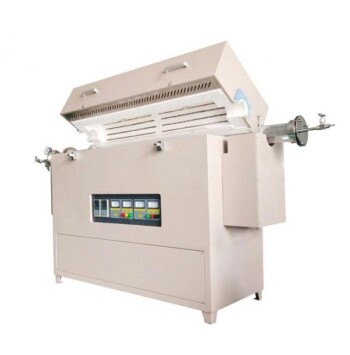
Heating rate isn't just a speed setting—it’s a chemical and structural lever that can shift densification to lower temperatures in polymeric gels. When you increase the ramp rate inside a high-temperature laboratory furnace, the gel retains more hydroxyl groups during heat-up. This raises the material’s effective hydroxyl content, which lowers its viscosity and compensates for the shorter time at peak temperature. The result is accelerated densification that can kick in at lower temperatures than a slow ramp would require.
Rapid heating chemically “locks in” hydroxyls that plasticize the gel network, shifting densification downward in temperature. But the same speed can trap volatile byproducts, causing cracking or bloating. The surface need is a simple cause-and-effect answer; the deep need is understanding how to exploit this lever without sacrificing structural integrity.
Why a Higher Ramp Rate Can Shift Densification to Lower Temperatures
The Chemical Mechanism in the Gel Network
During gel sintering, the rate at which you heat determines how many functional groups survive the ramp. A faster heating profile reduces the thermal exposure time in the low- and mid-temperature regime where dehydroxylation normally occurs. More residual hydroxyl groups remain in the structure as you approach the sintering window.
These retained –OH groups act as internal plasticizers. They lower the viscosity of the partially pyrolyzed gel, enhancing atomic mobility and viscous flow. This enhanced flow compensates for the reduced time-at-temperature, allowing the body to densify even though the furnace runs through the sintering range more quickly.
The Accelerated Densification Observed
Because the gel softens sooner, denser packing and pore elimination can begin at lower thermometer readings than a slow cycle would require. In effect, the material’s “active” sintering window shifts downward in temperature. The primary reference confirms that this shift is real and can be exploited to achieve full density without excessively long holds.
The Structural Integrity Risk: When Speed Breaks the Body
Incomplete Burnout of Organics
The same rapid ramp that preserves hydroxyls also rushes through the temperature zone where binders, solvents, and other organic additives decompose. If the heating is too aggressive, these species do not have time to diffuse out of the pore network. They carbonate or thermally crack inside the body rather than escaping cleanly.
Gas Expansion and Mechanical Failure
Residual carbon and trapped volatiles then reach temperatures where they expand violently or oxidize abruptly. The resulting internal gas pressure can exceed the green strength of the partially densified gel. The outcome is classic structural failure: blistering, bloating, or catastrophic cracking. So while faster ramps promote densification through retained chemistry, they simultaneously threaten integrity through incomplete mass transport of decomposition products.
Understanding the Trade-offs in Heating Rate Selection
Densification vs. Coarsening in Gel-Derived Ceramics
Supplementary references across ceramic systems show that faster heating suppresses non-densifying surface diffusion and grain growth. Less time is spent in the temperature range where neck growth without pore shrinkage dominates. For a polymeric gel that converts to a ceramic, this means a rapid ramp can help retain a finer grain size after full density is reached.
But the gel system adds a critical precursor stage. The benefit of suppressed coarsening only matters if the body survives the pyrolysis and burnout stages intact. So the densification/coarsening competition, well-known in powder sintering, must be balanced against the earlier risk of gas entrapment.
Managing Thermal Gradients in Real Components
A furnace’s programmed heating rate is the average. Fast ramp rates can create significant temperature gradients across thicker gel bodies. The surface heats and densifies faster than the core, generating tensile stresses and warping. This differential densification is especially dangerous in gel systems because the strength is low until significant ceramic conversion occurs. Hence, the “ideal” heating rate for small, thin-section specimens—where gradients are negligible—may destroy a larger part.
Designing an Optimized Heating Profile for Polymeric Gels
Multi-Stage Programs for Controlled Evolution
The practical lesson is that a single linear ramp is rarely optimal for polymeric gel precursors. You need a profile that respects two distinct phases:
- Controlled burnout stage: A slow ramp or a long intermediate hold in the 200–600 °C range allows organics to diffuse out and decompose without pressure buildup.
- Rapid densification ramp: Once the body is open-pored and volatile-free, a faster ramp through the sintering range can exploit the viscosity-lowering effect of retained hydroxyls, driving densification at lower temperatures while suppressing grain growth.
Common Pitfalls to Avoid
- Skipping the burnout hold entirely because a faster overall cycle seems convenient. This is the number one cause of bloating.
- Applying the same heating rate to thick and thin parts without accounting for thermal lag. Large cross-sections need a slower programmed rate to keep the internal temperature distribution uniform.
- Ignoring furnace atmosphere control. The oxidation or inert gas flow affects how organics leave the body. Fast heating in stagnant air can create a diffusion bottleneck at the gel surface that leads to a dense skin and a cracked core.
Making the Right Choice for Your Goal
The best heating rate for your gel sintering depends on what you prioritize most. Use these goal-oriented strategies to guide your furnace programming:
- If your primary focus is achieving full density without forming cracks or blisters: Combine a slow, ventilated burnout stage with a subsequent faster ramp. Ensure complete removal of volatiles before pushing the gel into the high-temperature densification window.
- If your primary focus is minimizing grain size in the final ceramic while maintaining integrity: Use a moderate fast ramp after burnout, leaning toward the upper end of what the component’s thickness can tolerate thermally. The increased hydroxyl retention will lower viscosity and shorten the coarsening window.
- If your primary focus is processing large, thick components: Slow down the ramp throughout the entire cycle. Sacrifice some of the chemical advantage of rapid heating in favor of thermal uniformity and stress elimination. A lower, uniform ramp prevents warping and differential densification.
Your heating rate is a tool to shift densification downward in temperature, but only if you first let the gel breathe. Optimize the early burnout phase, then exploit speed in the sintering phase to get the best of both worlds.
Summary Table:
| Process Stage / Strategy | Thermal & Chemical Mechanism | Structural Risk | Optimization Benefit |
|---|---|---|---|
| Low-Temp Burnout (Slow Ramp) | Allows organic binders and solvents to decompose and diffuse out | Rapid heating causes gas entrapment & cracking | Ensures clean volatile removal, preventing bloating |
| High-Temp Sintering (Fast Ramp) | Retains –OH groups, lowering viscosity & driving viscous flow | Thermal gradients can warp thick components | Shifts densification to lower temps & suppresses grain growth |
| Multi-Stage Heating Profile | Combines slow burnout hold with rapid final sintering ramp | Complex setup if furnace lacks multi-segment control | Achieves full density with fine grain size and zero cracking |
Unlock Precise Thermal Control for Your Advanced Materials
Optimizing sintering profiles for complex polymeric gels requires exact temperature ramping, multi-stage programming, and superior atmosphere control. KINTEK specializes in high-performance laboratory equipment, offering a comprehensive range of high-temperature furnaces—including muffle, tube, rotary, vacuum, atmosphere, and custom lab furnaces—engineered to deliver the precise thermal uniformity your research demands.
Whether you need custom multi-segment program controllers, vacuum capabilities, or specialized gas flows to ensure complete volatile burnout and defect-free densification, KINTEK provides reliable, tailored solutions to elevate your lab's performance.
Ready to eliminate structural defects and achieve superior material density? Contact KINTEK today to discuss your unique application with our thermal processing experts!
Related Products
- 1400℃ High Temperature Laboratory Tube Furnace with Alumina Tube
- 1700℃ High Temperature Laboratory Tube Furnace with Alumina Tube
- 1800℃ High Temperature Muffle Oven Furnace for Laboratory
- 1700℃ High Temperature Muffle Oven Furnace for Laboratory
- 1200℃ Muffle Oven Furnace for Laboratory
People Also Ask
- How does zone-melting in tube furnaces synthesize bismuth micro-wires? Master Single-Crystal Thermoelectric Growth
- How do high-temperature laboratory tube furnaces ensure environmental stability? Precision Thermal Reduction Tips
- How are high-temperature laboratory tube furnaces applied in long-term vacuum homogenization heat treatments for intermetallic samples?
- How are high-temp tube furnaces used to measure diffusion coefficients per Fick's law? Master Precision Annealing
- How are high-temperature tube furnaces applied in testing ceramic-supported alloy membranes? Insights