A molten droplet at a grain corner is just a thermodynamic accident waiting to spread. The dihedral angle—the internal angle a second phase forms at the junction of two solid grains—directly dictates whether that phase remains locked in isolated pockets at grain corners, elongates into interconnected channels along grain edges, or penetrates as a continuous nanoscale film that wets entire boundaries. But while thermodynamics sets the destination, the journey there is slow and kinetic: only precise, long-duration heating in high-temperature laboratory furnaces allows impurity segregation and liquid penetration to fully develop and stabilize those grain‑boundary films, transforming a microstructural blueprint into a controlled reality.
The dihedral angle sets the equilibrium distribution of second phases—pockets, networks, or films—but grain‑boundary films form over time via sluggish segregation and penetration of liquid from triple junctions. Achieving and managing these nanoscale kinetic features demands exceptionally stable, long thermal dwells and precise atmosphere control that only a high‑performance laboratory furnace can provide.
The Thermodynamic Framework of Interfacial Control
The entire behavior of a liquid or second phase during sintering starts with a local force balance between grain boundaries and solid‑liquid interfaces. This is the genesis of the dihedral angle.
Defining the Dihedral Angle from Interfacial Energies
The dihedral angle (\phi) emerges from the mechanical equilibrium of the two surface tensions pulling at a triple junction.
It is defined by the classic relation (\gamma_{\text{SS}} = 2,\gamma_{\text{SL}},\cos(\phi/2)), where (\gamma_{\text{SS}}) is the solid‑solid grain boundary energy and (\gamma_{\text{SL}}) is the solid‑liquid interfacial energy.
This simple force balance means the angle is independent of phase pressures and depends solely on the energy ratio (\gamma_{\text{SS}}/\gamma_{\text{SL}}).
Change that ratio—through composition, temperature, or atmosphere—and you immediately shift the microstructural ground rules.
The Critical Energy Ratio That Triggers Wetting
When the grain boundary energy is high relative to the solid‑liquid interface, the system pursues complete liquid penetration.
In fact, if (\gamma_{\text{SS}}/\gamma_{\text{SL}} > 2), the equation (\gamma_{\text{SS}} = 2\gamma_{\text{SL}}\cos(\phi/2)) yields (\cos(\phi/2) > 1), which is physically impossible—the dihedral angle drops straight to 0°.
At this zero‑dihedral‑angle limit, the liquid phase instantaneously wets and penetrates every grain boundary, separating all grains.
Conversely, a low energy ratio (near 1) forces the liquid to retract into isolated pockets, preserving extensive solid‑solid contact.
Dihedral Angle Thresholds and Second-Phase Topology
The dihedral angle’s magnitude splits microstructures into three distinct topological families, each with profound consequences for densification and properties.
Isolated Pockets: (\phi > 60^\circ)
At angles above 60°, the second phase lacks the driving force to spread.
It remains locked in disconnected pockets at grain corners and four‑grain junctions, leaving most grain boundaries clean and solid‑solid.
This configuration maximizes direct grain‑to‑grain bonding and limits liquid‑phase contributions to sintering.
While it resists grain‑boundary weakening, it also offers only minimal help with particle rearrangement and rapid densification.
Penetrating Networks: (0^\circ < \phi \leq 60^\circ)
Once the dihedral angle drops to 60° or below, the second phase can no longer stay tucked in corner pockets.
It elongates along three‑grain edges, carving a continuous, interpenetrating network that runs through the entire compact.
This interconnected liquid channel system dramatically accelerates particle sliding, rearrangement, and early‑stage densification.
It also sets the stage for nanoscale film formation at grain boundaries as the liquid network becomes a reservoir.
Complete Grain‑Boundary Wetting: (\phi = 0^\circ)
At the zero‑dihedral‑angle extreme, interfacial forces demand that the liquid completely infiltrates grain boundaries.
Adjacent grains are fully separated by a continuous liquid film, eliminating solid‑solid contact entirely.
While this can deliver extremely rapid densification, it also reduces structural rigidity at high liquid fractions.
The final microstructure then depends on whether you freeze this wet configuration during cooling or let it evolve.
The Kinetic Dimension: Why Films Don’t Appear Instantly
Thermodynamics gives you a map, but the actual formation of grain‑boundary films is a kinetic process driven by diffusion, segregation, and liquid migration.
From Dry Boundaries to Nanometer‑Thick Films
Even when the equilibrium dihedral angle at peak temperature is zero, boundaries rarely become instantly wetted.
Nanoscale liquid films must first nucleate and thicken at previously dry grain boundaries, a process that takes time.
In ceramic systems like BaTiO₃ with excess TiO₂, experience shows that extended holds—1350 °C for 50 hours—allow films to grow from less than a nanometer to over 10 nm.
Such slow kinetics arise because film formation requires impurity segregation to the boundary and the viscous flow of liquid from distant triple junctions.
Impurity Segregation and Liquid Penetration
The driving force for film formation often originates with residual impurities or deliberately added wetting agents that segregate to grain boundaries during prolonged heating.
As these species accumulate, they locally lower the solid‑solid energy and change the interfacial ratio, triggering liquid to penetrate along the flat boundary planes.
The liquid migration itself is slow: it depends on capillary pressure differences between grain‑edge channels and the boundaries, and on the viscosity of the molten phase at the sintering temperature.
Only a stable, precisely controlled thermal dwell gives these mass‑transport processes time to approach true equilibrium.
The Furnace as a Kinetic Tool: Precision and Long Duration
Managing grain‑boundary film kinetics is impossible without a high‑temperature laboratory furnace that can hold a target temperature with negligible drift over many tens of hours and maintain a tightly controlled atmosphere.
Why Stable Thermal Dwells Are Non‑Negotiable
Nanoscale film growth demands reliable, unwavering temperature plateaus.
Even small temperature oscillations can temporarily alter interfacial energies, re‑dissolve segregated layers, or reverse capillary flow, arresting or distorting film development.
Long dwells—often 20 to 100 hours—are required not for sintering to densify, but for the liquid film system to settle into its minimum‑energy thickness and connectivity.
Without this stability, you are merely sampling a transient snapshot, not building a reproducible microstructure.
Atmosphere Control to Lock Interfacial Energy
The dihedral angle is sensitive to oxygen partial pressure, vacuum level, or inert gas purity because these factors shift surface chemistries and interfacial energies.
A laboratory furnace capable of customizable atmosphere profiles (e.g., nitrogen, argon, vacuum, or reducing gases) ensures that (\gamma_{\text{SS}}/\gamma_{\text{SL}}) stays where you intend.
Atmosphere control also prevents contamination that could unpredictably alter wetting behavior, or mitigate volatilization of key species during extremely long runs.
A drift in furnace atmosphere halfway through the soak can completely reshape the grain‑boundary film network.
Understanding the Trade‑offs of Long Soaking
Long, precise heating is essential, but it comes with inherent risks. An objective sintering strategy must balance film kinetics against these competing processes.
Risks of Pore Coarsening and Abnormal Grain Growth
Prolonged high‑temperature exposure can coarsen residual pores, reducing final density, or drive abnormal grain growth that engulfs the very films you aim to control.
A dihedral angle that initially kept a liquid film stable may later lead to grain‑boundary migration that traps porosity or creates incoherent interfacial defects.
Contamination and Volatilization
Over tens of hours in a hot environment, furnace elements and insulation can release tramp elements that segregate to boundaries and inadvertently change the dihedral angle.
Similarly, volatile species (e.g., PbO in PZT ceramics, or alkali oxides) may evaporate, shifting the composition and thus the interfacial energy balance.
Balancing Kinetics and Thermodynamics
There is often a race between achieving the target grain‑boundary film configuration and the onset of degrading side‑reactions.
The art lies in selecting a temperature‑time profile that allows enough kinetic evolution while staying below the threshold for rapid grain growth or excessive volatile loss.
How to Apply This to Your Sintering Project
To harness the dihedral angle and grain‑boundary film kinetics, you match your furnace strategy to your specific microstructural objective.
- If your primary focus is rapid densification with liquid‑phase sintering: Formulate your additive to push (\phi) below 60°, creating an interconnected liquid network. Use a furnace that can hold a stable temperature just above the liquidus for the time needed to fill grain‑edge channels, then quench to preserve that distribution if needed.
- If your primary focus is a uniform, nanoscale intergranular film: Plan for extended isothermal holds of 20 hours or more at a temperature where (\phi) is zero. Ensure the furnace delivers <±1 °C drift and a clean, defined atmosphere so that film growth proceeds to a stable thickness, as seen in TiO₂‑excess BaTiO₃ systems.
- If your primary focus is tailoring the second‑phase topology through cooling: Exploit the shift in dihedral angle during cooling. Rapid quenching can lock in a zero‑angle film; a controlled slow cool can increase (\phi) and transform a continuous film into isolated pockets by precipitating secondary solids, altering the interfacial energy ratio.
When you understand that the dihedral angle draws the equilibrium map but the furnace writes the kinetic story, you gain the power to craft grain‑boundary architectures with precision, not guesswork.
Summary Table:
| Dihedral Angle ((\phi)) | Second-Phase Topology | Impact on Densification & Microstructure | Furnace & Kinetic Requirement |
|---|---|---|---|
| (\phi > 60^\circ) | Isolated Pockets | Maximizes solid-solid contact; minimal liquid assistance | Stable soak to achieve equilibrium boundary pockets |
| (0^\circ < \phi \le 60^\circ) | Interconnected Networks | Accelerates particle rearrangement & early densification | Precise thermal dwell for liquid flow along grain edges |
| (\phi = 0^\circ) | Complete GB Wetting | Separates grains entirely; forms nanoscale liquid films | Long isothermal hold (20–100 h) & strict atmosphere control |
Master Grain Boundary Engineering with KINTEK Furnace Solutions
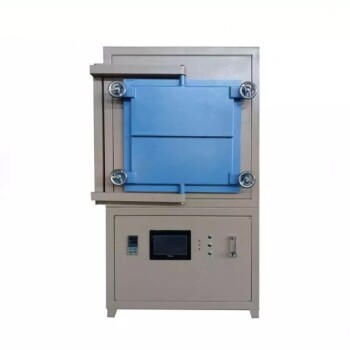
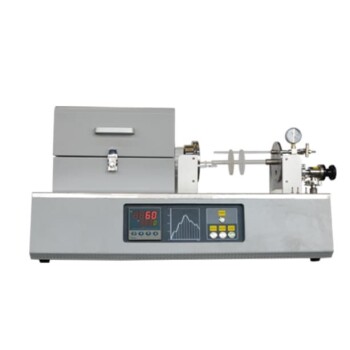
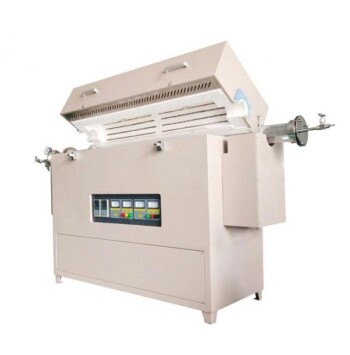
Achieving precise second-phase distribution and controlled grain-boundary film kinetics demands exceptional thermal stability and gas purity over extended runs. KINTEK specializes in high-performance laboratory equipment and high-temperature furnaces—including muffle, tube, rotary, vacuum, CVD, atmosphere, dental, and induction melting systems—all customizable to meet your exact material research needs.
Whether you need temperature drift under ±1 °C for multi-day dwells or customizable atmosphere controls to fine-tune interfacial energies, KINTEK provides the reliability your advanced ceramic and metallurgical sintering projects require.
Transform your lab's thermal processing—contact our furnace specialists today!
Related Products
- 1400℃ High Temperature Laboratory Tube Furnace with Alumina Tube
- 1700℃ High Temperature Laboratory Tube Furnace with Alumina Tube
- 1800℃ High Temperature Muffle Oven Furnace for Laboratory
- 1700℃ High Temperature Muffle Oven Furnace for Laboratory
- 1200℃ Muffle Oven Furnace for Laboratory
People Also Ask
- How does zone-melting in tube furnaces synthesize bismuth micro-wires? Master Single-Crystal Thermoelectric Growth
- How are high-temperature laboratory tube furnaces applied in long-term vacuum homogenization heat treatments for intermetallic samples?
- How do high-temperature laboratory tube furnaces ensure environmental stability? Precision Thermal Reduction Tips
- How are high-temp tube furnaces used to measure diffusion coefficients per Fick's law? Master Precision Annealing
- How are high-temperature tube furnaces applied in testing ceramic-supported alloy membranes? Insights