Here's the critical insight: The processing atmosphere inside your high-temperature laboratory furnace sets a hard physical limit on how much a ceramic compact can densify, because gases become trapped in closed pores during final-stage sintering. If that trapped gas dissolves and diffuses rapidly through the solid (like hydrogen in many oxides), the pore can shrink to zero. If the gas is insoluble and diffusive transport is slow—like argon, nitrogen, or helium in many technical ceramics—the internal gas pressure rises as the pore closes, eventually matching the capillary sintering stress and halting densification forever.
The choice of furnace atmosphere directly controls the ultimate porosity floor in sintered ceramics. The phenomenon is not a gradual kinetic slowdown; it is a thermodynamic limit. When an inert, slow‑diffusing gas is sealed inside a pore, the internal pressure that builds up provides an exact counter‑force that stops shrinkage at a finite pore size. Selecting a soluble, high‑diffusivity gas, applying vacuum, or using pressure‑assisted sintering are the only ways to break through this barrier and achieve true full density.
The Physics of Pore Pinning by Entrapped Gas
During the early and intermediate stages of sintering, open porosity allows furnace gas to circulate freely. The real trap snaps shut in the final stage, when pores become isolated from the surface.
How the Densification Limit Emerges
The driving force for pore shrinkage is the capillary pressure, ( \frac{2\gamma_{sv}}{r} ), where ( \gamma_{sv} ) is the solid‑vapor surface energy and ( r ) is the pore radius.
As a pore shrinks, any non‑condensable, insoluble gas trapped inside is compressed.
- Its internal pressure ( P_i ) rises following the ideal gas law.
- Densification stops precisely when ( P_i = \frac{2\gamma_{sv}}{r_f} ), where ( r_f ) is the final, stable pore radius.
Beyond this point, further shrinkage would require an external force beyond the sintering stress. The material can be held at temperature for hours, but no additional densification occurs.
The Decisive Role of Diffusive Gas Transport
The only way to avoid this limit is for the trapped gas to escape through the solid.
A gas that dissolves into the lattice and diffuses rapidly—via grain boundaries or volume diffusion—never reaches a high equilibrium pressure. Hydrogène in many oxide ceramics is the textbook example. Its small atomic size and high mobility allow it to leak from the pore faster than the pore shrinks.
- Fast‑diffusing gases (e.g., ( H_2 )): Allow near‑theoretical density. The pore disappears completely.
- Slow‑diffusing/inert gases (e.g., ( Ar, N_2, He )): Create a hard density ceiling. The trapped gas acts as a permanent internal spring.
Why Pore Size and Gas Pressure Determine the Severity
The same physical principle generates very different practical outcomes depending on your starting powder and furnace conditions.
Fine Powders Are Surprisingly Forgiving
For compacts made from sub‑micron powders, the initial open porosity consists of extremely fine channels.
Residual inert gas trapped at 1 atmosphere occupies a minuscule total volume. When these tiny pores close, the internal pressure rise is modest. Even with argon, densities above 99.8% of theoretical are routinely achievable.
Large Pores or Elevated Gas Pressures Are Decisive
If the green body contains agglomerates, voids, or coarse particles that yield larger isolated pores, the same 1 atm of trapped gas now has a much larger initial mass.
Alternatively, conducting sintering in a pressurized inert‑gas furnace deliberately increases the initial gas mass in every pore. The densification limit drops sharply. Achieving full density then requires either:
- Vacuum sintering to remove the gas before pore closure.
- Pressure‑assisted sintering (HIP) to apply an external pressure that overcomes the internal counter‑pressure.
Atmosphere Control Beyond Simple Entrapment
While pore pinning is often the primary densification barrier, the furnace atmosphere influences the sintering path in several other critical ways that feed into the final density.
Defect Chemistry and Diffusion Rates
The rate of matter transport by solid‑state diffusion depends directly on point‑defect concentrations. Controlling oxygen partial pressure (( P_{O_2} )) in an atmosphere furnace allows you to engineer vacancy populations.
- Higher vacancy concentrations accelerate lattice and grain‑boundary diffusion.
- Faster diffusion not only speeds shrinkage but can also increase the rate at which soluble gases are removed from pores.
Atmosphere management therefore influences both the kinetics of pore elimination and the thermodynamic limit described earlier.
Vapor‑Phase Transport: The Densification Killer
A furnace atmosphere can completely reroute mass transport from densifying paths (boundary diffusion) to non‑densifying paths (evaporation‑condensation).
Introducing reactive gas species, such as halide vapors, creates volatile reaction products. Matter moves across pores without the pore volume shrinking. A classic example is sintering titania (( TiO_2 )) at 1200°C:
- In air, a 0.2 µm powder reaches 76% theoretical density with a fine 1 µm grain size.
- Under HCl vapor, the density remains a mere 45% (virtually green density), but the grain size explodes to 6 µm.
The material coarsens aggressively while refusing to densify. This mechanism is often misinterpreted as a slow sintering problem; it is actually an atmosphere‑driven shift in the dominant transport mode.
Preventing Phase Decomposition and Volatilization
Many non‑oxide ceramics (e.g., ( Si_3N_4 )) and multivalent oxides (e.g., ZnO) decompose or lose volatile species at high temperature unless a specific overpressure or inert blanket is maintained.
Without atmosphere control, surface layers degrade, stoichiometry drifts, and grain boundaries become contaminated—all of which can increase the final stable pore size and reduce achievable density.
Understanding the Trade‑offs
A perfectly controlled atmosphere is not a one‑size‑fits‑all solution. Each choice carries its own risks.
- Vacuum sintering eliminates gas entrapment entirely, but it can accelerate the volatilization of species like Li, Na, or Pb in functional ceramics, creating secondary porosity or surface depletion layers.
- Hydrogen atmospheres solve the gas‑trapping problem for many oxides but can over‑reduce certain transition‑metal oxides, causing precipitation of metallic phases or exaggerated grain growth.
- Inert atmospheres (Ar, N₂) prevent oxidation but set up the pore‑pinning limit; they frequently require post‑sinter HIPing to close the last few percent of porosity.
- Reactive atmospheres that enhance diffusion (e.g., O₂ for oxides) can simultaneously induce grain growth if the boundary mobility becomes too high, compromising strength despite high density.
Successful atmosphere design is always a balancing act between pore elimination, phase stability, and microstructural control.
Making the Right Choice for Your Goal
Apply these decision rules when selecting and tuning the atmosphere for your high‑temperature lab furnace.
- If your primary focus is achieving >99.8% theoretical density with a fine‑grained oxide ceramic: Use a soluble, fast‑diffusing gas like hydrogen (if chemically compatible) or sinter under a high‑quality vacuum. Avoid inert gases unless your initial pore size is sub‑micron and agglomerate‑free.
- If your primary focus is maintaining precise stoichiometry in a multivalent or non‑oxide material: Control the oxygen partial pressure or use a static inert atmosphere that suppresses decomposition, and accept that a final HIP step may be necessary to close residual pores.
- If your primary focus is preventing coarsening while still reaching high density: Rule out any reactive species that enable vapor‑phase transport. Monitor both grain size and density; if density stalls while grains grow, your atmosphere is likely redirecting mass transport away from sintering.
- If your primary focus is scaling up a process for larger or coarser components: Recognize that gas entrapment becomes increasingly severe. An atmospheric‑pressure inert gas furnace will fail to deliver high density. Budget for vacuum sintering or pressure‑assisted densification as a non‑negotiable requirement.
Your furnace atmosphere is not just a protective blanket—it is a design variable that directly determines the final pore architecture. Align it with the specific solubility, diffusivity, and stability demands of your ceramic and you will break through what might otherwise look like an unshakable density ceiling.
Summary Table:
| Atmosphere Type | Primary Mechanism | Impact on Densification | Ideal Application / Solution |
|---|---|---|---|
| Fast-Diffusing (e.g., H₂) | Rapid gas solubility & diffusion through lattice | High (>99.8%): Pores shrink completely | Compatible oxide ceramics reaching full density |
| Inert / Slow (Ar, N₂) | Trapped gas creates internal counter-pressure | Limited: Densification halts at finite pore size | Preventing decomposition; requires sub-micron powder or post-HIP |
| High Vacuum | Eliminates internal gas before pore closure | Very High: Removes trapped gas barrier | Oxygen-sensitive ceramics & zero-porosity goals |
| Reactive Vapors (e.g., HCl) | Directs mass transport to evaporation-condensation | Severe Reduction: Causes coarsening without shrinkage | Avoid unless grain growth without densification is desired |
Achieve Maximum Material Density with KINTEK Precision Furnaces
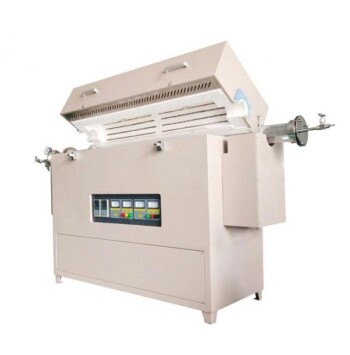
Don't let trapped gases or improper atmospheric controls compromise your sintering density. KINTEK specializes in high-performance laboratory equipment, offering a comprehensive lineup of high-temperature furnaces—including atmosphere, vacuum, tube, muffle, CVD, and custom systems designed specifically for advanced ceramic processing.
Whether you require exact oxygen partial pressure management, hydrogen-compatible heating, or deep vacuum capability, our customizable furnace solutions empower you to overcome pore pinning and achieve near-theoretical density.
Contact KINTEK Sintering Specialists Today to optimize your thermal processes and elevate your research outcomes!
Related Products
- 1400℃ High Temperature Laboratory Tube Furnace with Alumina Tube
- 1700℃ High Temperature Laboratory Tube Furnace with Alumina Tube
- 1800℃ High Temperature Muffle Oven Furnace for Laboratory
- 1700℃ High Temperature Muffle Oven Furnace for Laboratory
- 1200℃ Muffle Oven Furnace for Laboratory
People Also Ask
- How does zone-melting in tube furnaces synthesize bismuth micro-wires? Master Single-Crystal Thermoelectric Growth
- How are high-temp tube furnaces used to measure diffusion coefficients per Fick's law? Master Precision Annealing
- How do high-temperature laboratory tube furnaces ensure environmental stability? Precision Thermal Reduction Tips
- How are high-temperature laboratory tube furnaces applied in long-term vacuum homogenization heat treatments for intermetallic samples?
- How are high-temperature tube furnaces applied in testing ceramic-supported alloy membranes? Insights