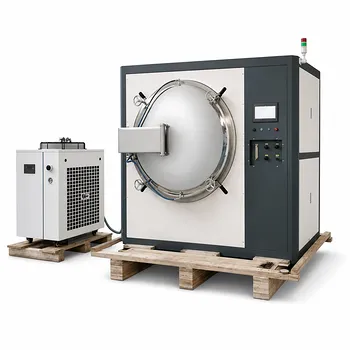
The decisive influence of a hot press furnace in reaction sintering is its ability to selectively supercharge densification. While it dramatically accelerates the rate at which a ceramic compact densifies, it leaves the kinetics of the accompanying chemical reaction virtually unchanged. This asymmetry allows you to reach near-theoretical density before the reaction can create complex, expansion-prone microstructures that normally trap porosity.
Reaction sintering is a race: you aim to densify the powder compact before the solid-state reaction locks in a rigid, hard-to-densify network. A hot press furnace tips the scales in your favor by injecting a massive, pressure-driven boost exclusively into the densification mechanism, letting it outpace the temperature-dependent reaction and achieve full density without falling into the porosity trap.
Understanding the Competing Rates in Reaction Sintering
Reaction sintering is not a single process—it's two processes running concurrently in your furnace. Their relative speeds dictate the final ceramic quality.
The Densification Imperative
Densification is the physical collapse of pores driven by a reduction in surface free energy. In conventional sintering without pressure, this driving force is remarkably weak—only about 75 J/mol for 1 µm particles.
The Reaction Arena
Simultaneously, the powder components react to form the desired ceramic phase. This chemical reaction is primarily temperature-activated, governed by the Arrhenius equation, and creates new interphase boundaries and often a volume expansion that can lock the microstructure.
The Core Conflict
If densification is too slow, the forming reaction product creates an interconnected, anisotropic network long before pores are eliminated. Once that rigid skeleton forms under zero external stress, further densification becomes virtually impossible, trapping porosity permanently.
How External Pressure Transforms the Densification Driving Force
Applying pressure in a hot press furnace changes the fundamental physics of mass transport without touching the chemistry of the reaction.
From a Peanut to a Sledgehammer
The driving force for sintering is the sum of surface curvature and any applied stress. For a 30 MPa applied pressure, the work done on each mole of atoms ($W = p_a V_m$) is approximately 750 J/mol. That is ten times greater than the 75 J/mol from surface energy alone.
Amplifying Stress at Grain Boundaries
The externally applied hydrostatic pressure is not evenly distributed. It is focused at grain contacts through a stress intensification factor. This localized pressure dramatically increases the vacancy concentration gradient, accelerating diffusional mass transport from grain boundaries into the pores.
Deformation Mechanisms Take Over
With this elevated stress, densification mechanisms like power-law creep and solution-precipitation become dominant. The densification rate scales linearly with applied pressure, enabling a speed that pressureless sintering simply cannot match.
Why the Reaction Rate Remains Largely Unchanged
Hot pressing does not turbocharge the chemical reaction in the same way. The reason lies in the different nature of the driving forces.
Reaction Kinetics Are Pressure-Insensitive
Solid-state chemical reactions between ceramic powders are driven by the free energy change of the reaction, not by mechanical stress. Their rate is overwhelmingly a function of temperature and composition—a few megapascals of pressure barely budge the atomic mobility needed for interdiffusion of reactants.
Minimal Effect on Phase Transformation Barriers
While extreme pressure can alter phase equilibria, typical hot pressing pressures (tens of MPa) have a negligible effect on the activation energy of the reaction. The reaction proceeds at its own pace, largely governed by the furnace temperature profile, while densification surges ahead under the added mechanical load.
The Strategic Advantage: Outpacing the Microstructural Lock-in
This difference in sensitivity gives the ceramic engineer a powerful processing lever.
Freezing a Favorable Microstructural State
Because densification accelerates by an order of magnitude relative to the reaction, the ceramic compact can achieve >99% theoretical density while the reaction is still in its early stages. You effectively “outrun” the issue of anisotropic grain growth or expansion that plagues pressureless processing.
Flattening the Microstructural Trajectory
On a grain size vs. density map, hot pressing creates a much flatter path. For a given grain size, the relative density is far higher, keeping the pores pinned to grain boundaries and avoiding pore-boundary separation that leads to trapped intra-granular porosity. The result is a fully dense, fine-grained ceramic.
Suppressing Deleterious Microstructural Evolution
By reaching full density quickly, you minimize the time the ceramic spends in a state where the reaction produces rigid, interconnected secondary phases. This prevents the volume expansion and rigid network formation that would otherwise inhibit the final densification step.
Understanding the Trade-offs and Practical Considerations
Hot pressing is not a silver bullet. Its power comes with inherent limitations that must be aligned with your objectives.
Shape Complexity and Tooling Cost
Hot pressing is inherently a near-net-shape process limited to relatively simple, flat geometries. Complex curves, undercuts, and large aspect ratios are challenging and raise die costs significantly.
Microstructural Anisotropy
The uniaxial pressure can induce texture or grain orientation in the final ceramic. While sometimes desirable, it means the resulting properties will be anisotropic—strength or thermal conductivity may differ along the pressing direction versus the lateral direction.
Reaction Rate vs. Furnace Cycle Time
If your reaction is exceptionally fast or the furnace heating rate is slow, even a boosted densification rate might not outpace it. The strategic advantage works best when the reaction can be thermally delayed (e.g., by using slightly larger reactant particles or a steep heating ramp) relative to the densification window.
Scale and Throughput
Hot press furnaces typically process one billet at a time, making them a batch process with lower throughput than continuous sintering. For high-volume production, this can be a cost barrier.
How to Apply This to Your Reaction Sintering Project
Use the following goal-based guide to decide if and how to leverage hot pressing.
- If your primary focus is achieving full density in a reaction-prone system: Hot pressing is your most reliable route. The pressure-driven densification boost lets you outpace the reaction, eliminating porosity before the microstructure locks up.
- If your primary focus is retaining a fine grain size while densifying: The flatter density-grain size trajectory of hot pressing suppresses coarsening. You can achieve a fully dense, fine-grained microstructure without needing ultra-high temperatures.
- If your primary focus is processing simple, flat parts where cost is secondary: Hot pressing offers unmatched density and microstructural control. Accept the higher tooling and batch costs in exchange for near-theoretical density.
- If your primary focus is complex shapes or high-volume manufacturing: Hot pressing may not be feasible. Investigate alternative strategies like suppressing the reaction through particle engineering or using additives to create a transient liquid phase that aids pressureless densification.
By decoupling the densification rate from the reaction rate, a hot press furnace hands you precise control over a previously chaotic race. Use it to leave porosity behind before the microstructure ever gets a chance to lock it in.
Summary Table:
| Feature / Parameter | Pressureless Sintering | Hot Press Sintering (External Pressure) |
|---|---|---|
| Driving Force | Surface energy alone (~75 J/mol) | Mechanical stress + surface energy (~750 J/mol) |
| Densification Mechanism | Slow physical pore collapse | Accelerated power-law creep & solution-precipitation |
| Chemical Reaction Kinetics | Temperature-governed (Arrhenius) | Virtually unchanged (pressure-insensitive) |
| Microstructural Outcome | Rigid network, trapped intra-granular porosity | >99% theoretical density with fine grain size |
Take control of your ceramic reaction sintering with high-performance thermal technology from KINTEK. Specializing in advanced laboratory equipment and consumables, KINTEK offers a comprehensive range of high-temperature furnaces—including hot press, vacuum, muffle, tube, rotary, CVD, atmosphere, dental, and induction melting furnaces—all customizable for your unique material needs. Outpace unwanted phase transitions and achieve theoretical density in your lab—contact us today!
Related Products
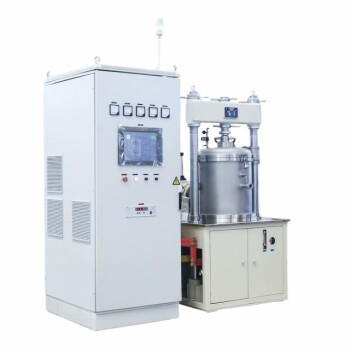
- Vacuum Hot Press Furnace Machine Heated Vacuum Press
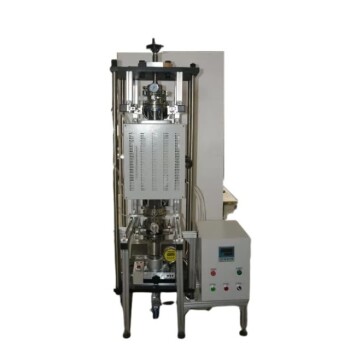
- Vacuum Hot Press Furnace Machine Heated Vacuum Press Tube Furnace
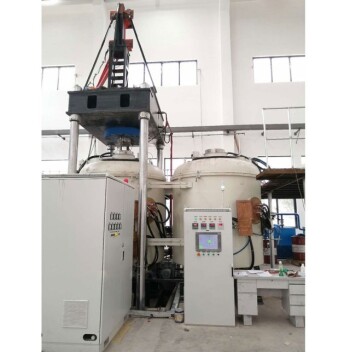
- 600T Vacuum Induction Hot Press Vacuum Heat Treat and Sintering Furnace
- High Pressure Laboratory Vacuum Tube Furnace
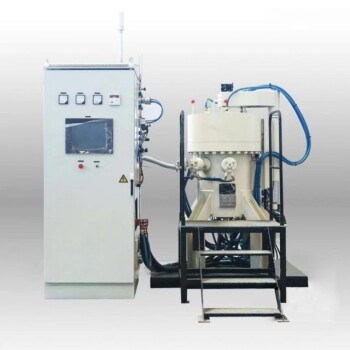
- 9MPa Air Pressure Vacuum Heat Treat and Sintering Furnace
People Also Ask
- What are the primary components of a vacuum hot press furnace? Master the Core Systems for Precise Material Processing
- What safety features are incorporated in vacuum hot press furnaces? Ensure Operator and Equipment Protection
- What are the benefits of the vacuum environment system in a vacuum hot press furnace? Unlock High-Density Sintering
- What types of heating elements are used in vacuum hot press furnaces? Optimize for High-Temp Performance
- What are the core advantages of using a vacuum hot press furnace? Achieve Near-Forged Density for Ti-6Al-4V Alloys