Precise thermal control up to 1400°C is not just a setting—it is the master variable that decides the entire phase evolution story in porcelain. In high-temperature laboratory furnaces, this level of accuracy orchestrates the stepwise transformation of kaolinite, feldspar, and quartz into a dense, mullite-reinforced glassy matrix. By holding exact heating rates and peak dwell times, the process eliminates unreacted mineral relics and prevents structural warping, directly determining the final mechanical strength and durability of the ceramic.
The deep value of precise 1400°C-capable furnace control lies in managing the kinetic and thermodynamic landscape of porcelain sintering. It ensures that transient liquid phases form at the right viscosity, mullite needles crystallize completely, and residual porosity is removed—without triggering slump, abnormal grain growth, or incomplete reactions. Every degree and minute shapes the architecture of the fired body.
The Chemistry of Porcelain: A Multi-Phase Transformation Journey
Porcelain is never simply “dried clay heated up.” Its strength emerges from a tightly choreographed sequence of solid-state reactions and liquid-phase sintering events that require exact thermal windows.
From Raw Minerals to Reactive Precursors
The starting blend—typically quartz, feldspar, and kaolinite—is chemically inert at room temperature. Applying controlled heat first drives off structural water from kaolinite, converting it into amorphous metakaolin. This dehydroxylation step is endothermic and must be completed before higher-temperature reactions can proceed.
If the furnace ramps too fast through this lower range, trapped vapor can cause bloating or micro-cracks. Precise heating rates give the compact time to outgas uniformly, setting a pristine foundation for the transformations to come.
The Critical Role of Mullite Needle Formation
Between roughly 1100°C and 1400°C, the real magic happens. Metakaolin breaks down further, and feldspar begins to melt, creating a transient alkaline aluminosilicate liquid. Within this reactive melt, primary and secondary mullite needles (3Al₂O₃·2SiO₂) crystallize—the backbone of porcelain’s strength.
Precise temperature control in this window is non-negotiable. Mullite nucleation and growth rates both depend exponentially on temperature. A furnace that overshoots or fluctuates can produce too few, overly coarse needles, or a poor network, directly weakening the final product.
Vitrification and the Glassy Matrix
As the temperature approaches the 1400°C peak, the feldspar-derived liquid volume increases and its viscosity plummets. The viscosity of this glassy phase drops by a factor of 1000 for every ~100°C rise, as described by the Vogel-Fulcher equation. This liquid must flow into pores between mullite and residual quartz grains, driving densification through capillary pressure.
Too low a temperature leaves a viscous, immobile melt that cannot fill voids, resulting in under-vitrified, porous ware. Too high, and the melt becomes dangerously fluid—the entire component can slump or deform under its own weight. The precise 1400°C capability allows operators to hit the exact viscosity sweet spot where rapid densification outpaces any tendency to warp.
How Precise Temperature Control Governs Phase Evolution
Controlling a furnace to within a few degrees at 1400°C is not trivial, but it is essential because the underlying physics of densification and reaction are acutely sensitive to thermal energy.
Heating Rate: Steady Kinetics for Complete Reactions
The ramp speed dictates the sequence completeness. A controlled, moderate rate (often 2–5°C/min) ensures that each phase transformation reaches adequate conversion before the next begins. For example, metakaolin must fully decompose to spinel-type phases before the feldspar melt floods the system; otherwise, unreacted kaolinite relics become trapped in the glass.
Moreover, densification surges occur within narrow temperature bands. In many ceramic systems, accelerated shrinkage happens between 1210°C and 1440°C. Racing through this gap starves the compact of the time needed for grain-boundary and volume diffusion to eliminate pore networks. A steady, controlled ramp allows atomic migration to keep pace with shrinkage, avoiding internal stress.
Peak Temperature Precision: Avoiding Over-Firing and Under-Firing
The difference between a perfectly sintered body and a flawed one can be as little as 5–10°C at the peak. Solid-state diffusion rates and liquid-phase viscosity are both Arrhenius-driven: a small temperature error translates to an exponential error in atomic mobility.
Under-firing by reaching only 1380°C instead of the required 1400°C may leave unreacted quartz grains and high porosity, creating stress concentrators that halve the modulus of rupture. Conversely, overshooting to 1410°C can dissolve already-formed fine mullite needles back into an excessive glass phase, coarsening the microstructure and inducing slump. The precise 1400°C setpoint is the calibration that locks in the target phase assemblage.
Isothermal Holds: Ensuring Equilibrium Phase Development
Dwelling at the peak temperature is just as critical as reaching it. A hold of 1–3 hours allows diffusion-governed processes to reach completion. During this soak, residual quartz slowly dissolves into the feldspathic melt, saturating it with silica and promoting secondary mullite precipitation.
If the hold is too short, the melt composition remains heterogeneous, and mullite networks are sparse. The supplementary references confirm that with a 3-hour hold at 1200°C, a beta-Ca₂SiO₄ scaffold can achieve 65% relative density and 40 MPa strength—a parallel principle: time at temperature defines the final crystalline-to-amorphous ratio and density. For porcelain at 1400°C, the hold sets the degree of vitrification and mullite aspect ratio.
Temperature Uniformity: Preventing Localized Phase Inhomogeneity
A precise average temperature is worthless if gradients exist across the furnace chamber. Grain boundary mobility varies exponentially with local temperature, so a 10°C cold spot will exhibit vastly slower grain growth and densification than a hot spot. This leads to warpage from differential shrinkage and a part with spatially variable crystallinity.
High-quality laboratory furnaces achieve uniform heat distribution, ensuring that the entire porcelain piece undergoes the same phase evolution. Without it, one edge might be fully vitrified while another remains porous—a catastrophic structural outcome.
The Microstructural Consequences of Imprecise Control
When temperature management fails, the telltale signs are written clearly in the fired microstructure.
Unreacted Quartz and Porosity
Quartz grains that do not dissolve into the melt act as micro-crack initiators due to their high thermal expansion mismatch with the surrounding glass. Incomplete densification leaves open pores that reduce the load-bearing cross-section. Both defects are direct residues of insufficient peak temperature or soak time, severely cutting down mechanical strength and translucency.
Abnormal Grain Growth and Warping
In dense polycrystalline ceramics, normal grain growth follows a parabolic law where the growth constant K has an exponential temperature dependence. Small temperature fluctuations can produce giant, exaggerated grains (secondary recrystallization) that trap pores inside them, making elimination impossible. In porcelain, this manifests as isolated large mullite clusters that disrupt the uniform fibrous interlock, while the overall piece may warp irreversibly if the glass phase viscosity drops too low.
Residual Amorphous Phase and Strength Degradation
An overabundance of residual glass, relative to crystalline mullite, softens the material at high temperatures and reduces room-temperature toughness. Only precise temperature profiles can balance the liquid volume fraction to maximize mullite yield while achieving full densification. A furnace that cannot maintain a tight thermal budget blurs the line between optimal vitrification and a weak, glass-dominated composite.
Understanding the Trade-offs
Precision at 1400°C brings immense benefits, but it also imposes practical constraints that must be acknowledged.
The most significant trade-off is processing time. Slow, exacting heating rates and long holds extend the firing cycle, impacting throughput and energy costs. Pushing for faster cycles to increase productivity directly risks the phase control advantages described above, leading to higher rejection rates.
There is also a furnace capability cost. Achieving ±1°C uniformity across a large chamber at 1400°C requires sophisticated heating elements and control systems, which demands a higher capital investment. However, for research and high-performance production, this cost is justified by the elimination of uncertainty in structure-property correlations.
Finally, the atmosphere must not be ignored. While precise temperature control is the primary knob, the oxygen partial pressure inside the furnace can shift defect equilibria and alter diffusion rates, adding another layer of complexity. A perfectly controlled temperature profile in an uncontrolled atmosphere can still yield unpredictable coloration or density.
Making the Right Choice for Your Sintering Goal
The level of thermal precision you enforce should map directly to your target outcome for the porcelain body.
- If your primary focus is maximizing mechanical strength: Implement the slowest practical heating rate through the mullite crystallization window and a full soak at the upper peak (e.g., 1390–1400°C) to achieve the densest network of fine mullite needles.
- If your primary focus is dimensional stability and low warping: Avoid temperature overshoot at all costs. A slightly lower peak with a longer hold often yields full vitrification while keeping the glass viscosity high enough to resist slumping.
- If your primary focus is electrical or thermal performance: Adhere strictly to the peak temperature and atmosphere control, as the residual glass phase fraction and dissolved ions directly dictate dielectric loss and thermal expansion.
- If your primary focus is throughput and cost efficiency: Identify the narrowest temperature window that still meets your minimum density specification, then invest in a furnace with exceptional uniformity to run that narrow profile without quality drift.
Mastering the temperature journey to 1400°C transforms porcelain from a simple mixture of minerals into a meticulously engineered microstructure where every mullite crystal and pore boundary is under your command.
Summary Table:
| Sintering Stage | Thermal Condition / Control | Impact on Phase Transformation & Structure |
|---|---|---|
| Dehydroxylation | Controlled initial ramp rate | Converts kaolinite to metakaolin; prevents gas entrapment and micro-cracking. |
| Mullite Formation | Precise 1100°C–1400°C window | Crystallizes primary & secondary mullite needles to form structural backbone. |
| Vitrification | Peak 1400°C & viscosity control | Optimizes liquid-phase flow for full densification without slumping or warping. |
| Isothermal Hold | 1–3 hour soak time | Promotes quartz dissolution, complete phase equilibrium, and zero residual porosity. |
Master Your Thermal Processes with KINTEK Precision Furnaces
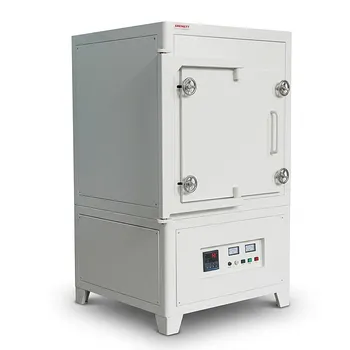
Achieving optimal mullite network formation and zero structural warping in porcelain ceramic sintering requires uncompromised thermal precision. KINTEK specializes in advanced laboratory equipment and consumables, offering a complete portfolio of high-temperature furnaces—including muffle, tube, vacuum, atmosphere, CVD, and customizable systems designed for tight temperature control up to 1400°C and above.
Whether you are conducting cutting-edge materials research or optimizing technical ceramic production, KINTEK provides high-uniformity heating solutions tailored to your exact experimental demands.
Contact KINTEK today to discuss your customizable furnace requirements!
Related Products
- 1400℃ High Temperature Laboratory Tube Furnace with Alumina Tube
- 1700℃ High Temperature Laboratory Tube Furnace with Alumina Tube
- 1800℃ High Temperature Muffle Oven Furnace for Laboratory
- 1700℃ High Temperature Muffle Oven Furnace for Laboratory
- 1200℃ Muffle Oven Furnace for Laboratory
People Also Ask
- How does zone-melting in tube furnaces synthesize bismuth micro-wires? Master Single-Crystal Thermoelectric Growth
- How are high-temperature laboratory tube furnaces applied in long-term vacuum homogenization heat treatments for intermetallic samples?
- How do high-temperature laboratory tube furnaces ensure environmental stability? Precision Thermal Reduction Tips
- How are high-temp tube furnaces used to measure diffusion coefficients per Fick's law? Master Precision Annealing
- How are high-temperature tube furnaces applied in testing ceramic-supported alloy membranes? Insights