Vacuum annealing at high temperature fundamentally restructures dense oxide ceramics by driving capillary-mediated equilibration. The elevated thermal energy combined with the environment's low oxygen partial pressure activates atomic diffusion, enabling the system to reduce its total interfacial free energy. This manifests as grain growth, redistribution of any residual glassy or liquid phases, and a pronounced morphological evolution at grain junctions. When an intergranular liquid film is present with a characteristic dihedral angle (e.g., 75°), the process follows a predictable path of Ostwald ripening and triple-junction rewetting, ultimately leading to more stable, lower-energy boundary configurations.
The primary influence is a shift toward thermodynamic equilibrium. The vacuum environment accelerates diffusion without oxidation, but the final grain boundary stability hinges on the volume, composition, and dihedral angle of any intergranular liquid. Optimizing temperature and time prevents runaway coarsening while locking in a homogeneous, low-energy grain boundary network.
The Driving Forces for Microstructural Change
Grain boundaries and interfaces represent the highest energy regions in a dense ceramic. Provided the temperature is high enough and the vacuum prevents surface oxidation, atoms can move across these boundaries to shrink the total interfacial area.
Capillarity as the Universal Engine
The curvature difference between grains of varying size generates a chemical potential gradient. This capillary force pulls atoms from convex small grains toward concave necks and larger grains, reducing the system's total boundary area.
Minimization of Interfacial Energy
Every grain boundary, solid/liquid interface, and triple junction contributes excess free energy. Diffusion under vacuum conditions allows the microstructure to reorganize so that the sum of these energies is minimized.
Ultra-Clean Environment Enables True Equilibration
Without atmospheric contaminants that would otherwise form new phases or pin boundaries, the vacuum furnace lets the intrinsic material thermodynamics dictate the final structure.
Role of the Intergranular Liquid Phase and Dihedral Angle
Many dense oxide ceramics retain a residual siliceous or glassy liquid phase at grain boundaries from liquid-phase sintering. The behavior of this liquid under vacuum annealing dictates the entire microstructural trajectory.
The Dihedral Angle Defines the Liquid Distribution
The dihedral angle (θ) is the internal angle of a liquid pocket at a grain boundary, set by the ratio of grain boundary energy to solid/liquid interfacial energy. A value around 75° indicates that the liquid wets the grain boundaries partially but remains concentrated at triple junctions as isolated pockets rather than continuous films.
Ostwald Ripening as the Growth Mechanism
With insufficient liquid to form continuous channels, the small interfacial curvature differences drive Ostwald ripening. Larger grains grow at the expense of smaller ones through liquid-mediated diffusion, reducing the total solid/liquid interface area.
Restructuring of Triple Junctions
As the liquid phase redistributes, the three-grain junctions evolve into equilibrium shapes defined by the dihedral angle. The liquid pockets become more spherical, the solid-liquid interfaces flatten locally, and the grain boundaries approach a configuration that balances the acting capillary forces.
Microstructural Consequences of Vacuum Annealing
The combination of thermal activation and controlled environment produces a series of observable changes that collectively push the material toward greater stability.
Controlled Grain Growth
Grain coarsening is inevitable but can be tuned. By selecting the annealing temperature and time, researchers can achieve a uniformly larger grain size without exaggerated, runaway coarsening. The absence of an oxide scale means no oxidic pinning particles form to artificially restrict growth.
Grain Boundary Straightening and Faceting
Thermally activated diffusion tends to eliminate curved, high-energy boundaries. When boundary mobility is not impeded by a continuous liquid film, boundaries can transition to lower-energy faceted configurations with atomic-scale ledges, which are inherently less mobile and thus contribute to stability.
Elimination of Isolated Pores
Vacuum annealing aids the removal of trapped gas from residual pores. The vacuum partial pressure pulls gaseous species out of closed pores, allowing them to shrink and disappear, bringing the ceramic closer to full density with clean, strong boundaries.
Grain Boundary Stability Through Interface Engineering
Stability is not merely the absence of further growth; it is a state where the boundary network resists further coarsening under subsequent thermal cycles.
Liquid Phase Pinning and the Stable Junction Angle
When the dihedral angle is finite, the liquid pockets exert a Zener-like pinning force on the grain boundaries. However, true stability is reached when the liquid phase geometry fully satisfies the interfacial force balance at every triple junction. At this equilibrium, further boundary migration requires an increase in energy, effectively trapping the structure.
Comparison with Alternative Systems
Dual-Phase Ceramics Exhibit Extreme Coarsening Resistance
In contrast to single-phase or liquid-containing ceramics, dense dual-phase composites like alumina-zirconia (AZ50) restrict grain growth drastically. The interpenetrating network and low mutual solubility pin boundaries so effectively that grains increase only from ~1 µm to ~2 µm even after 54 hours at 1650°C. Vacuum annealing in such systems leads to structural homogenization without grain coarsening, a fundamentally different outcome.
Vacuum-Induced Stoichiometry Changes Can Affect Conductivity
For oxides susceptible to reduction (e.g., TiO₂), vacuum annealing creates oxygen vacancies that drastically increase electronic conductivity. This change does not directly stabilize grain boundaries, but it can enable electrical-field-assisted processing techniques that use Joule heating for densification at lower temperatures, indirectly preserving finer grain sizes.
Understanding the Trade-offs
No processing method is without pitfalls. The vacuum environment introduces risks that must be managed to avoid degrading the ceramic.
Volatile Species Loss
Certain oxide additives or liquid formers (e.g., PbO, Bi₂O₃, alkali silicates) evaporate under vacuum at high temperature. This shifts the composition of the intergranular phase, potentially altering the dihedral angle, reducing liquid volume, and changing the sintering and creep behavior unpredictably.
Uncontrolled Reduction
Vacuum can partially reduce the ceramic matrix itself, generating oxygen vacancies that may embrittle grain boundaries or change their wetting characteristics. This is material-specific and must be evaluated before selecting vacuum annealing for a particular oxide.
Risk of Transient Boundary Melting
If the vacuum incorrectly lowers the melting point of a residual glassy phase, a transient continuous liquid film can form, leading to rapid, uncontrolled grain growth or liquid-phase migration that disrupts the desired boundary stability. Precise temperature profiling is mandatory.
Making the Right Choice for Your Goal
The decision to use high-temperature vacuum annealing and the specific parameters depend entirely on what you want to achieve for your dense oxide ceramic.
- If your primary focus is achieving thermodynamic grain boundary stability: Use a moderate temperature and sufficient time to allow liquid phase redistribution to equilibrium, ensuring the dihedral angle is stable. Monitor the composition to avoid volatility losses.
- If your primary focus is suppressing grain growth while densifying: Consider operating just below the liquid phase formation temperature, or switch to a dual-phase composite that inherently resists coarsening. Vacuum can still be beneficial for pore removal.
- If your primary focus is electrical functionality of reduced oxides: The same vacuum annealing process can be leveraged to intentionally create oxygen vacancies, but this must be combined with a strategy to then stabilize the resulting defective boundary structure against re-oxidation.
A well-designed vacuum annealing profile empowers you to lock in a low-energy grain boundary network, transforming a metastable sintered body into a predictable, robust material whose microstructure has been driven to a true state of equilibrium.
Summary Table:
| Aspect / Mechanism | Microstructural Mechanism | Impact on Ceramic Stability |
|---|---|---|
| Capillarity & Diffusion | Drives atomic movement from convex to concave necks | Reduces total interfacial free energy |
| Liquid Phase & Dihedral Angle (~75°) | Governs Ostwald ripening & triple-junction rewetting | Pins grain boundaries into stable equilibrium angles |
| Ultra-Clean Vacuum | Removes trapped gases and prevents atmospheric contamination | Eliminates pinning oxides and enables boundary straightening |
| Controlled Thermal Profile | Prevents runaway coarsening while facilitating pore loss | Yields uniform grain growth and dense, stable microstructures |
Ready to achieve precise microstructural control and superior thermodynamic stability in your advanced ceramics? KINTEK specializes in high-performance laboratory equipment and consumables, offering a comprehensive range of high-temperature furnaces—including high-vacuum, atmosphere, muffle, tube, rotary, CVD, and induction melting systems—all fully customizable to meet your unique research and production needs. Protect your materials from unwanted oxidation, minimize volatile loss, and engineer low-energy grain boundary networks with absolute thermal precision. Contact us today to discover your custom furnace solution!
Related Products
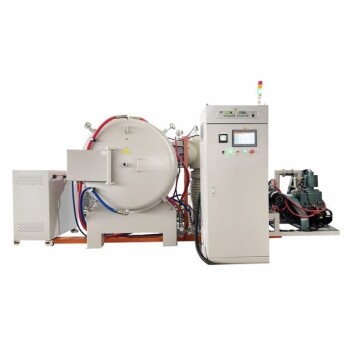
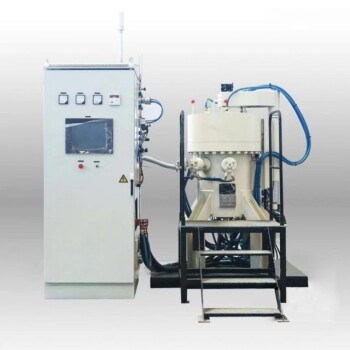
- 2200 ℃ Tungsten Vacuum Heat Treat and Sintering Furnace
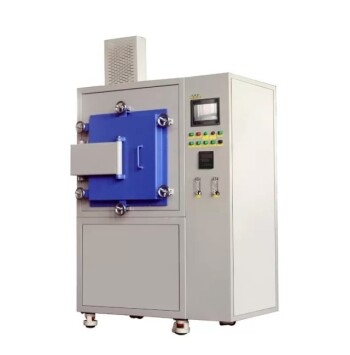
- 1400℃ Controlled Inert Nitrogen Atmosphere Furnace
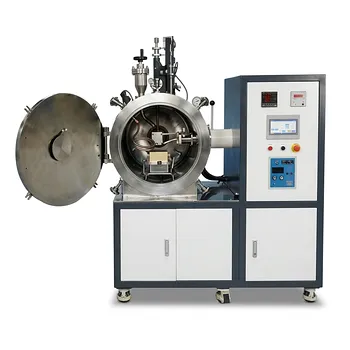
- Molybdenum Vacuum Heat Treat Furnace
- 2200 ℃ Graphite Vacuum Heat Treat Furnace
- Vacuum Heat Treat Sintering Furnace Molybdenum Wire Vacuum Sintering Furnace
People Also Ask
- How does a tungsten-heated vacuum sintering furnace prepare (TbxY1-x)2O3 ceramics? Achieve 99%+ Density & Purity
- How do compaction pressure and vacuum sintering optimize porous ceramics? Maximize Density & Toughness
- What wear-resistance enhancements are achieved by powder coating? The Role of Vacuum Sintering Furnaces
- What role does a high-temperature vacuum sintering furnace play in the densification of WC-10(Ni, Ni/Co) alloys?
- How does high-temp vacuum sintering influence Y-TZP mechanical properties? Achieve Max Toughness