The short answer: High-temperature furnace annealing transforms porous silicon sub-oxide (SiOx) by driving phase separation.
This process fully oxidizes the non‑stoichiometric matrix to stoichiometric SiO₂ while nucleating nanocrystalline silicon (nc‑Si) clusters. Physically, the film consolidates, porosity drops sharply (e.g., from ~62 % to ~47 %), film thickness contracts, and the surface becomes significantly smoother. All these changes are critically dependent on precise temperature control and an inert furnace atmosphere.
Core Takeaway
Annealing porous SiOx above 700 °C chemically restores Si–O bonds and creates a two‑phase SiO₂/nc‑Si nanocomposite, while physically densifying the film. The process is not just a chemical fix—it is a deliberate structural engineering technique, and its success hinges on the stability and controllability of the high-temperature laboratory furnace.
Chemical Stoichiometry: From Non‑Stoichiometric to Phase‑Separated
Restoration of the Si–O Network
As‑deposited porous SiOx films (e.g., SiO₁.₇₄) contain a high density of broken or dangling bonds.
Thermal energy supplied by the furnace drives atomic rearrangement, restoring a fully connected, stoichiometric SiO₂ backbone. This eliminates sub‑oxide states and homogenizes the oxygen distribution.
Phase Separation and nc‑Si Nucleation
Above roughly 700 °C, the excess silicon can no longer remain dissolved in the oxide matrix.
The material undergoes spinodal or nucleation‑driven phase separation, forming discrete silicon clusters. At higher temperatures (950–1000 °C) and under inert gas, these clusters crystallize into nanocrystalline silicon (nc‑Si) embedded in the stoichiometric SiO₂ host.
Evolution of Optical Constants
The formation of nc‑Si particles dramatically alters the film’s refractive index and extinction coefficient.
This allows researchers to tune the optical band gap and dispersion characteristics of the composite—a critical lever for light‑emitting and photonic devices.
Physical Structure: Densification and Morphological Evolution
Porosity Collapse and Thickness Contraction
As the matrix oxidizes and phase separates, the film undergoes a physical consolidation.
Open porosity is drastically reduced, often from values above 60 % to well below 50 %. This densification is accompanied by significant thickness reduction—up to 25 % in highly silicon‑rich films—as structural defects are annihilated.
Surface Smoothing
Thermal treatment also heals the as‑deposited surface texture.
Atomic force microscopy confirms that high‑temperature annealing reduces surface roughness, which is essential when integrating these layers into non‑volatile memory stacks or planar photonic structures.
Competing Morphological Instabilities
Under constrained sintering, differential shrinkage between the film and its rigid substrate generates large transient stresses.
If the heating profile is not carefully managed, grain boundary grooving, pinhole expansion, and Rayleigh instabilities can cause the thin film to break up into isolated islands, exposing the substrate.
The Critical Role of the Laboratory Furnace
Why Temperature Control Defines the Outcome
Phase separation kinetics and oxidation rates are exponential functions of temperature.
A deviation of just a few degrees around the target (e.g., 950 °C) can shift the nc‑Si size distribution, oxidation state, and final density. Programmable, multi‑stage ramp‑and‑soak profiles are mandatory to complete densification before morphological degradation sets in.
The Necessity of an Inert Atmosphere
Annealing must be performed under high‑purity Argon or nitrogen to prevent uncontrolled oxidation.
Laboratory tube or atmosphere furnaces that maintain a continuous flow of inert gas ensure that the conversion of SiOx to SiO₂ proceeds stoichiometrically, without atmospheric oxygen altering the final phase balance.
Understanding the Trade‑offs and Common Pitfalls
Risk of Film Breakup During Densification
The same capillary forces that drive porosity reduction also pull the film inward, creating severe in‑plane tensile stress.
If the heating ramp is too slow, the film spends too long in a high‑stress state and dewets or breaks into droplets before full density is reached. Fast, controlled ramps let the film densify quickly, freezing the structure before instabilities take over.
Stoichiometric‑to‑Structural Trade‑off
Higher temperatures (1000 °C) produce larger, more perfect nc‑Si crystals and a more ordered SiO₂ network.
However, they also increase the risk of grain‑boundary grooving and interface roughening at the substrate, which can compromise device performance. The optimal annealing condition is a balance between chemical perfection and structural integrity.
Not All Furnaces Are Equal
Variations in thermal uniformity across the hot zone, gas purity, and the presence of backstreaming contaminants will directly imprint on the film.
A poorly calibrated muffle furnace can leave behind sub‑oxide residues or introduce unwanted surface species, negating the benefits of annealing.
Making the Right Choice for Your Thin‑Film Process
The annealing recipe you choose must align with your final application. Use the following goal‑based guidelines to navigate the process window.
- If your primary focus is luminescence or photonics: Prioritize phase separation at 950–1000 °C in Argon to grow well‑defined nc‑Si clusters. Accept a moderate thickness contraction and verify the refractive index change matches your photonic design.
- If your primary focus is a stable, low‑defect dielectric layer: Aim for complete oxidation to stoichiometric SiO₂ with minimal nc‑Si content. A slightly lower temperature (700–800 °C) and an oxygen‑gettered atmosphere can maximize oxide quality while keeping the interface electronically clean.
- If your primary focus is maintaining mechanical integrity on rigid substrates: Use a fast ramp rate and a precisely controlled 950 °C plateau to densify the film quickly. Monitor final thickness and porosity, and be prepared to accept a slightly broader nc‑Si size distribution if it prevents catastrophic film breakup.
Ultimately, the high‑temperature furnace is not merely a heat source—it is the precision instrument that turns a chemically disordered, porous SiOx layer into a structurally engineered nanocomposite.
Summary Table:
| Aspect / Property | As-Deposited SiOx Film | Post-Annealing (700–1000 °C) | Primary Mechanism / Impact |
|---|---|---|---|
| Stoichiometry | Non-stoichiometric sub-oxide matrix | Phase-separated SiO₂ + embedded nc-Si | Thermal rearrangement & bond restoration |
| Porosity | High (~60%+) | Densified (~47% or lower) | Pore collapse & structural consolidation |
| Film Thickness | Baseline thickness | Contracted by up to 25% | Defect annihilation & material compaction |
| Surface Roughness | Higher micro-roughness | Smoother surface profile | Thermal healing (requires ramp rate control) |
| Optical Gap | Variable sub-oxide bandgap | Tunable index & dispersion | Nucleation & growth of nc-Si particles |
| Process Atmosphere | N/A | High-purity Argon / N₂ atmosphere | Prevents uncontrolled external oxidation |
Master Precision Thin-Film Annealing with KINTEK
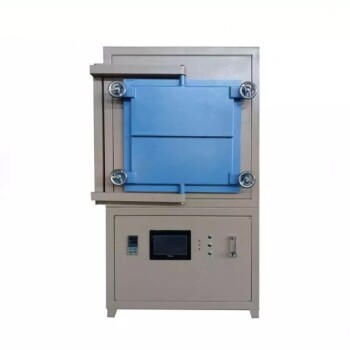
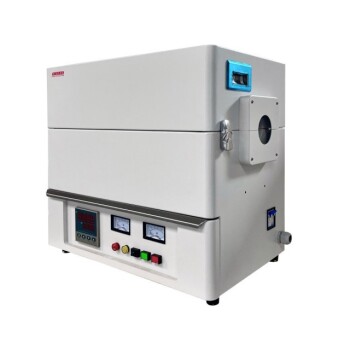
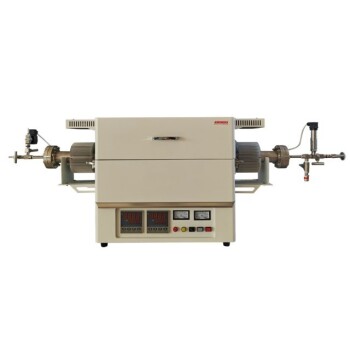
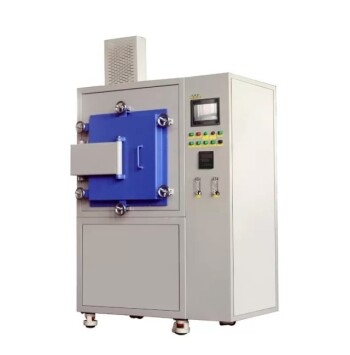
Achieving exact phase separation and film densification in SiOx thin films requires strict temperature precision and reliable atmosphere isolation. KINTEK offers high-performance laboratory equipment, including specialized atmosphere furnaces, tube furnaces, vacuum furnaces, and muffle furnaces—all fully customizable to meet your specific research and material synthesis requirements.
Whether you need precise multi-stage ramp profiles or ultra-pure inert environments, our high-temperature furnace solutions eliminate thermal gradients and prevent process defects.
Contact KINTEK today to optimize your lab's thermal processes!
Related Products
- 1400℃ High Temperature Laboratory Tube Furnace with Alumina Tube
- 1700℃ High Temperature Laboratory Tube Furnace with Alumina Tube
- 1800℃ High Temperature Muffle Oven Furnace for Laboratory
- 1700℃ High Temperature Muffle Oven Furnace for Laboratory
- Laboratory Muffle Oven Furnace with Bottom Lifting
People Also Ask
- How does zone-melting in tube furnaces synthesize bismuth micro-wires? Master Single-Crystal Thermoelectric Growth
- How are high-temp tube furnaces used to measure diffusion coefficients per Fick's law? Master Precision Annealing
- How do high-temperature laboratory tube furnaces ensure environmental stability? Precision Thermal Reduction Tips
- How are high-temperature laboratory tube furnaces applied in long-term vacuum homogenization heat treatments for intermetallic samples?
- How are high-temperature tube furnaces applied in testing ceramic-supported alloy membranes? Insights