The inverse power law between grain size and densification rate is the master key to sintering. During the intermediate and final stages, the densification rate is inversely proportional to the grain size raised to a significant power—$G^{-3}$ for lattice diffusion and $G^{-4}$ for grain boundary diffusion. This means even a small amount of grain growth can cause a catastrophic drop in the speed at which a material densifies. Precise control of your high-temperature laboratory furnace is therefore not just a best practice; it's the primary tool you have to manipulate this fundamental kinetic relationship and achieve near-theoretical density.
The core challenge of sintering is a kinetic race between densification and grain growth, both driven by heat. While higher temperatures exponentially accelerate the atomic diffusion needed to close pores, they also fuel grain coarsening. A precisely controlled furnace is essential to navigate this trade-off, providing the thermal energy to maximize diffusion while strategically limiting time-at-temperature to prevent the grain growth that would otherwise choke the process.
The Kinetic Penalty of Grain Growth
At the microscopic level, sintering eliminates surface energy by removing pores. The rate at which this occurs is dictated by how fast atoms can move from grain boundaries to these pores. The grain size ($G$) is the defining length scale for this journey.
The $G^{-3}$ and $G^{-4}$ Rule
Kinetic models are explicit: the densification rate ($d\rho/dt$) is brutally sensitive to grain size.
- Lattice Diffusion: When atoms diffuse through the crystal bulk, the rate scales as $1/G^3$. Doubling the grain size reduces the densification rate by a factor of eight.
- Grain Boundary Diffusion: When atoms move along grain boundaries, the rate scales as $1/G^4$. Doubling the grain size here decreases the rate by a factor of sixteen.
From Rapid Progress to a Crawl
This mathematical relationship explains a common practical observation. A part may densify quickly to 95% of its theoretical density, then suddenly stop.
- The initial fine powder provided a short diffusion distance, enabling rapid pore removal.
- As the process continued, the high temperature coarsened the microstructure. The driving force for sintering couldn't overcome the now-dramatically increased diffusion distance.
- Pores become trapped within large grains. Once isolated, the boundary diffusion path is severed, and further densification becomes practically impossible.
Furnace Control as Your Primary Variable
You don't directly control grain size during a thermal cycle; you control the furnace. The precision of your furnace's temperature control and uniformity dictates the microstructure's evolution.
Managing the Diffusion-Growth Tradeoff
The relationship with temperature is an exponential one, defined by Arrhenius behavior. A small temperature overshoot doesn't just make the process a little faster—it can cause a massive spike in diffusivity. While this spike does accelerate sintering, it often preferentially triggers rapid grain coarsening. A highly stable furnace ensures you operate at the precise target temperature where the ratio of densification rate to grain growth rate is optimal.
Preventing Runaway Coarsening
Excessive dwell time at high temperature is the primary cause of stagnant densification. A furnace with a responsive, programmable controller allows you to design two-step profiles or short high-temp holds. These strategies provide enough thermal energy for diffusion kinetics to close pores but terminate the process before grain boundaries can migrate and swallow those pores. This precision prevents the "pore-boundary separation" that permanently limits final density.
Understanding the Trade-offs
No single furnace profile is universally optimal. The goal is to understand the conflict between two thermally activated processes so you can design an intelligent compromise.
The Fundamental Conflict: High temperature is a double-edged sword. It is mandatory to activate the diffusion mechanisms ($D_l$, $D_b$) that remove pores. Yet, it simultaneously activates the mechanisms that move grain boundaries and increase $G$, which then crushes the densification rate. A hotter, less controlled cycle will produce a coarser-grained product that stops densifying early, while a precisely controlled, lower-temperature cycle can achieve a higher final density with a finer grain structure.
Thermal Uniformity Matters: A gradient within your furnace means different parts of your component are in different stages of this kinetic race. One section could be densifying perfectly while another is already undergoing grain growth, creating non-uniform shrinkage that leads to warping, cracking, or heterogeneous final properties.
Making the Right Choice for Your Goal
Your furnace profile must be dictated by your specific objective. Precision control enables you to prioritize different outcomes at different stages.
- If your primary focus is achieving maximum final density: Use a controlled, lower-temperature hold or a two-step sintering profile. The first step initiates densification, and a rapid cooldown to a lower second step arrests grain growth while allowing boundary diffusion to finish closing pores.
- If your primary focus is a fine-grained microstructure for superior mechanical strength: Minimize time at peak temperature aggressively. Use a rapid heating rate to bypass low-temperature surface diffusion mechanisms that coarsen necks without densifying, and rely on a brief, precisely controlled soak to achieve the target density.
- If your primary focus is process consistency and eliminating warping: Invest in furnace calibration and mapping to ensure exceptional zone uniformity. A consistent thermal history across the entire part prevents differential densification caused by one area undergoing grain growth before another.
By treating your high-temperature furnace as a precise kinetic instrument, you gain the ability to outrun grain growth, ensuring your material reaches its full potential in both density and performance.
Summary Table:
| Mechanism / Factor | Kinetic Scaling | Impact of Grain Coarsening | Furnace Control Solution |
|---|---|---|---|
| Lattice Diffusion | Rate $\propto 1/G^3$ | Doubling grain size reduces rate by $8\times$ | Programmed short high-temp holds |
| Grain Boundary Diffusion | Rate $\propto 1/G^4$ | Doubling grain size reduces rate by $16\times$ | Two-step sintering profiles |
| Thermal Non-Uniformity | N/A | Differential shrinkage, warping, & cracking | Multi-zone thermal calibration |
| Excess Dwell Time | N/A | Traps pores inside large grains (stagnant density) | Precise soak & rapid cool-down |
Outrun Grain Growth with KINTEK's High-Precision Furnaces
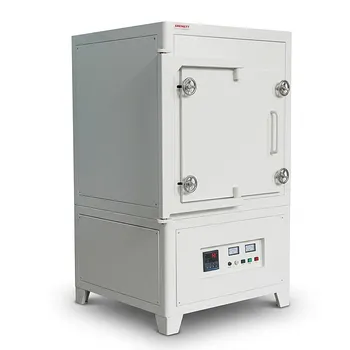
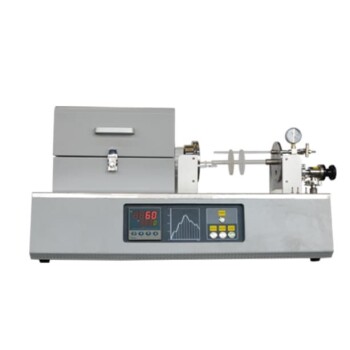
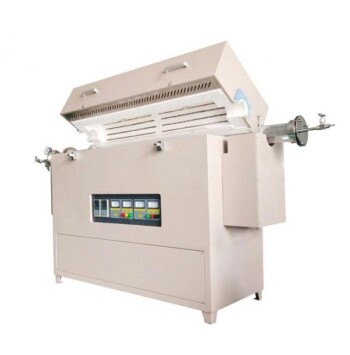
Don't let runaway grain coarsening compromise your material's final density and mechanical strength. KINTEK offers a comprehensive range of customizable high-temperature laboratory furnaces—including muffle, tube, rotary, vacuum, CVD, atmosphere, dental, and induction melting furnaces—engineered for exceptional thermal uniformity and ultra-precise thermal profiling.
Ready to master your sintering kinetics and consistently achieve near-theoretical density? Contact KINTEK today to consult with our thermal processing experts and find the perfect high-temp solution for your exact research or production needs!
Related Products
- 1400℃ High Temperature Laboratory Tube Furnace with Alumina Tube
- 1700℃ High Temperature Laboratory Tube Furnace with Alumina Tube
- 1800℃ High Temperature Muffle Oven Furnace for Laboratory
- 1700℃ High Temperature Muffle Oven Furnace for Laboratory
- 1200℃ Muffle Oven Furnace for Laboratory
People Also Ask
- How does zone-melting in tube furnaces synthesize bismuth micro-wires? Master Single-Crystal Thermoelectric Growth
- How do high-temperature laboratory tube furnaces ensure environmental stability? Precision Thermal Reduction Tips
- How are high-temp tube furnaces used to measure diffusion coefficients per Fick's law? Master Precision Annealing
- How are high-temperature laboratory tube furnaces applied in long-term vacuum homogenization heat treatments for intermetallic samples?
- How are high-temperature tube furnaces applied in testing ceramic-supported alloy membranes? Insights