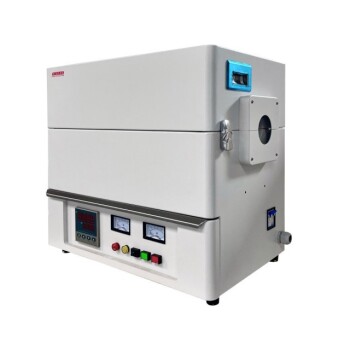
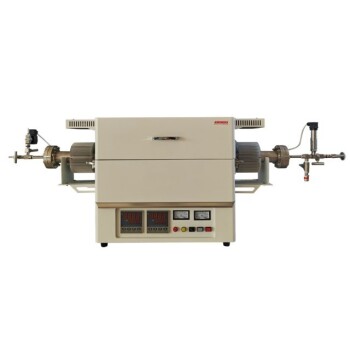
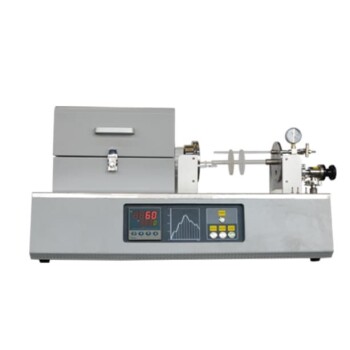
Atmosphere control is the silent architect of ceramic perfection. The gas environment inside a laboratory high‑temperature furnace directly determines whether a ceramic compact will achieve full density or retain a network of isolated pores. By governing gas solubility, defect chemistry, and vapor‑transport pathways, the chosen atmosphere can either enable complete pore elimination—yielding optically translucent alumina or fully dense silicon nitride—or permanently halt densification at a limiting value. The science hinges on preventing the entrapment of insoluble gases that push back against the capillary sintering forces.
Mastering the furnace atmosphere transforms sintering from a simple heat treatment into a precision‑engineering process. The key physical challenge is final‑stage pore closure: a wrong gas choice traps internal pressure that stops shrinkage, while a well‑matched atmosphere dissolves and diffuses gas out of the pores. Vacuum, hydrogen, or carefully‑tuned oxygen levels unlock theoretical density; inert gases often leave residual porosity. Your material system and performance goal dictate which atmosphere strategy is non‑negotiable.
The Hidden Battle Against Trapped Gases
Dense ceramics are not built by heat alone. The most stubborn barrier to full densification emerges only at the very end of the thermal cycle.
Final‑Stage Sintering and Pore Closure
As the ceramic body shrinks, interconnected pore channels eventually pinch off into isolated, closed pores. At that instant, whatever gas is present in the furnace becomes permanently sealed inside. The trapped gas creates an internal pressure (Pi) that pushes outward against the pore walls.
Sintering continues only while the capillary pressure (2γs/rf)—the driving force from surface energy—exceeds this internal back‑pressure. As soon as the two equalize, densification stops. The final porosity is then locked in by the very gas you chose to surround the part.
The Role of Gas Diffusivity
The fate of a closed pore depends entirely on whether the trapped gas can escape through the solid ceramic. Fast‑diffusing gases like hydrogen or helium readily dissolve in the lattice and migrate along grain boundaries. When sintering oxide ceramics in an H2 atmosphere, for example, the gas diffuses out before internal pressure can build up—enabling near‑100 % theoretical density.
Slowly diffusing or inert gases—nitrogen, argon—are a different story. They dissolve poorly and diffuse even more poorly. As the pore shrinks, the trapped gas compresses until its pressure balances the sintering stress. The result is a hard density limit, often around 95–98 %, and further heating can even cause pores to coarsen or swell as the gas pressure overcomes local strength.
Vacuum operation eliminates the root problem entirely. By removing the gas before pores close, a vacuum furnace allows the material to densify without any internal counter‑pressure, making it the most direct route to residual‑porosity‑free microstructures.
Engineering the Atomic Highway: Defect Chemistry and Diffusion
What the gas does inside the furnace goes far beyond pore mechanics—it fundamentally changes how quickly atoms can move.
Point Defects as the Engine of Densification
Solid‑state sintering is a diffusion‑controlled process. Atoms and vacancies migrate along grain boundaries and through the crystal lattice; the rate of migration directly governs how fast pores can be eliminated. The population of point defects—chiefly vacancies—is exquisitely sensitive to the oxygen partial pressure (for oxides) or the redox environment.
A precisely controlled atmosphere lets you engineer the defect concentration. By tuning the PO2 inside a laboratory tube furnace, you can create a surge of cation or anion vacancies. This flood of extra vacant sites dramatically accelerates mass transport, allowing densification to proceed at lower temperatures or in shorter cycles. Without that chemical tuning, diffusion rates can be orders of magnitude too slow to remove porosity.
Preventing Unwanted Phase Changes
Atmosphere control also acts as a chemical shield. Non‑oxide ceramics such as Si3N4 or SiC will catastrophically oxidize in air at sintering temperatures. An inert argon or nitrogen blanket is mandatory simply to preserve the desired compound.
Even in oxides, the wrong atmosphere can cause stoichiometry drift or volatilization of critical elements. Zinc oxide may lose oxygen and form conductive defects; multivalent cations can switch oxidation states, altering grain boundary segregation. A tailored atmosphere—whether reducing, oxidizing, or precisely neutral—locks in the exact chemical identity your material needs to densify uniformly and without contamination.
Understanding the Trade‑offs and Pitfalls
No single atmosphere is universally ideal. Several hidden traps can derail your densification goals even with a nominally “right” gas choice.
The Slow‑Diffusion Trap in Fine‑Grained Systems
For powders where the initial pore size is very small (sub‑micron range), the internal pressure of trapped inert gas remains low enough that densities above 99.8 % can still be reached at 1 atm. However, with coarser starting particles or elevated furnace pressures, the trapped gas volume is larger, and the limiting density can plummet. If you are targeting true pore‑free transparency, a vacuum or a high‑diffusivity gas like hydrogen is mandatory—pressure‑less sintering in nitrogen will always leave a stubborn residual porosity.
Atmosphere‑Induced Coarsening
Not all mass transport is helpful. Some gas environments promote surface diffusion or evaporation‑condensation that redistribute material without shrinking pores. An uncontrolled atmosphere can cause neck growth and particle coarsening while wasting the sintering driving force. This leaves a coarse, low‑density skeleton that is far harder to densify. The furnace atmosphere thus influences the ratio of densifying to coarsening transport, and a misstep here can permanently ruin the microstructure.
Complexity with Dopants and Multiphase Systems
When using sintering aids—such as MgO in alumina for optical translucency—the atmosphere’s effect on defect chemistry becomes intertwined with solute segregation. For MgO‑doped Al2O3, sintering in oxygen allows the trapped gas to dissolve and diffuse through the lattice, reaching near‑theoretical transparency. In air, where insoluble nitrogen gets trapped, densification stalls at about 95 % and subsequent heating causes pore coalescence. The right atmosphere must support both the dopant’s role and gas removal simultaneously; getting one without the other leads to failure.
Vacuum‑Only or Pressure‑Assistance Limitations
Vacuum sintering elegantly removes gas, but it can also accelerate volatilization of certain species, degrading stoichiometry or causing surface depletion. In such cases, a controlled partial pressure of a reactive gas (e.g., a slight oxygen bleed for some titanates) is the only way to maintain composition. And when even a perfect atmosphere cannot eliminate porosity—due to agglomerates or extremely stable pore networks—pressure‑assisted methods (hot pressing, SPS) must provide extra mechanical work.
Making the Right Choice for Your Goal
Your atmosphere strategy must be built around your specific ceramic chemistry, your powder morphology, and the performance endpoint you require.
- If your primary focus is achieving theoretical density and optical translucency: Use a vacuum or a high‑diffusivity gas (H2 for many oxides; O2 for doped alumina) . This ensures that no insoluble gas remains trapped in closed pores, enabling complete pore elimination and photon‑grade clarity.
- If your primary focus is sintering non‑oxide ceramics (Si3N4, SiC, AlN): Operate under inert nitrogen or argon to prevent oxidation. For nitrides, a slight nitrogen overpressure can suppress decomposition while still allowing out‑diffusion of trapped species.
- If your primary focus is controlling grain growth and stoichiometry: Precisely tune the oxygen partial pressure or use a controlled reducing/inert mix. This lets you dial in the exact point‑defect population for fast diffusion while avoiding unwanted phase transformations or volatile loss.
When atmosphere alone cannot extinguish every last pore, consider vacuum as your baseline and pair it with a short pressure‑assist step. The furnace atmosphere is not just a background parameter—it is the invisible hand that guides atomic migration and decides whether your ceramic emerges as a fully dense monolith or a body riddled with hidden voids.
Summary Table:
| Atmosphere Type | Primary Mechanism | Target Applications & Density Impact |
|---|---|---|
| Vacuum | Prevents internal gas back-pressure in closed pores | Achieves near-100% density; ideal for optical transparency & void-free parts |
| High-Diffusivity (H₂, O₂) | Enables trapped gas to rapidly diffuse through lattice | Prevents pressure buildup in oxides; reaches theoretical density |
| Inert (Ar, N₂) | Prevents catastrophic oxidation/decomposition | Essential for non-oxides (Si₃N₄, SiC); may cap density at 95–98% |
| Tuned Partial Pressure (P_O₂) | Tailors point defect/vacancy concentrations & stoichiometry | Accelerates diffusion kinetics without phase change or volatile loss |
Unlock Flawless Ceramic Densification with KINTEK
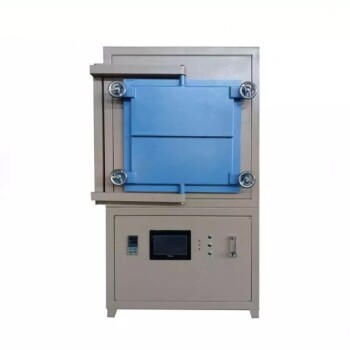
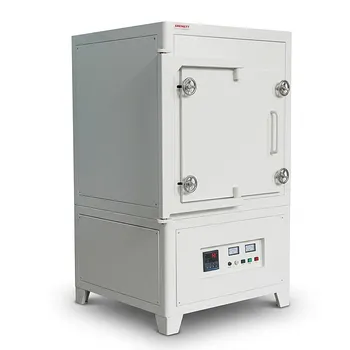
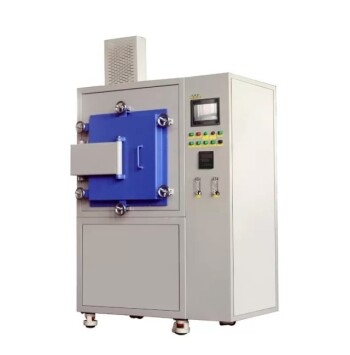
Don't let trapped gases and suboptimal atmospheres compromise your ceramic research and production. KINTEK specializes in advanced laboratory equipment and high-temperature furnace technology designed for precise thermal processing. From vacuum, tube, and atmosphere furnaces to muffle, rotary, CVD, and induction melting systems, our equipment is fully customizable to meet your exact material synthesis requirements.
Ready to achieve theoretical density and flawless microstructures? Contact KINTEK today to consult with our experts!
Related Products
- 1400℃ Controlled Inert Nitrogen Atmosphere Furnace
- 1700℃ Controlled Inert Nitrogen Atmosphere Furnace
- 1200℃ Controlled Inert Nitrogen Atmosphere Furnace
- 1200℃ Muffle Oven Furnace for Laboratory
- 1800℃ High Temperature Muffle Oven Furnace for Laboratory
People Also Ask
- How does nitrogen atmosphere control in high-temperature furnaces prevent the decomposition of silicon nitride during sintering?
- How does oxygen partial pressure control affect ceramic sintering? Master Defect Chemistry
- Why is controlled-atmosphere heating required for functional ceramics and sensors? Master Defect Engineering
- How do controlled-atmosphere furnaces support polymer pyrolysis? Master SiC & Si3N4 Ceramic Conversion
- Why is thorough binder burnout necessary before sintering advanced ceramics? Ensure Peak Density & Zero Defects