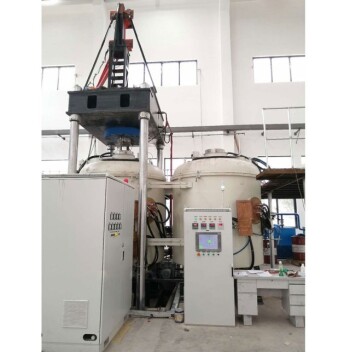
External pressure directly supercharges the densification driving force without accelerating grain growth, enabling full density at lower temperatures or shorter times. In high-temperature pressure-assisted sintering furnaces—like hot presses or HIP systems—the applied mechanical load adds to the intrinsic surface-energy-driven sintering stress, dramatically increasing the chemical potential at particle contacts. Because grain boundary mobility and grain coarsening rates are essentially independent of pressure, this selective boost to densification kinetics allows the material to reach near-theoretical density while bypassing the thermal exposure that normally feeds grain growth.
The core principle of pressure-assisted sintering: external load amplifies the driving force for densification but leaves grain growth unaffected. This lets you trade temperature for pressure—achieving rapid, high-density consolidation at fewer thermal “grains” of processing time, which preserves an ultra-fine microstructure.
How External Pressure Amplifies the Driving Force for Densification
In conventional, pressureless sintering, densification is driven solely by the capillary stress that arises from particle surface curvature. Adding an external mechanical load transforms the process.
Surface Energy vs. External Pressure: The Total Driving Force
The intrinsic sintering stress ((\Sigma)) from surface energy is relatively low—for typical 40 µm particles, it’s only about 0.2 MPa. This modest force often requires high temperatures and long hold times to reach high density, giving ample opportunity for grain growth.
Applying an external pressure ((p_a)) in a hot press furnace creates a new total driving force for densification:
[
\text{DF} = p_e + \gamma_{sv} \cdot K
]
where (p_e) is the effective external pressure, (\gamma_{sv}) the surface energy, and (K) the surface curvature. In practice, the mechanical stress is amplified at grain boundaries by a stress intensification factor, dramatically increasing the chemical potential of atoms at contact points. This vastly higher driving force triggers accelerated mass transport from the very first moments of sintering.
Stress Amplification at Localized Particle Contacts
In the early stages of pressure-assisted sintering, the external load is concentrated at the tiny contact zones between particles. This generates local stresses far above the nominal applied pressure.
The result is an immediate burst of plastic flow and particle rearrangement—what researchers refer to as initial rapid compaction. This “cold” or “warm” consolidation stage closes large pores quickly, lowering the required peak processing temperature and curtailing the time available for grains to coarsen.
Accelerated Densification Kinetics: Why Pressure Wins
The real magic happens at the level of diffusion mechanisms. External pressure not only increases the driving force but also changes how the densification rate scales with grain size.
Diffusion Mechanisms and Grain Size Dependence
In pressureless sintering, densification by lattice diffusion (Nabarro–Herring creep) scales as (1/a^3)—inversely with the cube of grain radius. Grain boundary diffusion (Coble creep) is even more sensitive, scaling as (1/a^4).
Applying external pressure reduces the grain-size exponent by 1 for both mechanisms. The pressure-assisted densification rate then scales as:
- Lattice diffusion: (1/a^2) (instead of (1/a^3))
- Grain boundary diffusion: (1/a^3) (instead of (1/a^4))
Reduced Sensitivity to Initial Grain Coarsening
Because the exponent is lower under pressure, the densification rate is less penalized by any initial grain coarsening that occurs during heat-up. This is crucial for material systems where grain growth is naturally fast relative to densification. You can start with a slightly coarser powder and still achieve rapid, high-density consolidation.
Moreover, since pressure-driven diffusion and power-law creep continue to operate effectively even at lower temperatures, the furnace operator can hold the material at a peak temperature well below the point where grain boundary mobility spikes, further protecting the fine grain structure.
How External Pressure Controls Grain Growth
The critical insight is that grain growth is a thermally activated process, largely insensitive to mechanical pressure. This independence creates a powerful lever.
Trading Temperature for Pressure: The Decoupling Effect
Grain coarsening is far more sensitive to processing temperature than to applied pressure. By increasing the external load, you can afford to lower the sintering temperature while still achieving full density.
This temperature–pressure trade-off means you can “dial in” exactly the densification rate you need, bypassing the high-temperature regime where grain boundaries become highly mobile. You achieve the same relative density at a lower thermal energy state, freezing the microstructure in a fine-grained, high-strength configuration.
Enhancing the Densification-to-Grain-Growth Ratio
The densification rate ((\dot{\rho})) increases sharply with pressure, but the grain growth rate ((\dot{G})) remains virtually unchanged. The ratio (\dot{\rho}/\dot{G})—which directly dictates final grain size at full density—therefore shifts dramatically in your favor.
This enhanced ratio allows pressure-assisted furnace cycles to reach near-theoretical density with only a fraction of the grain growth that would occur in a conventional pressureless run. It’s the single most powerful mechanism for producing nanostructured ceramics, transparent ceramics, and high-temperature composites with uniform, isotropic properties.
Understanding the Trade-offs of Pressure-Assisted Sintering
While the benefits are substantial, this technique introduces constraints that must be weighed carefully against the material and component requirements.
- Equipment complexity and cost: Hot press and HIP furnaces require robust tooling, pressure vessels, and often inert handling, increasing capital and operating expenses.
- Die material limitations: Graphite dies are common but can react with certain ceramics or degrade in oxidizing atmospheres; refractory metal dies add cost and fabrication challenges.
- Shape and size restrictions: Uniaxial pressing is inherently directional and best suited for simple shapes; complex geometries may need post-processing. HIP can handle more complex shapes but adds turnaround time.
- Potential for non-uniform pressure distribution: Friction against die walls can create pressure gradients, leading to density variations if not managed carefully.
- Cycle time flexibility: The ability to reduce temperature and time often offsets these costs, but for high-volume or very large components, the economics must be evaluated against the microstructural payoff.
Making the Right Choice for Your Material System
The decision to use pressure-assisted sintering hinges on what you need to preserve in the microstructure and what your final application demands.
- If your primary focus is achieving nanostructured grains with near-theoretical density: Leverage the temperature–pressure trade-off aggressively. Select a hot pressing cycle that peaks at a temperature where grain boundary mobility is still sluggish, and use high pressure to push densification to completion.
- If you are processing materials with inherently high grain growth rates (e.g., certain carbides, borides): Pressure-assisted sintering is not just beneficial—it is often essential. The ability to decouple densification from grain growth prevents abnormal grain coarsening that would otherwise ruin mechanical properties.
- If you need to eliminate residual porosity and microstructural strings in high-performance alloys or tool steels: HIP powder processing applies uniform pressure to erase gas porosity and directionality, yielding isotropic properties that pressureless sintering cannot match.
- If your components have complex geometries and minimal post-machining is acceptable: Consider HIP over uniaxial hot pressing. Encapsulation or pressure-assisted sintering with near-net-shape molds can provide density without extensive shape-changing distortion.
By understanding that external pressure selectively accelerates densification while leaving grain growth untouched, you gain a precise tool to craft microstructures that are both fully dense and exceptionally fine-grained—the foundation of high-performance ceramic and metal components.
Summary Table:
| Mechanism / Parameter | Pressureless Sintering | Pressure-Assisted Sintering (Hot Press / HIP) |
|---|---|---|
| Primary Driving Force | Capillary stress from surface curvature (~0.2 MPa) | Surface energy + Amplified mechanical load ($p_a$) |
| **Densification Rate ($\dot{ | ||
| ho}$)** | Slower; dependent on high thermal energy | Accelerated; lower kinetic exponents ($1/a^2$ or $1/a^3$) |
| Grain Growth ($\dot{G}$) | Rapid at high peak sintering temperatures | Suppressed by lowering required thermal budget |
| Densification-to-Growth Ratio | Standard ratio (coarsening occurs before full density) | Significantly enhanced (achieves density with minimal growth) |
| Final Material State | Moderate density or coarser grain structure | Near-theoretical density with ultra-fine/nanostructured grains |
Ready to optimize your advanced material sintering and achieve theoretical density without sacrificing fine grain structures? KINTEK specializes in premium laboratory equipment and consumables, offering a comprehensive range of high-temperature furnaces—including muffle, vacuum, atmosphere, tube, rotary, CVD, dental, and induction melting systems—all fully customizable to meet your unique research and manufacturing demands. Whether you need precise thermal control or specialized atmosphere capabilities for advanced ceramics and alloys, our experts are here to help. Contact KINTEK today to custom-design your high-temperature furnace solution!
Related Products
- High Temperature Muffle Oven Furnace for Laboratory Debinding and Pre Sintering
- 2200 ℃ Tungsten Vacuum Heat Treat and Sintering Furnace
- 9MPa Air Pressure Vacuum Heat Treat and Sintering Furnace
- 2200 ℃ Graphite Vacuum Heat Treat Furnace
- 600T Vacuum Induction Hot Press Vacuum Heat Treat and Sintering Furnace
People Also Ask
- What thermal phenomena occur during polymer binder burnout in ceramic green bodies? Lab Furnace Guide
- Why is controlled heat treatment in a muffle furnace necessary for calcined clay? Achieve Optimal Pozzolanic Activity
- What role does a high-temperature muffle furnace play in STFO synthesis? Achieve Pure Perovskite Results
- How does a high-temperature muffle furnace facilitate the formation of LaNbxAl1−xO3+δ perovskite structures? Key Roles
- What role does a high-temperature muffle furnace play in the multi-stage synthesis of Li0.5MnFe1.5O4? Key to Pure Spinel