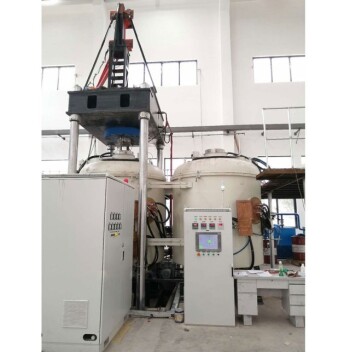
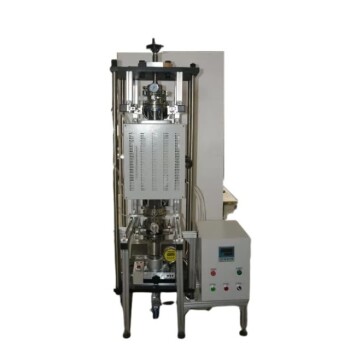
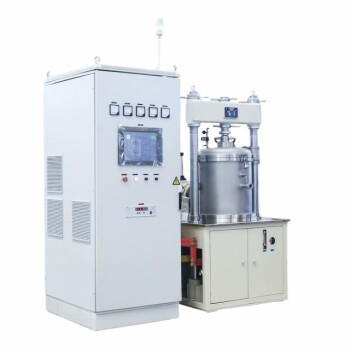
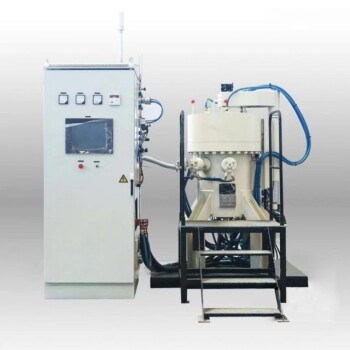
Applying external pressure dramatically accelerates densification without proportionally speeding up crystallization. This allows an amorphous ceramic compact to reach near-full density before the matrix can crystallize, bypassing the high-viscosity, low-mobility state that would otherwise trap porosity and ruin the final component.
For amorphous ceramics, the fundamental processing challenge is outrunning crystallization. Hot pressing solves this by adding a powerful, independent densification driver—mechanical work—that dwarfs the weak, surface-energy-driven sintering stress, while leaving the kinetics of crystal nucleation and growth largely unchanged. The result: full densification can occur first, freezing the material before unwanted crystals form.
The Race Inside the Furnace
What Happens When Amorphous Ceramics Are Heated
When you heat a glassy powder compact in a furnace, two processes compete from the very start. Viscous flow lets the material densify as particles soften and merge under the pull of surface tension. Simultaneously, the amorphous phase has a thermodynamic tendency to crystallize, forming ordered domains that are far more rigid.
Crystallization is the enemy of densification. Once crystals nucleate and grow, the effective viscosity of the matrix skyrockets. That jump in viscosity freezes pore closure, locking in residual porosity that no amount of time or temperature can later remove.
Why Pressureless Sintering Often Fails
Without external pressure, the only force pushing densification is the intrinsic sintering stress. This is determined by surface energy divided by pore radius ((\Sigma \approx \gamma_{sv} / r)). For fine powders, this driving force is modest—on the order of 75 J/mol for 1 µm particles, equivalent to a sintering stress of only a few tenths of a megapascal.
In large green compacts or those with coarser particle distributions, the effective pore radius is large, making the intrinsic driving force even weaker. Densification can be painfully slow, giving crystallization a huge head start. The material crystallizes long before it can fully densify, and the window for processing closes.
Leveraging External Pressure to Win the Race
The Mechanical “Overdrive” for Densification
A hot pressing furnace applies a uniaxial external pressure—typically tens of megapascals—directly to the specimen. This mechanical stress performs work on the particle system that is an order of magnitude larger than surface-energy-driven sintering. A pressure of 30 MPa adds roughly 750 J/mol of driving force, compared to the 75 J/mol from surface curvature alone.
That tenfold boost changes everything. It doesn’t just nudge densification faster; it fundamentally alters which process dominates the timeline. Viscous flow responds immediately to the amplified stress, while crystallization kinetics remain governed primarily by temperature and time, with minimal sensitivity to applied pressure.
Why Crystallization Doesn’t Keep Up
Pressure accelerates densification through mechanical work, but chemical reactions such as crystallization are insensitive to moderate mechanical stress. The activation energy for viscous flow decreases locally under pressure, whereas the nucleation and growth of crystals are diffusion-limited processes that do not scale equally with applied load.
In short, you can pour energy into compaction without equally feeding the reaction that ruins your glass. This decoupling is the key to success. The ratio of densification rate to crystallization rate shifts decisively in your favor.
The Mechanics: How Pressure Accelerates Viscous Flow
Amplified Stress at Particle Contacts
In the early stages of sintering, the external pressure is amplified at the tiny contact points between particles. This local stress intensification triggers rapid initial compaction via viscous flow or power-law creep, even at temperatures where pressureless sintering would barely have started.
The densification rate in hot pressing relative to conventional sintering scales with the ratio ((p_a \phi + \alpha \gamma_{sv} / r) / (\alpha \gamma_{sv} / r)), where (p_a) is the applied pressure and (\phi) is a stress intensification factor. When (p_a) is high compared to the intrinsic sintering stress of (\alpha \gamma_{sv} / r), the densification rate skyrockets.
Closing Large Pores Before They Become Defects
Amorphous green bodies often contain large inter-particle pores. Their intrinsic sintering stress is negligible, so under pressureless conditions they would simply not close. External pressure, however, creates a new effective driving force that scales with particle size, ensuring that even large pores collapse quickly.
Once the matrix is fully dense, the material can be cooled before significant crystallization occurs. You freeze a dense, glassy solid with homogeneous properties, free of the directional stringers and residual porosity that plague pressureless-sintered amorphous ceramics.
Understanding the Trade-offs
The Temperature–Pressure Balancing Act
Pressure is not a license to lower your guard on temperature control. If the furnace temperature is set too high, crystallization can still outpace densification—even under high pressure. The goal is to find the sweet spot where viscous flow is fluid enough to allow rapid compaction, but the temperature stays below the nose of the time–temperature–transformation curve for crystal formation.
Equipment and Shape Limitations
Hot pressing furnaces are limited to simple shapes (disks, rectangles) because uniaxial pressure cannot be applied uniformly to complex geometries. Hot isostatic pressing overcomes this but adds cost and complexity. Also, tooling materials must withstand the pressure and temperature, which can lead to contamination concerns for ultra-high-purity glasses.
Potential for Residual Stresses
Rapid, pressure-driven densification can introduce residual stress gradients within the component if cooling is not managed carefully. These stresses may cause distortion or cracking, particularly if crystallization begins non-uniformly in stressed regions.
Making the Right Choice for Your Material
The processing strategy depends on what you need your amorphous ceramic to achieve.
- If your primary focus is achieving near-theoretical density without crystallization: Use hot pressing with a pressure that exceeds the intrinsic sintering stress of your starting powder by at least an order of magnitude. This lets you densify at a lower temperature and shorter time, closing the porosity window before crystals can nucleate.
- If your primary focus is retaining a fully amorphous microstructure in a bulk component: Map out the crystallization kinetics of your glass. Then, design your hot pressing cycle so that full densification (via viscous flow) is reached well before the onset of detectable crystallization—typically by using a fast ramp, high pressure, and minimal hold time at peak temperature.
- If your primary focus is simplifying processing and cost is secondary: Consider hot isostatic pressing if you need complex shapes or absolutely isotropic properties. Just be aware that the fundamental pressure–crystallization decoupling remains the same, but the cost and cycle time increase.
The ultimate lesson is this: pressure lets you separate what nature has tied together. By pouring mechanical work into densification while leaving crystallization kinetics behind, you can capture a dense, glassy ceramic exactly where and when you want it.
Summary Table:
| Process Parameter / Feature | Pressureless Sintering | Hot Pressing Furnace |
|---|---|---|
| Driving Force | Intrinsic surface stress (~0.1 MPa) | Applied mechanical pressure (30+ MPa) |
| Densification Rate | Slow (surface-tension driven) | Dramatically accelerated (mechanical overdrive) |
| Crystallization Impact | High risk before full density | Minimized (crystallization kinetics unaffected) |
| Pore Closure | Large pores often remain trapped | Large & inter-particle pores collapse rapidly |
| Final Microstructure | Porous with uncontrolled crystals | Near-theoretical density, fully amorphous |
Master complex ceramic sintering and material processing with KINTEK! As specialists in high-performance laboratory equipment and consumables, we offer a comprehensive range of customizable high-temperature furnaces—including hot pressing, vacuum, atmosphere, tube, muffle, CVD, rotary, and induction melting furnaces—designed to meet your precise research and manufacturing needs. Boost your lab's productivity and achieve theoretical density effortlessly—contact us today to consult with our technical experts!
Related Products
- 1400℃ High Temperature Laboratory Tube Furnace with Alumina Tube
- 1700℃ High Temperature Laboratory Tube Furnace with Alumina Tube
- 1800℃ High Temperature Muffle Oven Furnace for Laboratory
- 600T Vacuum Induction Hot Press Vacuum Heat Treat and Sintering Furnace
- 1700℃ High Temperature Muffle Oven Furnace for Laboratory
People Also Ask
- How does zone-melting in tube furnaces synthesize bismuth micro-wires? Master Single-Crystal Thermoelectric Growth
- How are high-temperature laboratory tube furnaces applied in long-term vacuum homogenization heat treatments for intermetallic samples?
- How do high-temperature laboratory tube furnaces ensure environmental stability? Precision Thermal Reduction Tips
- How are high-temp tube furnaces used to measure diffusion coefficients per Fick's law? Master Precision Annealing
- How are high-temperature tube furnaces applied in testing ceramic-supported alloy membranes? Insights