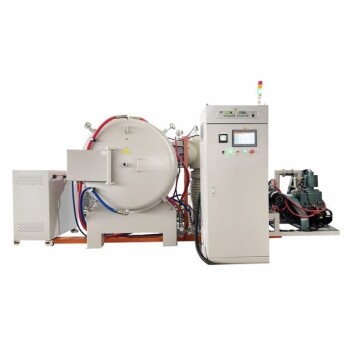
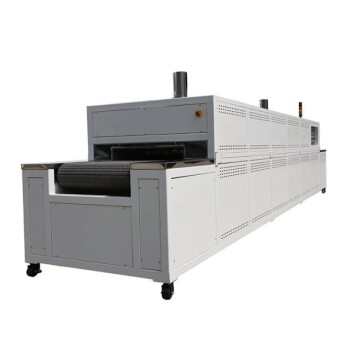
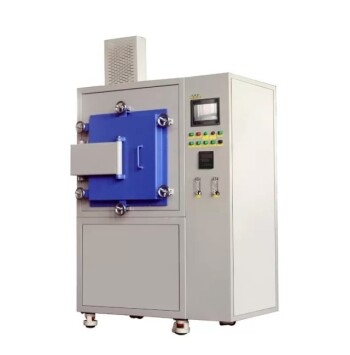
The fundamental role of high-temperature controlled atmosphere and vacuum furnaces in advanced sintering is to serve as precision environmental reactors. These systems go far beyond simple heating; they create a meticulously controlled chemical and physical environment that dictates material purity, mass transport mechanisms, and the final equilibrium state of the component. By managing vacuum levels or introducing specific inert, reducing, or reactive gases, these furnaces directly prevent surface oxidation, strategically accelerate pore removal, and control the delicate capillary forces and defect chemistry essential for achieving full densification in both solid-state and liquid-phase processes.
While often viewed simply as "high-temperature ovens," controlled atmosphere and vacuum furnaces are active process tools. The core problem they solve in sintering is the management of surface chemistry and internal porosity—preventing oxide contamination that blocks diffusion and evacuating entrapped gases from closed pores. Their ultimate value lies in enabling a stable, defect-free material to transition from a compacted powder into a dense, high-performance component through precise thermodynamic control.
Building Purity: The Role of Vacuum and Atmosphere
The very first obstacle to successful sintering is the inherent surface chemistry of powder particles. Exposure to ambient air creates oxide layers, adsorbed moisture, and organic contaminants that physically block the diffusion pathways necessary for bonding. A furnace's primary job is to clean the playing field.
Eliminating Oxidation for Unimpeded Diffusion
In solid-state sintering, material transport relies entirely on diffusion across particle boundaries. An oxide layer acts as a resistive barrier, halting this process. A high-temperature vacuum or inert atmosphere (like argon) furnace actively desorbs these surface contaminants and prevents re-oxidation during heating. This provides chemically clean interparticle contact. Only then can surface, grain boundary, and volume diffusion mechanisms activate efficiently, enabling the pore removal and grain growth required for densification.
Managing Stoichiometry and Defect Chemistry
The furnace atmosphere directly influences the defect chemistry of ionic compounds, particularly in advanced functional ceramics. By controlling the partial pressure of a specific gas, you can intentionally tune the concentration of vacancies in the crystal lattice. This level of control directly governs mass transport rates. A precisely controlled reducing or inert atmosphere preserves the target stoichiometry, optimizing diffusion kinetics in a way that is impossible in uncontrolled air.
Mastering the Liquid Phase: Capillarity and Stability
Liquid-phase sintering introduces a molten component to dramatically accelerate mass transport. However, this powerful mechanism is inherently unstable and exquisitely sensitive to the furnace environment, requiring a shift in control strategy from solid-state diffusion to managing fluid dynamics and surface physics.
Controlling Surface Tension and Wettability
The efficiency of liquid-phase sintering hinges on capillary action—the ability of the liquid to wet the solid particles and pull them together. The surrounding furnace atmosphere directly influences the liquid's surface tension and its wettability on the solid phase. An optimized vacuum or protective gas environment ensures the liquid perfectly wets the solid grains. This maximizes the capillary forces that drive rapid particle rearrangement, dissolution, and the solution-reprecipitation process, leading to pore-free densification.
Preventing Volatile Phase Loss and Gas Entrapment
A major pitfall during liquid-phase sintering is the evaporation of the liquid-forming additive or the entrapment of insoluble gas inside closed pores. A static inert gas atmosphere (e.g., argon at a controlled pressure) can suppress the evaporation of the liquid phase, maintaining its crucial function. Conversely, a vacuum environment is critical for final-stage sintering to evacuate entrapped process gases from isolated pores, eliminating the primary source of residual porosity that limits mechanical integrity.
Enabling True Thermodynamic Equilibrium
Sintering is a journey toward a minimal energy state. In liquid-phase systems, this equilibrium is defined by the force balance between solid-vapor, solid-liquid, and liquid-vapor surface tensions. Standard room-temperature tests cannot replicate this, as the solid phase cannot deform. Sustained high temperatures in a controlled-atmosphere furnace provide the solid mobility needed for grain shape accommodation. This allows the system to find its true static force balance, transitioning from a metastable packed-powder state to a stable, optimally-bonded microstructure.
Navigating Complex Metallurgies and Reactions
Advanced materials often involve sensitive compositions or require an in-situ chemical transformation alongside densification. These processes demand the highest levels of atmospheric purity and thermal precision.
Protecting Reactive and Sensitive Powders
Specialized alloys (such as MCrAlY or carbide-modified stainless steels) and intermetallic powders (like MoSi₂) are highly susceptible to oxidation and decarburization, which would devastate their final properties. A high-purity vacuum or reducing gas environment (e.g., hydrogen) is non-negotiable. It protects these sensitive powders, preventing volatile phase loss and ensuring the formation of clean grain boundaries. This is essential for achieving the target heat resistance, tribological performance, or magnetic properties.
Directing Reactive Sintering Pathways
Reactive sintering combines chemical synthesis and densification in a single step. The furnace atmosphere here becomes a reactant, not just a shield. By introducing a specific gas like nitrogen, the furnace drives the intended phase transformation, forming nitrides alongside densification. Simultaneously, a flow of gas can sweep away volatile reaction byproducts, shifting the chemical equilibrium toward product formation and creating a material unattainable through conventional melt-processing or passive-atmosphere sintering.
Understanding the Trade-offs
Choosing between furnace types and atmospheres is a strategic decision of optimization, not an inherent superiority. Each approach presents distinct limitations.
- Vacuum vs. Evaporation: While high vacuum is excellent for degassing pores, it can actively promote the evaporation of critical alloying elements or liquid-phase formers at high temperatures. A partial pressure of inert gas is often a necessary compromise to suppress elemental loss.
- Inert Gas vs. Gas Entrapment: An argon atmosphere effectively suppresses evaporation, but argon itself is a large atom that is insoluble in most materials. It can become trapped in closed pores during final-stage sintering, creating a back-pressure that fundamentally limits the achievable final density.
- Temperature Uniformity: Achieving precise thermal uniformity across a large load is a significant engineering challenge. A slight temperature gradient can lead to one section reaching full density while another experiences either under-sintering or, in liquid-phase systems, catastrophic slumping and shape distortion.
- Homogenization Potential: While liquid-phase sintering accelerates densification, uneven distribution of the liquid can cause localized swelling or leave behind brittle, solidified pools of the additive phase, creating microstructural defects rather than a homogenous composite.
How to Apply This to Your Project
Selecting the right sintering environment is a decision that must be guided by your core objective: ultimate densification, precise microstructural control, or the creation of a novel reactive material.
- If your primary focus is achieving maximum theoretical density: Prioritize vacuum sintering for its unparalleled ability to evacuate entrapped gases from pores, but validate that your base composition is not prone to volatile element loss.
- If your primary focus is liquid-phase sintering of stable alloys (e.g., WC-Co): Utilize an inert gas partial pressure to suppress liquid metal evaporation and ensure stable capillary action, achieving uniform liquid distribution and shape retention.
- If your primary focus is processing oxidation-sensitive structural alloys: Employ a reducing atmosphere, such as hydrogen or forming gas, to actively remove existing oxides and maintain perfectly clean interparticle bonds for superior mechanical strength.
- If your primary focus is synthesizing a new compound during densification: Your choice of reactive gas is a critical process variable. Select nitrogen, hydrogen, or another gas to actively drive the desired phase transformation while its flow purges unwanted byproducts.
By viewing your furnace not as a simple heater but as a precision environmental reactor, you unlock the full potential of sintering to create advanced materials with tailored, reproducible properties.
Summary Table:
| Sintering Mode | Furnace Environment | Primary Mechanism | Key Material Advantage |
|---|---|---|---|
| Solid-State | High Vacuum / Inert Gas | Desorbs surface contamination & drives diffusion | Chemically clean boundaries; prevents oxide barriers |
| Liquid-Phase | Controlled Partial Pressure | Manages surface tension, wetting & capillary forces | Prevents volatile phase loss; evacuates trapped gases |
| Reactive | Active Gas (e.g., N₂, H₂) | Drives in-situ phase changes & purges byproducts | Enables custom stoichiometry & synthesis during heating |
Maximize Densification and Precision with KINTEK High-Temp Furnaces
Achieving defect-free microstructures and theoretical density requires absolute environmental control. KINTEK specializes in advanced laboratory equipment and customizable high-temperature furnaces—including vacuum, atmosphere, muffle, tube, rotary, CVD, and induction melting systems—engineered to meet your exact sintering and material processing requirements.
Whether you are processing oxidation-sensitive alloys, tuning ceramic stoichiometry, or scaling liquid-phase sintering, KINTEK provides the precise gas management, thermal uniformity, and vacuum integrity your applications demand.
Ready to enhance your lab's capabilities and product performance? Contact KINTEK today for a tailored solution!
Related Products
- 1400℃ Controlled Inert Nitrogen Atmosphere Furnace
- 1700℃ Controlled Inert Nitrogen Atmosphere Furnace
- 2200 ℃ Tungsten Vacuum Heat Treat and Sintering Furnace
- 1200℃ Controlled Inert Nitrogen Atmosphere Furnace
- 2200 ℃ Graphite Vacuum Heat Treat Furnace
People Also Ask
- How does nitrogen atmosphere control in high-temperature furnaces prevent the decomposition of silicon nitride during sintering?
- How does oxygen partial pressure control affect ceramic sintering? Master Defect Chemistry
- Why is controlled-atmosphere heating required for functional ceramics and sensors? Master Defect Engineering
- How do controlled-atmosphere furnaces support polymer pyrolysis? Master SiC & Si3N4 Ceramic Conversion
- Why is thorough binder burnout necessary before sintering advanced ceramics? Ensure Peak Density & Zero Defects