
At its core, a muffle furnace achieves high temperatures by converting electrical energy into heat through a principle known as resistance heating. Specialized heating elements, made from materials that strongly resist the flow of electricity, are energized. This resistance generates intense, radiant heat inside a highly insulated chamber, allowing temperatures to reach upwards of 1700°C in some models.
A muffle furnace's critical function is not merely generating extreme heat, but doing so within a highly controlled and isolated environment. This combination of electrical heating and advanced control ensures that materials can be processed with exceptional precision and without the risk of contamination.
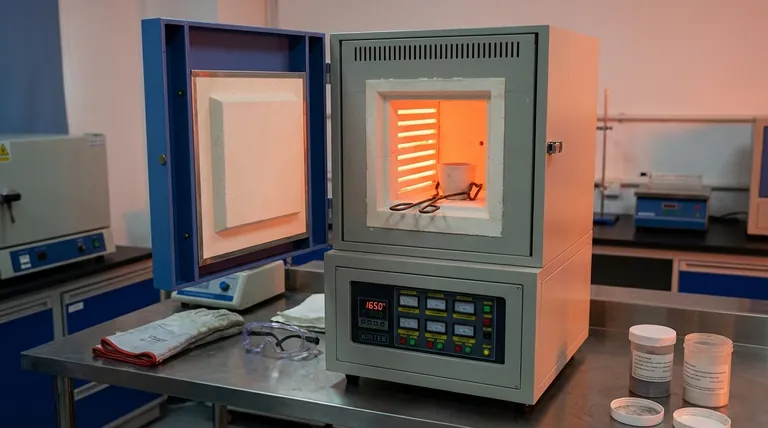
The Core Heating Mechanism Explained
The process of generating and containing heat in a muffle furnace is a function of three key components working in concert: the heating elements, the insulated chamber, and the control system.
From Electricity to Heat
The furnace operates on the fundamental principle of Joule heating. When an electric current is passed through a conductor, heat is generated. Muffle furnaces exploit this by using materials designed to have very high electrical resistance.
As electricity struggles to pass through these elements, the electrical energy is converted directly into thermal energy, causing the elements to glow and radiate heat into the chamber.
The Role of High-Resistance Elements
The heating elements are the heart of the furnace. They are typically made from robust alloys like Kanthal (iron-chromium-aluminum) or nickel-chromium.
These materials are chosen for their ability to resist high temperatures without melting or degrading quickly, and for their stable electrical resistance across a wide temperature range.
The Isolated Chamber (The "Muffle")
The term "muffle" refers to the furnace's inner chamber, which is isolated from the heating elements themselves. This chamber is constructed from refractory ceramic materials that can withstand thermal shock.
This design serves two purposes. First, it contains the heat and creates a uniform temperature environment for the sample. Second, and more importantly, it protects the sample from any impurities or gases produced by the heating elements, ensuring a clean processing environment.
Achieving Precision: The Control System
Simply getting hot is not enough; precision is paramount. Modern muffle furnaces use a sophisticated feedback loop to maintain exact temperatures.
The Temperature Sensor
A thermocouple acts as the furnace's internal thermometer. This sensor is placed inside the chamber to provide a constant, real-time temperature reading.
The Programmable Controller
The thermocouple sends its data to the temperature controller—the brain of the furnace. This digital unit compares the actual chamber temperature to the setpoint programmed by the user.
Based on the difference, the controller precisely modulates the amount of power sent to the heating elements, turning them on and off rapidly to maintain the target temperature with incredible accuracy.
Advanced Heating Cycles
Modern controllers allow users to program complex heating profiles. This includes setting specific ramp-up rates (how fast to heat), hold times (how long to stay at a specific temperature), and controlled cooling periods. This capability is essential for reproducible scientific and industrial processes.
Understanding the Trade-offs
While powerful, the design of a muffle furnace comes with inherent operational considerations that every user must understand.
Significant Power Consumption
Reaching and maintaining temperatures of 1200°C or higher requires a substantial amount of electrical energy. This is a primary operational cost and a key factor in facility planning.
Thermal Inertia
The heavy insulation required to reach high temperatures also means the furnace has significant thermal mass. It cannot heat up or cool down instantly. This "thermal inertia" must be factored into process timing.
Consumable Heating Elements
The heating elements are subjected to extreme thermal stress. Over time, through repeated heating and cooling cycles, they will degrade and eventually fail. They are a consumable component that will require periodic replacement.
Electric vs. Fuel-Fired Designs
While virtually all modern laboratory and precision muffle furnaces are electric, the term historically applied to fuel-fired furnaces that used a physical barrier (a muffle) to protect the workpiece from the flame and its combustion byproducts. Electric heating offers far superior purity and control.
Making the Right Choice for Your Goal
Understanding the furnace's operation helps you optimize your process.
- If your primary focus is material purity: The key benefit is the isolated muffle chamber, which prevents any contamination from the heating source.
- If your primary focus is process repeatability: Leverage the programmable controller to define precise heating and cooling cycles that can be run identically every time.
- If your primary focus is operational efficiency: Account for the furnace's thermal inertia in your workflow and be mindful of the energy costs associated with high-temperature, long-duration runs.
By viewing the muffle furnace as a precision instrument rather than a simple oven, you can fully control your material processing outcomes.
Summary Table:
| Component | Function | Key Features |
|---|---|---|
| Heating Elements | Convert electricity to heat via resistance | Made from Kanthal or nickel-chromium alloys |
| Insulated Chamber | Contains heat and isolates samples | Refractory ceramic materials prevent contamination |
| Control System | Maintains precise temperature | Uses thermocouples and programmable controllers for accuracy |
Unlock Precision in Your Lab with KINTEK's Advanced Furnace Solutions
Leveraging exceptional R&D and in-house manufacturing, KINTEK provides diverse laboratories with advanced high-temperature furnace solutions. Our product line, including Muffle, Tube, Rotary Furnaces, Vacuum & Atmosphere Furnaces, and CVD/PECVD Systems, is complemented by our strong deep customization capability to precisely meet unique experimental requirements. Whether you need contamination-free processing, repeatable results, or efficient operations, our expertise ensures optimal performance. Contact us today to discuss how we can enhance your material processing outcomes!
Visual Guide

Related Products
- 1400℃ Muffle Oven Furnace for Laboratory
- 1700℃ High Temperature Muffle Oven Furnace for Laboratory
- 1800℃ High Temperature Muffle Oven Furnace for Laboratory
- 1200℃ Muffle Oven Furnace for Laboratory
- High Temperature Muffle Oven Furnace for Laboratory Debinding and Pre Sintering
People Also Ask
- How does a high-temperature laboratory muffle furnace affect material properties? Transform Anodic Oxide Films Fast
- What is the primary function of a high-temperature laboratory muffle furnace in chemical synthesis? Achieve Precision.
- How is a laboratory high-temperature muffle furnace utilized to achieve the specific crystalline structure of LaFeO3 catalysts?
- What role does a laboratory high-temperature muffle furnace play in the treatment of highly contaminated waste glass?
- How is a laboratory high-temperature muffle furnace used in agloporite preparation? Optimize Material Synthesis



















