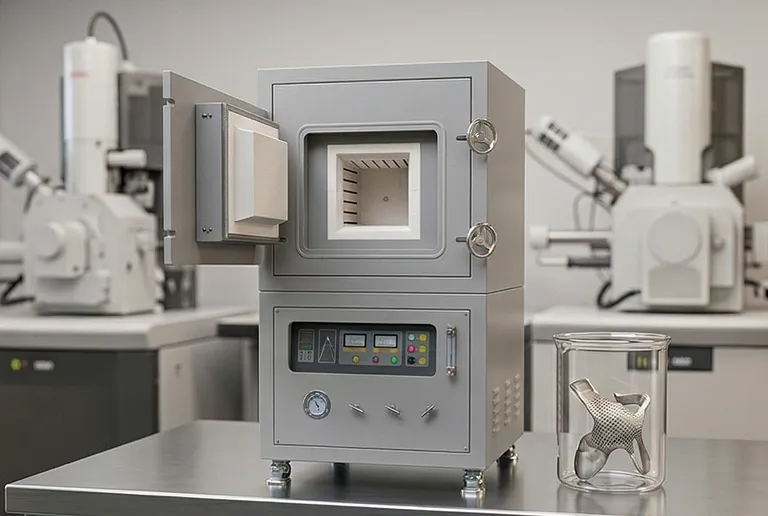
The "Perfect" Coating That Cracks Under Pressure
Imagine your team has spent weeks perfecting the sputtering process for a new NiTi (Nickel-Titanium) nanolaminated coating. Under the microscope, the layers look flawless. But the moment you subject the material to a functional test, it fails. Instead of the "shape memory" or superelastic behavior you expected, the coating is brittle, shows signs of surface scaling, and delaminates under minimal stress.
This is a frustratingly common scenario in advanced materials research. You have the right ingredients and the right deposition technique, yet the final product lacks the mechanical integrity required for high-erosion environments or medical applications. The problem isn't your recipe; it’s what happens—or fails to happen—during the critical "missing step" of post-deposition heat treatment.
The Common Struggle: Chasing Stability in the Wrong Places
When a coating doesn't perform, the instinctive reaction is often to tweak the deposition parameters—changing the power, the gas flow, or the substrate temperature. If that fails, many researchers attempt a standard annealing process in a basic muffle furnace or a low-vacuum environment.
However, these "quick fixes" often introduce a new set of headaches:
- Severe Oxidation: Titanium is a "getter" material; it craves oxygen. At the temperatures required for annealing (typically 650°C to 1000°C), even a trace amount of oxygen will turn your high-performance alloy into a useless oxide layer.
- Hydrogen Embrittlement: In non-vacuum environments, hydrogen can seep into the metal lattice, making the material prone to sudden, catastrophic cracking.
- Inconsistent Phase Transitions: If the temperature isn't controlled with surgical precision, the material fails to reach the "Austenite B2 phase"—the specific crystalline structure responsible for superelasticity.
The result? A wasted batch, a delayed project timeline, and a mounting bill for specialized raw materials that ended up in the scrap bin.
The Root of the Problem: The Invisible Barrier to Atomic Harmony
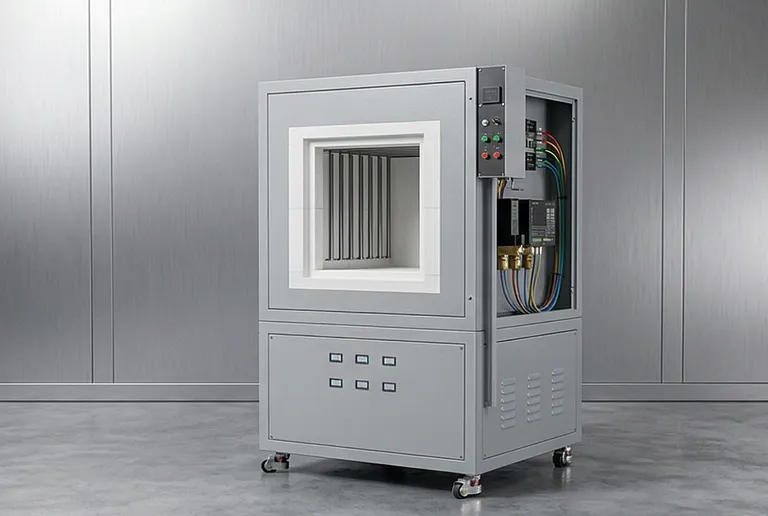
To understand why these failures happen, we have to look at the atomic level. When NiTi films are first deposited, they are often amorphous—a chaotic jumble of atoms with no internal order. This state has no shape memory effect and very little strength.
To transform this chaos into a high-performance superelastic coating, two things must happen simultaneously:
- Atomic Interdiffusion: The Nickel and Titanium atoms must migrate across their interfaces to form a stable alloy.
- Structural Rearrangement: The atoms must settle into a precise crystalline lattice (the B2 phase).
The "enemy" of this process is any impurity—specifically oxygen or nitrogen. If an oxide layer forms at the interface between nanolayers, it acts as a physical wall, blocking atomic diffusion. Furthermore, residual stresses trapped during the deposition process act like tiny internal springs, waiting to pull the coating apart.
Standard furnaces cannot provide the "cleanroom" thermal environment needed to allow these atoms to rearrange without interference. Without a high-vacuum environment (often down to $10^{-5}$ torr), you aren't just annealing your material; you are chemically compromising it.
The Solution: The Vacuum Furnace as a Precision Catalyst
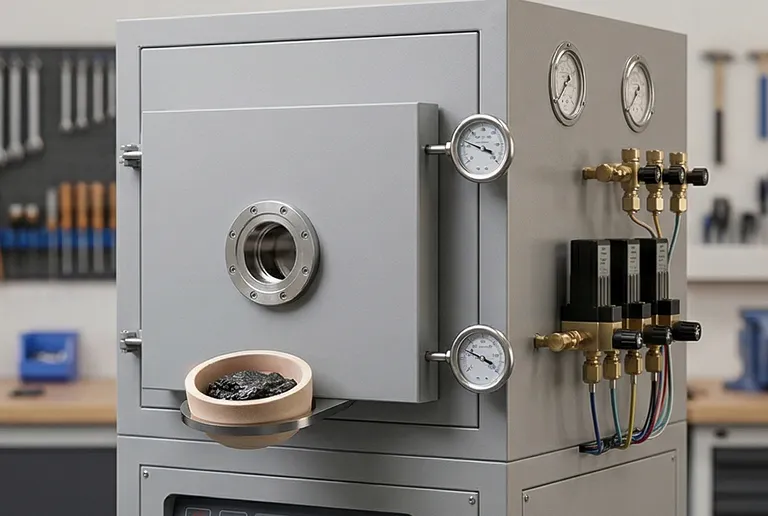
Solving this requires more than just heat; it requires a controlled vacuum environment that acts as a protective cocoon for the material. This is where an industrial-grade vacuum furnace becomes the most important tool in your lab.
A KINTEK vacuum furnace doesn't just "get hot." It is engineered to address the root causes of coating failure:
- Eliminating Oxidation: By operating at extremely low pressures, the furnace removes the oxygen that would otherwise ruin the Ti-alloy chemistry, ensuring the formation of a pure superelastic phase.
- Precision PID Control: Our systems use integrated PID controllers to execute multi-stage heating programs. This allows for "isothermal holding," giving atoms the exact amount of time and energy they need to rearrange and eliminate brittle residual stresses without overshooting the target temperature.
- Promoting Diffusion Bonding: For dual-layer or ternary systems (like adding Copper or Hafnium), our vacuum heat treatment facilitates the diffusion of these elements into interfacial micro-cracks. This "heals" the material from the inside out, creating a dense, bonded structure that resists erosion.
Whether you are working with thin-film sputtering or 3D-printed (SLM) titanium components, the vacuum furnace provides the stable thermal foundation necessary to transform a raw deposit into a functional engineering material.
Beyond the Fix: Unlocking New Material Frontiers
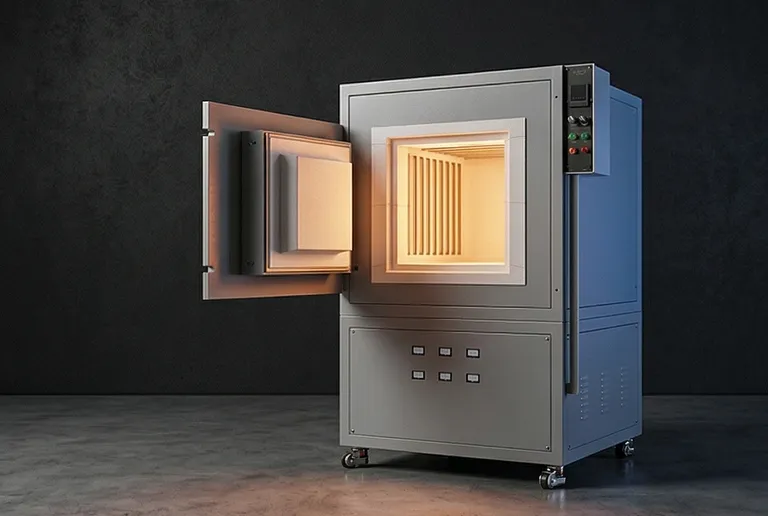
Once you master the vacuum annealing process, the "problem" of brittleness disappears, replaced by a world of new possibilities. When you can reliably control the phase transformation of your coatings, you can begin to push the boundaries of what your materials can do:
- Extreme Erosion Resistance: Produce coatings that can withstand the harshest industrial environments by ensuring a perfect austenitic structure.
- Advanced Alloying: Experiment with ternary elements like Hafnium or Zirconium to shift phase transformation temperatures for specific aerospace or medical needs.
- Microstructure Tailoring: Use long-duration homogenization at temperatures up to 1200°C to create alloys with macroscopic uniformity that were previously impossible to achieve.
By solving the fundamental challenge of oxidation and stress, you stop troubleshooting the past and start engineering the future.
At KINTEK, we understand that your research depends on more than just "standard" equipment. Whether you require a vacuum tube furnace for delicate coatings or a vacuum hot press for dense composite layering, our team specializes in providing the precision thermal tools necessary for your most challenging projects. Contact Our Experts today to discuss how we can help you achieve consistent, high-performance results in your next material breakthrough.
Related Products
- 600T Vacuum Induction Hot Press Vacuum Heat Treat and Sintering Furnace
- Vacuum Hot Press Furnace Machine Heated Vacuum Press
- 2200 ℃ Tungsten Vacuum Heat Treat and Sintering Furnace
- Vacuum Hot Press Furnace Machine Heated Vacuum Press Tube Furnace
- Vacuum Heat Treat Furnace with Ceramic Fiber Liner
Related Articles
- How Vacuum Hot Press Furnaces Transform Advanced Material Engineering
- How to Select the Right Vacuum Hot Pressing Furnace Temperature for Your Materials
- How Vacuum Pressure Sintering Furnaces Elevate Material Performance Across Industries
- Beyond the Parts List: The Real Reason Your Vacuum Hot Press Fails (And How to Fix It)
- Why Your High-Temperature Materials Fail: The Hidden War Inside Your Furnace



















