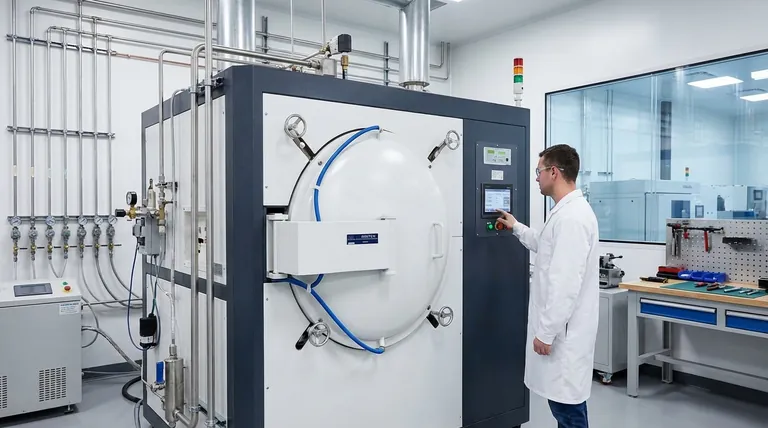
The Tyranny of the Atmosphere
An aerospace engineer designing a turbine blade lives with a single, persistent fear: imperfection. A microscopic oxide inclusion or a void in a brazed joint, invisible to the naked eye, can become the starting point for catastrophic failure under extreme stress and heat.
This isn't just a problem in aerospace. It's a fundamental challenge across all advanced manufacturing. The very air we breathe, rich with reactive oxygen, becomes an aggressive contaminant at high temperatures. It attacks surfaces, compromises structural integrity, and introduces a chaotic variable into what must be a predictable process.
The instinct of a materials scientist or engineer in this situation is not to add another element to counteract the problem, but to remove the problem itself. This is the psychological and engineering principle behind the vacuum furnace. It's not just a tool for heating; it's a system for creating certainty in an uncertain world.
A vacuum furnace's primary function is not to heat materials, but to create an environment where heat can do its work without interference. By removing the atmosphere, you remove the risk of unwanted chemical reactions.
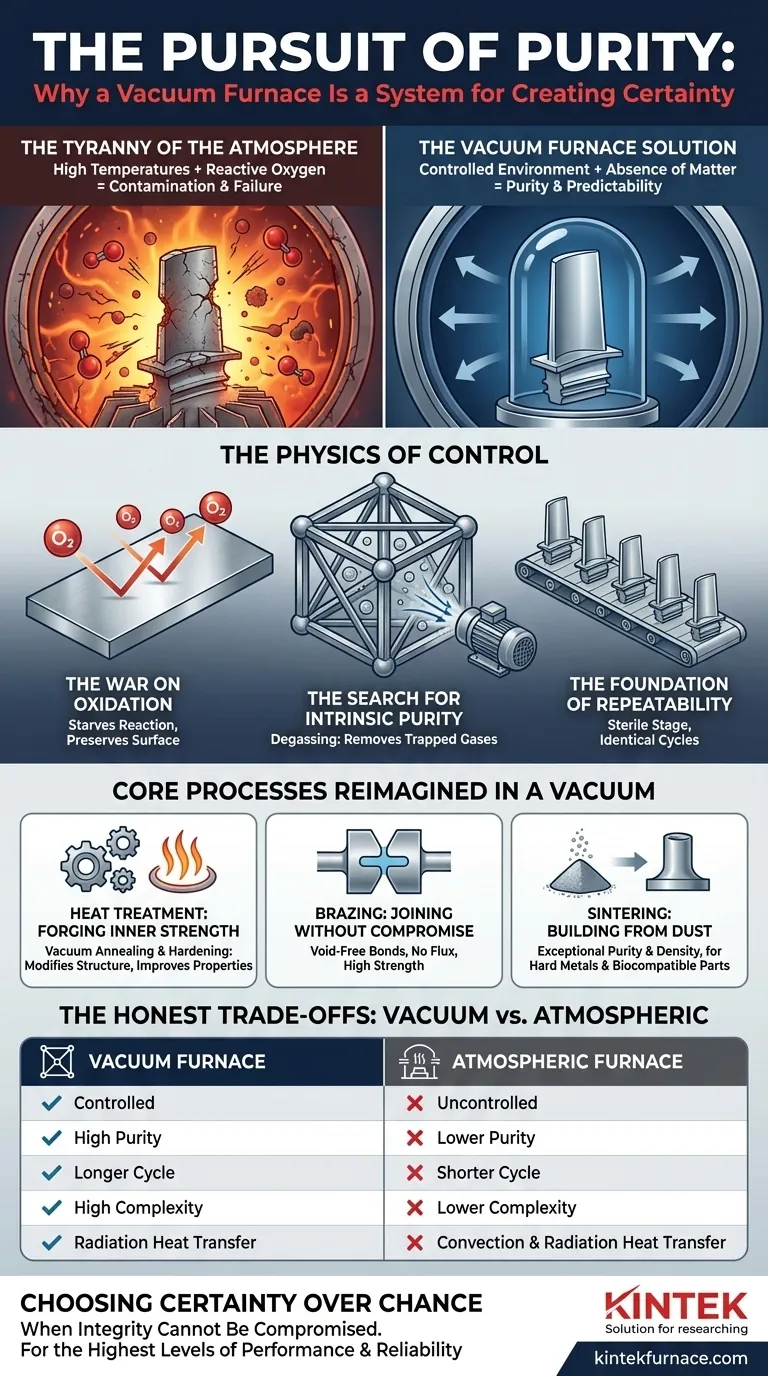
The Physics of Control
To appreciate why industries invest in vacuum technology, we must first appreciate the problems it solves by its very absence of matter.
The War on Oxidation
At high temperatures, metals are desperate to react with oxygen. This reaction, oxidation, forms a weak, brittle oxide layer that degrades a component's surface finish, mechanical strength, and electrical properties. A vacuum furnace starves this reaction by removing the oxygen, preserving the material's intended state.
The Search for Intrinsic Purity
The battle for purity is also fought within the material itself. A vacuum actively pulls out trapped gases and volatile impurities from the metal's lattice—a process called degassing. This results in a denser, purer final product with superior performance, something impossible to achieve when the surrounding atmosphere is constantly trying to push contaminants in.
The Foundation of Repeatability
By eliminating atmospheric variables, a vacuum furnace provides a sterile, predictable stage for thermal processing. Every cycle is identical. This level of control ensures that the first part produced is metallurgically identical to the thousandth, a cornerstone of modern quality assurance.
Core Processes Reimagined in a Vacuum
This controlled environment enables critical manufacturing processes that are defined by their need for cleanliness and precision.
Heat Treatment: Forging Inner Strength
Heat treatment modifies a material's microscopic crystal structure to refine its properties.
- Vacuum Annealing: Relieves internal stresses and improves ductility without surface discoloration.
- Vacuum Hardening & Quenching: Creates exceptionally hard, wear-resistant surfaces on advanced alloys for tooling and automotive parts, free from the decarburization that plagues atmospheric processes.
Brazing: Joining Without Compromise
Vacuum brazing is the art of joining components with a filler metal in an impeccably clean environment. The vacuum allows the filler to flow into the joint purely by capillary action, creating an incredibly strong, void-free bond. This is non-negotiable for mission-critical assemblies like medical implants and aerospace fuel injectors, where corrosive fluxes used in atmospheric brazing are an unacceptable risk.
Sintering: Building from Dust
Sintering creates solid, dense parts from metal or ceramic powders. In a vacuum, the process yields components of exceptional purity and density, essential for:
- Hard Metals & Carbides: For cutting tools and wear parts.
- Biocompatible Metals: For medical implants where purity is paramount.
- Post-Processing: For densifying 3D-printed metal parts.
These are not just manufacturing steps; they are guarantees of performance. They represent a decision to prioritize the absolute integrity of the final component over all else.
The Honest Trade-Offs
This pursuit of perfection comes at a cost. A vacuum furnace is a deliberate choice that involves accepting certain trade-offs for its superior results.
| Consideration | Vacuum Furnace | Atmospheric Furnace |
|---|---|---|
| Environment | Controlled, inert (or specific gas) | Uncontrolled air, or purged gas |
| Purity | High (degassing occurs) | Lower (risk of oxidation/contamination) |
| Cycle Time | Longer (pump-down and controlled cooling) | Shorter (often continuous) |
| Complexity | High (requires pumps, controls, cooling) | Lower (simpler mechanics) |
| Heat Transfer | Primarily Radiation | Convection and Radiation |
Heat transfer in a vacuum occurs almost entirely through radiation. This provides excellent temperature uniformity but requires careful part placement to avoid "shadowing" effects on complex geometries. The longer cycle times and higher capital investment make it ideal for high-value applications where the cost of failure is far greater than the cost of control.
Choosing Certainty Over Chance
The decision to use a vacuum furnace is a strategic one, driven by the end goal.
- When joining complex, high-stress parts, vacuum brazing offers the cleanest, strongest bonds.
- When maximizing the properties of advanced alloys, vacuum heat treatment delivers unmatched precision.
- When creating high-purity parts from powders, vacuum sintering is the industry standard.
Ultimately, a vacuum furnace is chosen when the material's chemical and structural integrity cannot be compromised. For applications demanding the highest levels of performance and reliability, controlling the processing environment is not a luxury—it is the entire foundation of success.
At KINTEK, we build the systems that provide this certainty. Specializing in customizable Muffle, Tube, Vacuum, and CVD furnaces, we understand that every advanced application has unique demands. We partner with researchers and engineers to design and manufacture the precise thermal environments they need to turn ambitious concepts into reliable realities.
If your work demands absolute control and uncompromising purity, let's build the right solution together. Contact Our Experts
Visual Guide
Related Products
- Vacuum Hot Press Furnace Machine Heated Vacuum Press Tube Furnace
- Vacuum Hot Press Furnace Machine Heated Vacuum Press
- 600T Vacuum Induction Hot Press Vacuum Heat Treat and Sintering Furnace
- 2200 ℃ Tungsten Vacuum Heat Treat and Sintering Furnace
- Vacuum Heat Treat Sintering Furnace with Pressure for Vacuum Sintering
Related Articles
- How Vacuum Hot Press Furnaces Transform Advanced Material Engineering
- How to Select the Right Vacuum Hot Pressing Furnace Temperature for Your Materials
- Beyond the Parts List: The Real Reason Your Vacuum Hot Press Fails (And How to Fix It)
- Why Your High-Temperature Materials Fail: The Hidden War Inside Your Furnace
- Is Your Material Data Real? Why Temperature Gradients Are Sabotaging Your Cu2Se Resistivity Measurements



















