The Illusion of the Simple Box
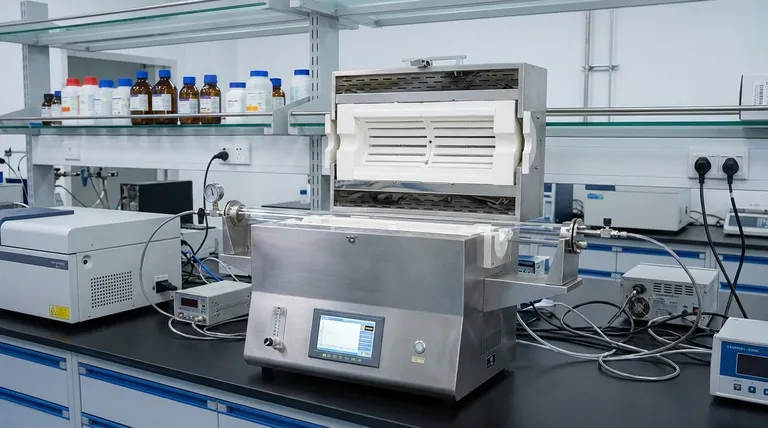
In any lab, the box furnace often sits as a silent, unassuming workhorse. To a casual observer, it’s just a high-temperature oven. But to an engineer or scientist, it represents a controlled universe where the fundamental properties of matter are forged and refined.
The psychological trap is its apparent simplicity. We see a box, we know it gets hot, and we assume it's the default tool for any thermal process. But this assumption can be the difference between a breakthrough and a failed experiment. The most critical decision isn't just what temperature you need, but what environment your material must inhabit at that temperature.
The Box Furnace: A Universe in a Chamber
The box furnace, or muffle furnace, earns its ubiquity for a reason: versatility. Its core design—an insulated chamber with a front-loading door—makes it the definitive tool for batch processing.
You can load it with multiple samples, irregularly shaped parts, or large components. Its excellent temperature uniformity ensures that from corner to corner, your materials experience the same precise thermal cycle. This makes it the go-to solution for a vast range of applications:
- Heat Treating: Processes like annealing to soften metals, hardening to increase their strength, or tempering to reduce brittleness.
- Material Synthesis: Sintering powdered metals or ceramics into solid parts, or calcining raw materials to induce thermal decomposition.
- Firing and Debinding: Hardening ceramics to their final state or carefully removing binder materials from injection-molded parts.
The box furnace is the master of general-purpose thermal processing in air or a modified inert atmosphere. It is the foundation upon which much of materials science is built.
When the Universe Needs a Different Shape
The problem arises when the process demands more than just uniform heat. The geometry of the sample and the nature of the atmosphere become the defining constraints. This is where we must look beyond the box.
The Tube Furnace: Precision in Flow and Form
Imagine your task is to synthesize a novel nanomaterial on a thin substrate, requiring a continuous flow of a specific reactive gas.
In a box furnace, you would fill the entire chamber with expensive gas, with no way to ensure a consistent, laminar flow over your sample's surface. The process would be inefficient and uncontrollable.
A tube furnace solves this problem elegantly. The sample sits within a narrow tube, allowing for a highly controlled atmosphere with minimal gas consumption. It's designed for:
- Small, uniform samples: Wires, rods, or small substrates.
- Continuous gas flow: Applications like chemical vapor deposition (CVD) or reactions requiring a specific, moving atmosphere.
- Higher purity: The smaller volume makes it easier to purge and maintain a pure atmospheric environment.
The Vacuum Furnace: When Nothing is Everything
Now, consider a different challenge: brazing a titanium alloy for a medical implant.
Titanium at high temperatures is incredibly reactive. Even a trace amount of oxygen, imperceptible in an "inert" atmosphere, will react with the metal, forming a brittle oxide layer and compromising the integrity of the final part. The risk is not just a failed component, but a catastrophic failure in a critical application.
This is where a vacuum furnace becomes non-negotiable. It isn't just about removing air; it's about creating an environment of nothing. By removing virtually all molecules, it eliminates the possibility of unwanted reactions. A vacuum furnace is essential for:
- Processing reactive metals: Titanium, zirconium, and other specialty alloys.
- High-purity brazing and sintering: Where oxide formation cannot be tolerated.
- Degassing: Removing trapped gases from a material's matrix.
A Decision Framework for Thermal Processing
Choosing the right furnace is a strategic decision rooted in the physics of your material and process. Don't start by asking what furnace you have; start by asking what environment your material truly needs.
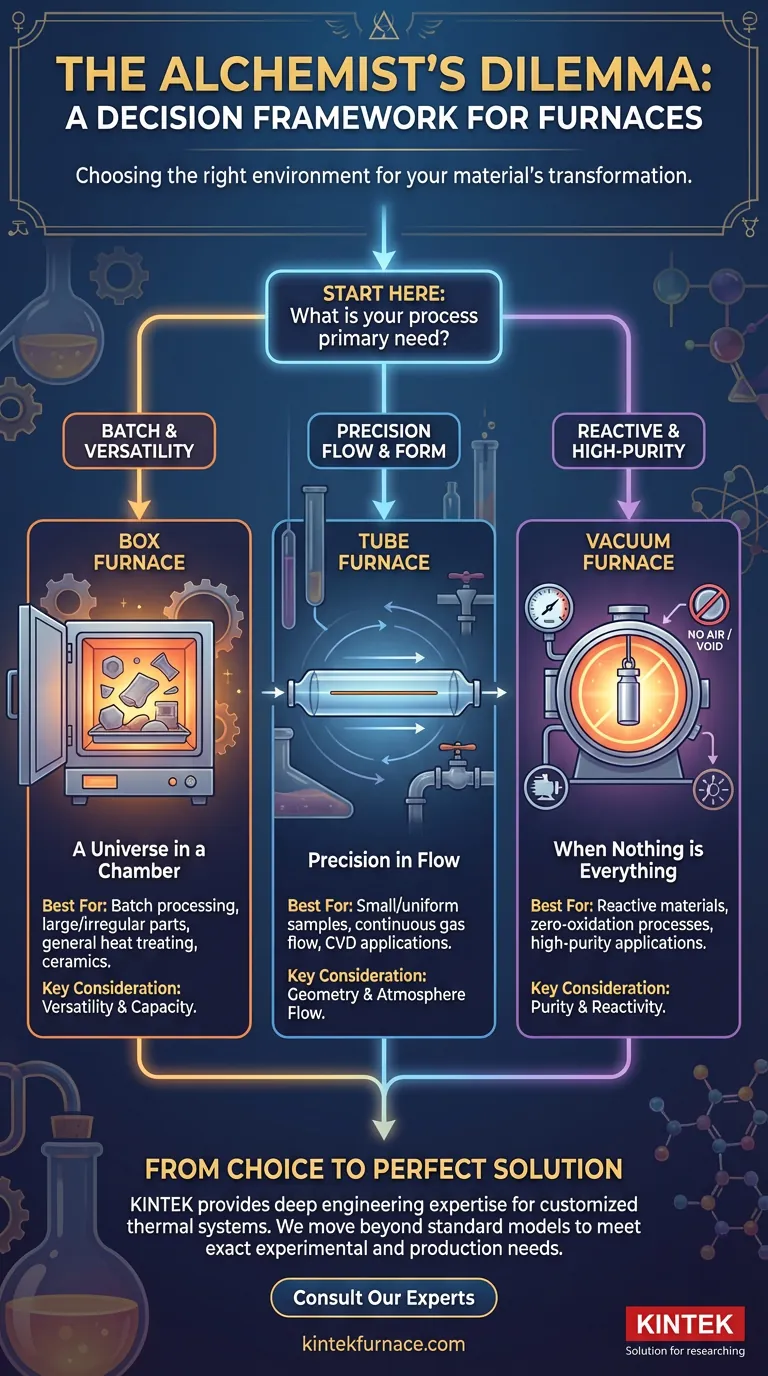
| Furnace Type | Best For... | Key Consideration |
|---|---|---|
| Box/Muffle Furnace | Batch processing, large or irregular parts, general heat treating, ceramics | Versatility & Capacity |
| Tube Furnace | Small/uniform samples, continuous/controlled gas flow, CVD applications | Geometry & Atmosphere Flow |
| Vacuum Furnace | Reactive materials, zero-oxidation processes, high-purity applications | Purity & Reactivity |
This framework shifts the focus from the tool itself to the fundamental requirements of the task. Once you understand the specific atmospheric and geometric needs of your process, the correct choice becomes clear.
From Correct Choice to Perfect Solution
Identifying the right type of furnace—box, tube, or vacuum—is the first step. The second, equally crucial step is ensuring the furnace is perfectly tailored to your unique parameters. Off-the-shelf solutions rarely account for the specific thermal profiles, atmospheric controls, or chamber dimensions that cutting-edge research and production demand.
This is where deep engineering expertise becomes indispensable. At KINTEK, we specialize in moving beyond standard models. Our complete line of Muffle, Tube, Rotary, and Vacuum furnaces are all built upon a foundation of expert R&D and in-house manufacturing, allowing for deep customization. We create thermal systems designed to meet your exact experimental or production needs, ensuring your process is not just possible, but optimal.
To ensure your thermal process is built on the right foundation, it's best to consult with those who build the tools. Contact Our Experts
Visual Guide
Related Products
- High Temperature Muffle Oven Furnace for Laboratory Debinding and Pre Sintering
- Mesh Belt Controlled Atmosphere Furnace Inert Nitrogen Atmosphere Furnace
- 1200℃ Controlled Inert Nitrogen Atmosphere Furnace
- 1200℃ Muffle Oven Furnace for Laboratory
- High Pressure Laboratory Vacuum Tube Furnace
Related Articles
- The Hidden Saboteur in Your HT-LiCoO2 Synthesis: Why Precise Ramp Rates Can Make or Break Your Battery Materials
- Why Your High-Temperature Experiments Fail: The Hidden Flaw in Your Furnace
- Why High-Purity Gas Fails Your High-Temp Brazing—And How Mono-Silane Doping Fixes It
- Your Furnace Meets Spec, So Why Are Your Results Inconsistent?
- Why Your Muffle Furnace Might Be Masking Your Alloy Kinetics—And How to Fix It



















