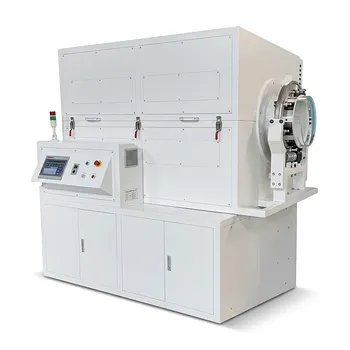
The final stage of sintering is a battle between capillary forces and entrapped gas. When isolated pores form in a polycrystalline or liquid-phase matrix, any gas species trapped inside can bring densification to a dead stop. High-temperature vacuum and controlled-atmosphere laboratory furnaces solve this by either evacuating those gases before pore closure or replacing insoluble species with gases that can dissolve or diffuse out through the solid. This restores the driving force for pore elimination and allows the compact to reach near-theoretical density.
The core barrier to full density is internal gas pressure inside closed pores. If the trapped gas is insoluble in the host material, its rising pressure eventually balances the capillary stress that shrinks the pore. The only way to break this deadlock is to remove the gas entirely or switch to a species with high solubility and diffusivity—decisions that are executed inside the furnace atmosphere before the pore network seals off.
The Physics of Pore Closure and Gas Entrapment
From Open Channels to Isolated Pores
During the initial and intermediate stages of sintering, porosity remains interconnected as an open network. Gas can freely flow to the sample surface. The critical turning point is Stage 3, where the pore channels pinch off into discrete, isolated voids. Once this connectivity drops to zero, any gas inside those pores is permanently trapped within the dense matrix.
The Pressure Balance That Halts Densification
As the pore tries to shrink under the capillary driving force (the sintering stress), the trapped gas gets compressed. If the gas is insoluble in the host lattice, it cannot escape. The internal pressure rises until it equals the sintering stress. At that equilibrium, pore shrinkage stops. This is why an otherwise well-sintered compact plateaus at a density far below theoretical, and prolonged heating can even cause pore coarsening via coalescence or Ostwald ripening, further degrading density.
The Role of Gas Solubility and Diffusivity
Why Some Gases Are Showstoppers
Common ambient gases like argon, nitrogen, or air are effectively insoluble in many engineering ceramics and metals. In an alumina (Al₂O₃) compact, for example, nitrogen has extremely low solubility and diffusivity. Once trapped in a closed pore, it acts like a spring—compressing without ever absorbing into the lattice. Every increment of shrinkage just increases the counter-pressure.
The Solubility Switch
The escape mechanism is not mechanical but chemical. Gases with high solubility and diffusivity in the host phase—such as hydrogen or oxygen in certain doped ceramics—can diffuse out to the free surface even after pore closure. The molecules dissolve into the solid at the pore wall, diffuse through the lattice, and desorb at the compact exterior. This constantly relieves the internal pressure, allowing the capillary forces to continue eliminating the pore and driving densification to completion.
How High-Temperature Furnaces Provide the Solution
Vacuum Sintering: Evacuation Before Closure
A high-vacuum furnace physically removes gas molecules from the entire system while the pore channels are still open. By sintering under vacuum during Stages 1 and 2, you prevent any appreciable gas from becoming entrapped in the first place. By the time the porosity drops to ~0.08 and channels pinch off, the isolated pores are virtually empty. Capillary action can then draw the material together unopposed, achieving near-theoretical density without any gas-pressure barrier.
Controlled Atmosphere Sintering: Replacing Insoluble with Soluble Gases
When vacuum is impractical or the material has high vapor pressure, a flowing or static controlled atmosphere takes over. The furnace is purged with a gas that is highly soluble and diffusible in the matrix—pure hydrogen or oxygen are classic choices. This flushes out the insoluble ambient gases before pore closure. Once isolated, the soluble gas inside each pore can continuously dissolve and diffuse outward, ensuring that the internal pressure never builds to a level that stalls densification. The result is the same: full pore elimination and a high-density compact.
Understanding the Trade‑offs
The Cost and Complexity of Vacuum
High‑vacuum systems demand specialized hardware, longer pump‑down times, and careful fixturing to avoid contamination. They can also increase the evaporation rate of volatile species, shifting stoichiometry in sensitive materials. For large‑scale production, the capital and cycle‑time costs must be weighed against the density benefit.
Atmosphere Selection and Safety
Soluble gases like hydrogen deliver outstanding densification results but introduce flammability, explosion hazards, and embrittlement risks in some alloys. Oxidizing atmospheres can alter surface chemistry and degrade furnace heating elements. The choice of atmosphere must align not just with solubility data but with material compatibility and safety protocols.
Timing is Everything
Both vacuum and atmosphere strategies must be applied before the pore network closes off, which typically occurs when porosity falls below ~8–10%. Ramping atmosphere changes or engaging vacuum too late in the sintering cycle leaves residual insoluble gas already locked inside pores, rendering the furnace atmosphere ineffective. Process design must ensure the open pore channels are thoroughly purged during the early and intermediate stages.
Making the Right Choice for Your Process
Your optimal furnace strategy depends on material properties, target density, and operational reality.
- If your primary focus is achieving absolute theoretical density in oxide ceramics: Use a high‑vacuum furnace to completely eliminate gas entrapment, but verify that vacuum does not cause deleterious volatilization of dopants or matrix species.
- If your primary focus is sintering metals or alloys to full density without sacrificing mechanical integrity: Operate a controlled atmosphere furnace with pure hydrogen to take advantage of high solubility and rapid diffusion, while strictly managing safety controls for hydrogen handling.
- If your primary focus is a scalable, cost‑sensitive process: Evaluate a flowing atmosphere that matches the solubility profile of your material (e.g., forming gas or inert‑soluble blends) and design the thermal profile to close pores only after the insoluble background gases have been thoroughly displaced.
- If your primary focus is liquid‑phase sintered composites: A vacuum or soluble‑gas atmosphere is equally critical; the internal gas pressure counters the sintering stress in exactly the same way, and the liquid phase alone cannot fill pores against trapped insoluble gas.
By matching your furnace atmosphere to the thermodynamic escape path of entrapped gases, you convert a process‑limiting physical barrier into a controllable variable—and unlock the full densification potential of your material.
Summary Table:
| Sintering Atmosphere / Strategy | Pore Elimination Mechanism | Primary Application / Material | Key Benefit & Trade-off |
|---|---|---|---|
| High-Vacuum Sintering | Physical evacuation of gas before pore channels close (Stage 1 & 2) | Oxide ceramics, non-volatile alloys | Benefit: Prevents entrapment entirely. Trade-off: Risk of volatile species loss. |
| Controlled Atmosphere (Soluble Gas) | Swaps insoluble gases for H₂ or O₂ that dissolve & diffuse through matrix | Doped oxide ceramics, refractory metals | Benefit: Relieves internal pressure post-closure. Trade-off: Requires safety & element controls. |
| Insoluble Gas Atmosphere (Air/Ar) | Trapped gas compresses, balancing capillary forces and stalling shrinkage | Standard porous media, low-density parts | Benefit: Low operational complexity. Trade-off: Caps density far below theoretical limit. |
Achieve Near-Theoretical Density with KINTEK Thermal Solutions
Don't let entrapped gases limit your material performance. KINTEK specializes in high-performance laboratory equipment and consumables, providing fully customizable high-temperature furnaces—including vacuum, controlled atmosphere, muffle, tube, CVD, and induction melting furnaces—engineered to deliver precise control over temperature and gas profiles.
Whether you need to purge insoluble gases or sinter under deep vacuum, our team of experts is ready to tailor the ideal setup for your research or production goals.
Contact KINTEK Today to Optimize Your Sintering Process
Related Products
- 2200 ℃ Tungsten Vacuum Heat Treat and Sintering Furnace
- 1400℃ High Temperature Laboratory Tube Furnace with Alumina Tube
- 1400℃ Controlled Inert Nitrogen Atmosphere Furnace
- 1700℃ High Temperature Laboratory Tube Furnace with Alumina Tube
- 1700℃ High Temperature Muffle Oven Furnace for Laboratory
People Also Ask
- How does a tungsten-heated vacuum sintering furnace prepare (TbxY1-x)2O3 ceramics? Achieve 99%+ Density & Purity
- What wear-resistance enhancements are achieved by powder coating? The Role of Vacuum Sintering Furnaces
- How do compaction pressure and vacuum sintering optimize porous ceramics? Maximize Density & Toughness
- What role does a high-temperature vacuum sintering furnace play in the densification of WC-10(Ni, Ni/Co) alloys?
- How does high-temp vacuum sintering influence Y-TZP mechanical properties? Achieve Max Toughness