
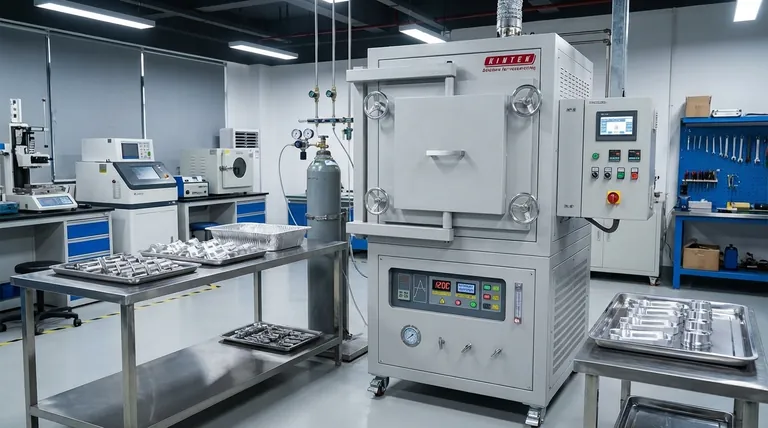
In modern manufacturing, an inert atmosphere furnace is essential because it creates a chemically non-reactive environment for high-temperature processing. This controlled atmosphere prevents unwanted reactions, primarily oxidation and contamination, which is critical for ensuring the integrity, performance, and quality of advanced materials in industries from metallurgy to semiconductors.
The true value of an inert atmosphere furnace is not just its ability to heat materials, but its power to control the chemical environment during that heating. This control makes it possible to achieve specific material properties that are simply unattainable in open air.
The Fundamental Problem: Oxygen's Reactivity
Why Normal Air Is a Problem
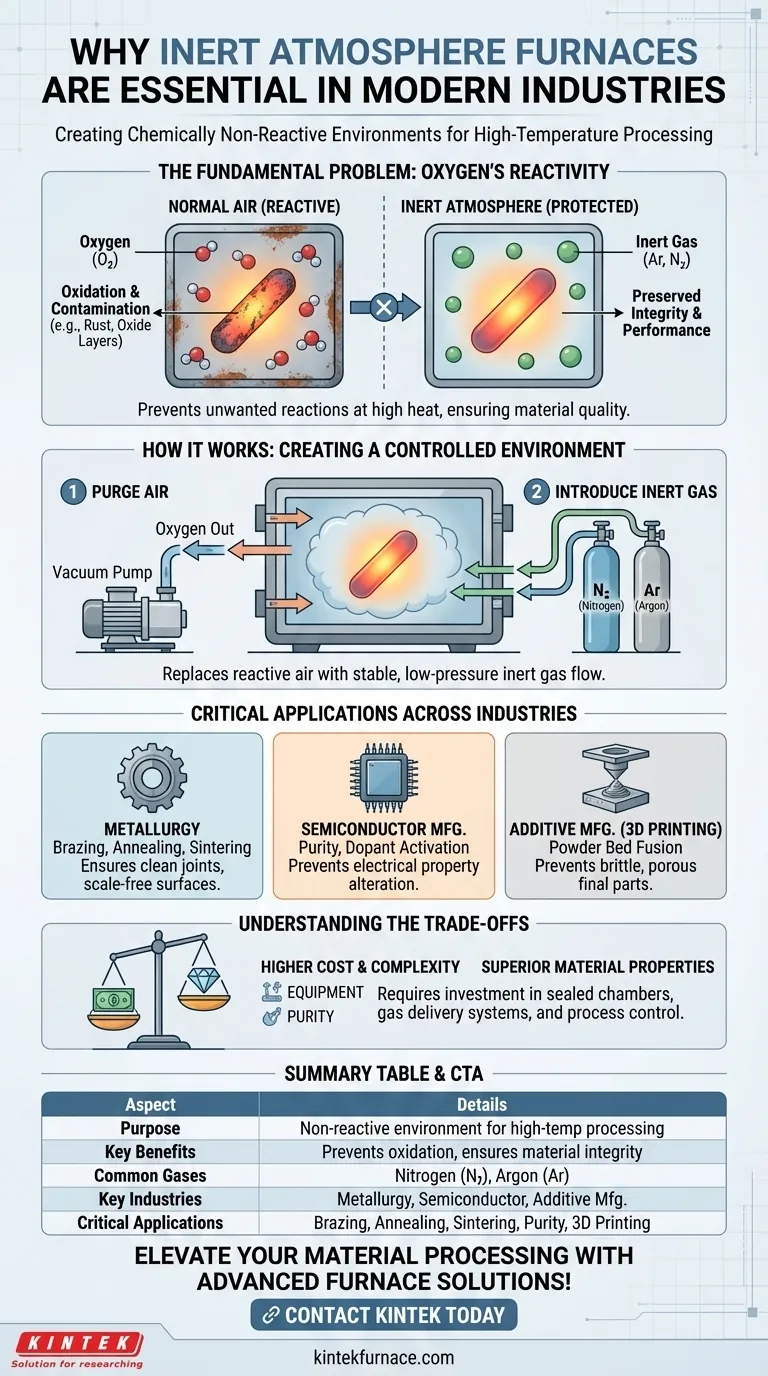
At room temperature, the oxygen in the air is relatively benign. However, at the high temperatures required for processes like brazing, annealing, or sintering, oxygen becomes extremely reactive.
This reactivity causes oxidation—the same chemical process that causes iron to rust. When processing sensitive metals or materials, this leads to the formation of unwanted oxide layers on the material's surface.
The Impact of Oxidation and Contamination
Oxidation and other forms of contamination are not minor issues; they fundamentally degrade the material.
These unwanted reactions can dramatically reduce a material's structural integrity, create weak points in bonded joints, alter a semiconductor's electrical properties, or lead to outright component failure. For high-performance applications, even microscopic levels of contamination can be catastrophic.
How Inert Atmosphere Furnaces Provide the Solution
Creating a Controlled Environment
An inert atmosphere furnace solves this problem by systematically removing the reactive atmosphere (air) and replacing it with a non-reactive one.
This is typically achieved by first purging the sealed furnace chamber to remove the oxygen. Then, a continuous, low-pressure flow of an inert gas is introduced to maintain a clean, oxygen-free environment throughout the heating and cooling cycle.
The Role of Inert Gases
The most commonly used inert gases are Nitrogen (N₂) and Argon (Ar).
These gases are chosen because they are chemically stable and will not react with the materials being processed, even at extreme temperatures. This ensures that the only changes happening to the material are the ones intended by the heat treatment process itself.
Critical Applications Across Industries
Metallurgy: Brazing, Annealing, and Sintering
In metallurgy, inert atmospheres are crucial for joining, shaping, and strengthening metals. During brazing, an inert gas prevents oxides from forming, which would otherwise inhibit the flow of the filler metal and create a weak joint.
For annealing, the process of heating and cooling to soften a metal and relieve internal stress, an inert atmosphere ensures a clean, bright surface finish free of scale.
Semiconductor Manufacturing: Purity and Precision
The semiconductor industry relies on absolute purity. Processes like dopant activation or the annealing of thin films must occur in an oxygen-free environment.
Even trace amounts of oxygen can contaminate the silicon wafer, altering its electrical properties and rendering the resulting microchips useless. An inert atmosphere is the only way to guarantee the required purity and reliability.
Additive Manufacturing: Powder Bed Fusion
In metal 3D printing, such as powder bed fusion, fine metal powders are melted layer-by-layer with a laser or electron beam.
These powders have an enormous surface-area-to-volume ratio, making them incredibly susceptible to oxidation. Processing them in an inert atmosphere is essential to prevent the formation of oxides that would result in a brittle, porous, and structurally compromised final part.
Understanding the Trade-offs
Cost and Complexity
Inert atmosphere systems are inherently more complex and expensive than standard air furnaces. They require tightly sealed chambers, sophisticated gas delivery and monitoring systems, and vacuum pumps, all of which increase initial investment.
Operational Costs
Beyond the initial purchase, there is an ongoing operational cost associated with the consumption of inert gases. The sourcing, storage, and handling of high-purity gas cylinders or bulk tanks must be factored into the total cost of ownership.
Process Control Requirements
Operating an inert atmosphere furnace demands more rigorous process control. Operators must be trained to manage gas flow rates, monitor for leaks, and ensure the atmospheric purity remains within strict specifications for the entire process cycle to be successful.
Making the Right Choice for Your Process
Choosing the right furnace technology depends entirely on the chemical nature of your material and your final quality requirements.
- If your primary focus is material integrity and strength: An inert atmosphere is non-negotiable for heat-treating reactive metals, brazing critical joints, or sintering powdered metals.
- If your primary focus is electronic or chemical purity: For applications in semiconductors, medical implants, or aerospace, an inert environment is the only way to prevent performance-killing contamination.
- If your primary focus is cost-sensitive, non-reactive materials: For simple heat-treating of materials that do not readily oxidize, a standard air furnace is often a more economical and perfectly sufficient choice.
Ultimately, mastering your material requires you to first master its environment.
Summary Table:
| Aspect | Details |
|---|---|
| Purpose | Creates a non-reactive environment for high-temperature processing |
| Key Benefits | Prevents oxidation and contamination, ensures material integrity and performance |
| Common Gases | Nitrogen (N₂), Argon (Ar) |
| Key Industries | Metallurgy, Semiconductor Manufacturing, Additive Manufacturing |
| Critical Applications | Brazing, Annealing, Sintering, Dopant Activation, Powder Bed Fusion |
| Trade-offs | Higher initial cost, operational gas expenses, need for rigorous process control |
Elevate your material processing with KINTEK's advanced furnace solutions! Leveraging exceptional R&D and in-house manufacturing, we provide diverse laboratories with high-temperature furnaces like Muffle, Tube, Rotary, Vacuum & Atmosphere, and CVD/PECVD Systems. Our strong deep customization capability ensures precise solutions for your unique experimental needs, whether in metallurgy, semiconductors, or additive manufacturing. Contact us today to discuss how we can enhance your process efficiency and material quality!
Visual Guide
Related Products
- 1400℃ Controlled Inert Nitrogen Atmosphere Furnace
- 1700℃ Controlled Inert Nitrogen Atmosphere Furnace
- Controlled Inert Nitrogen Hydrogen Atmosphere Furnace
- 1200℃ Controlled Inert Nitrogen Atmosphere Furnace
- Mesh Belt Controlled Atmosphere Furnace Inert Nitrogen Atmosphere Furnace
People Also Ask
- Why is controlled-atmosphere heating required for functional ceramics and sensors? Master Defect Engineering
- Why is thorough binder burnout necessary before sintering advanced ceramics? Ensure Peak Density & Zero Defects
- How do controlled-atmosphere furnaces support polymer pyrolysis? Master SiC & Si3N4 Ceramic Conversion
- How does real-time dilatometric analysis in a controlled-atmosphere furnace optimize PZT ceramic sintering?
- How do controlled-atmosphere furnaces verify ceramic powder sinterability? Get True Empirical Densification Data


















