The primary role of a thermocouple monitoring system is to act as a precision control mechanism that isolates time as the sole independent variable. By maintaining a strict temperature of 300°C through direct contact with the graphite box, the system ensures that variations in the antimony trisulfide (Sb2S3) thin films are caused exclusively by the duration of sulfurization, rather than thermal fluctuations.
By guaranteeing thermal stability, the system validates that a 40-minute sulfurization period is the distinct optimal window for achieving a 1.69 eV bandgap and correct chemical stoichiometry.
The Mechanics of Precision Control
Direct Contact Monitoring
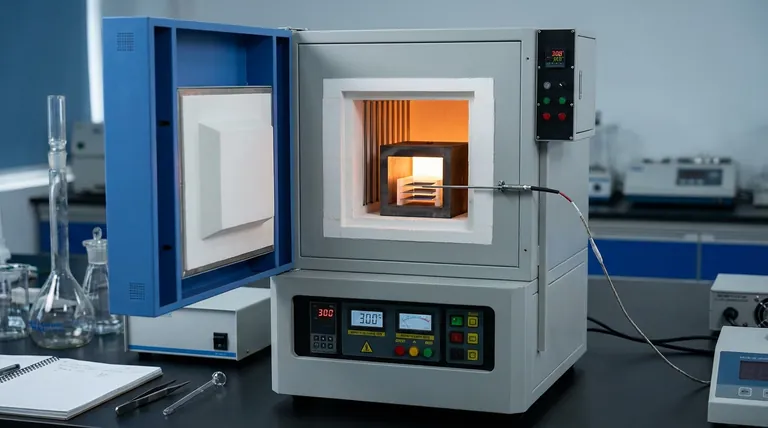
The system utilizes a thermocouple placed in direct physical contact with the graphite box.
This specific placement is crucial because it measures the temperature of the immediate environment surrounding the sample, rather than the general ambient temperature of the furnace.
This provides real-time feedback, allowing for immediate adjustments to maintain stability.
Isolating the Time Variable
To scientifically determine the "optimal" time, temperature must be eliminated as a variable.
The monitoring system locks the processing temperature at exactly 300 degrees Celsius.
This constant thermal baseline allows researchers to confidently test durations ranging from 20 to 50 minutes, knowing that time is the only changing factor.
Critical Outcomes for Film Quality
Defining the Optimal Bandgap
Through this controlled setup, the system helped identify 40 minutes as the critical inflection point for film performance.
At this specific duration, the Sb2S3 thin films achieve a bandgap of 1.69 eV.
Shorter or longer durations would yield suboptimal optical properties, which are detected only because the temperature was held constant.
Ensuring Stoichiometric Balance
Beyond optical properties, the chemical composition of the film relies on precise thermal exposure.
The monitoring system ensures the heat transfer is sufficient to achieve the desired chemical stoichiometry without overheating the sample.
This confirms that the 40-minute mark is not just effective for energy levels, but for the structural integrity of the material itself.
Understanding the Trade-offs
Proxy Measurement Limitations
It is important to note that the thermocouple measures the graphite box, not the thin film directly.
While this is effective for process control, it assumes perfect thermal equilibrium between the box and the sample.
Sensitivity to Contact Quality
The accuracy of this system is entirely dependent on the quality of the contact between the sensor and the box.
If the contact is loose or intermittent, the system may report a lower temperature than exists, leading to overheating of the actual sample.
Making the Right Choice for Your Experiment
To replicate these results or apply this methodology to your own thin film processing, consider your specific optimization goals.
- If your primary focus is Optical Performance: Target a 40-minute duration at a verified 300°C to achieve the ideal 1.69 eV bandgap.
- If your primary focus is Experimental Validity: Ensure your thermocouple has direct, unbroken contact with the sample holder to eliminate thermal drift as a variable.
Precise thermal monitoring is the only way to turn variable experimental data into definitive material science conclusions.
Summary Table:
| Parameter | Influence of Monitoring System | Impact on Sb2S3 Thin Film |
|---|---|---|
| Temperature | Maintains constant 300°C baseline | Eliminates thermal drift variables |
| Sulfurization Time | Validates 40-minute duration | Achieves optimal 1.69 eV bandgap |
| Chemical Composition | Prevents overheating | Ensures correct stoichiometric balance |
| Feedback Loop | Real-time direct contact monitoring | Guarantees thermal stability/equilibrium |
Elevate Your Thin Film Research with KINTEK
Precision is the difference between experimental failure and breakthrough. At KINTEK, we understand that high-performance materials like Sb2S3 require absolute thermal control. Backed by expert R&D and manufacturing, we provide high-precision Muffle, Tube, Rotary, Vacuum, and CVD systems, all fully customizable to your specific research requirements.
Whether you need to maintain a strict 300°C baseline or scale up your thin film production, our lab high-temp furnaces offer the stability and accuracy your science demands.
Contact KINTEK today to discuss your custom furnace needs and ensure your research is built on a foundation of precision.
References
- Sheyda Uc-Canché, Juan Luis Ruiz de la Peña. Influence of Sulfurization Time on Sb2S3 Synthesis Using a New Graphite Box Design. DOI: 10.3390/ma17071656
This article is also based on technical information from Kintek Furnace Knowledge Base .
Related Products
- Multi Heating Zones CVD Tube Furnace Machine for Chemical Vapor Deposition Equipment
- Multi Zone Laboratory Quartz Tube Furnace Tubular Furnace
- High Temperature Muffle Oven Furnace for Laboratory Debinding and Pre Sintering
- Vertical Laboratory Quartz Tube Furnace Tubular Furnace
- Split Multi Heating Zone Rotary Tube Furnace Rotating Tube Furnace
People Also Ask
- What is the function of a multi-zone tube furnace in CVD synthesis? Master 2D In2Se3 Nanosheet Precision
- Why are multi zone tube furnaces particularly useful for nanomaterial research? Unlock Precise Thermal Control for Advanced Synthesis
- What role do multi zone tube furnaces play in new energy research? Unlock Precise Thermal Control for Innovation
- What temperature-related capabilities make multi zone tube furnaces valuable for research? Unlock Precision Thermal Control
- What environmental protection applications utilize multi zone tube furnaces? Unlock Precision in Waste Treatment and Green Tech