
In essence, a box furnace is a highly versatile tool capable of performing a wide range of thermal processes on diverse materials. Its primary applications include annealing, brazing, calcining, ceramics firing, debinding, metal injection molding (MIM), heat treating, materials testing, sintering, and melting for everything from metals and alloys to glass and powdered materials.
The true value of a box furnace is its adaptability for batch processing a variety of materials and sample sizes in air or a controlled atmosphere. The critical decision is less about what process you need and more about the specific atmospheric control and temperature uniformity your application demands.
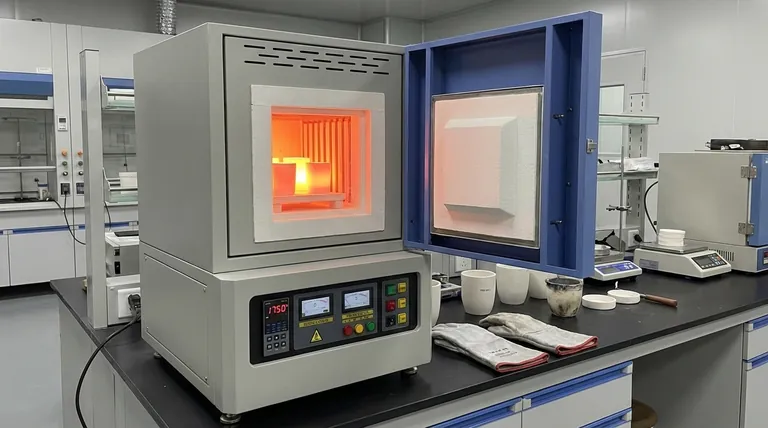
What Defines a Box Furnace?
A box furnace, also known as a muffle furnace, is defined by its core design: a chamber-like insulated cabinet with a front-loading door. This simple, robust design makes it a staple in both industrial production and laboratory research settings.
Core Characteristics
The key functional characteristics of a modern box furnace are its high-temperature capability, excellent temperature uniformity throughout the chamber, and convenient, user-friendly operation via digital controllers. These features allow for precise and repeatable thermal cycling.
Material Versatility
These furnaces are not limited to one type of material. They are designed to accommodate a broad spectrum of materials, including various metals, alloys, ceramics, and glass. This makes them a flexible asset for multi-purpose labs and production lines.
A Breakdown of Key Thermal Processes
The long list of potential processes can be grouped into a few key categories, each serving a distinct purpose in materials science and manufacturing.
Heat Treating Metals and Alloys
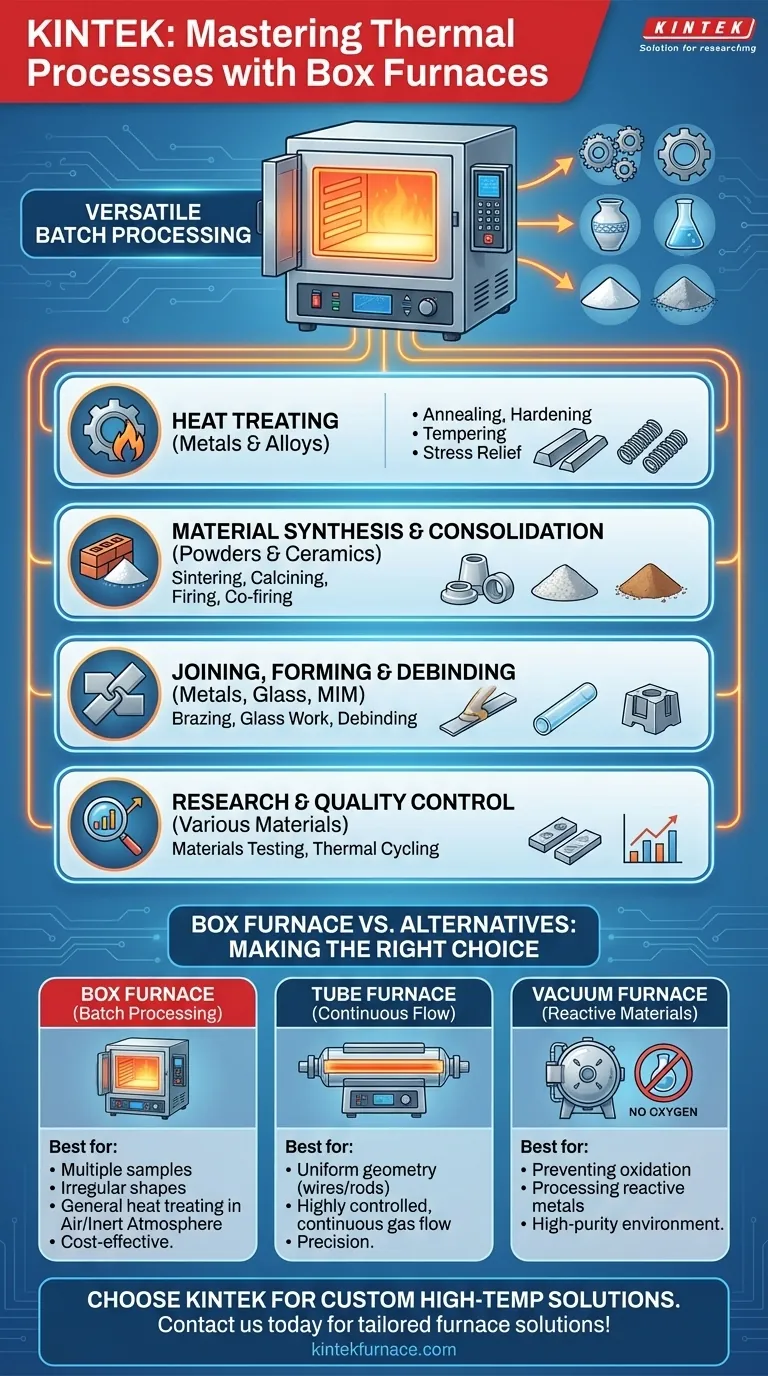
This is one of the most common uses for a box furnace. Processes like annealing (softening a material to improve ductility), hardening (increasing strength), tempering (reducing brittleness after hardening), and stress relief are all routinely performed to modify the mechanical properties of metals.
Material Synthesis and Consolidation
Box furnaces are fundamental for creating solid parts from powders or raw materials. Sintering fuses powdered materials into a solid mass below their melting point, while calcining involves high-heat thermal decomposition. This category also includes firing and co-firing ceramics to achieve their final, hardened state.
Joining, Forming, and Debinding
These processes involve changing the state or shape of a material. Brazing joins two pieces of metal using a filler metal, while various forms of glass work rely on the furnace's heat. For parts made via injection molding, debinding is a critical step to remove binder materials before final sintering.
Research and Quality Control
In a laboratory setting, box furnaces are indispensable for materials testing and research. They are used to perform controlled thermal cycling to test a material's response to temperature changes, helping scientists and engineers understand material behavior and durability.
Understanding the Trade-offs: Box vs. Other Furnaces
While versatile, a box furnace is not always the optimal tool. The choice depends entirely on your specific process requirements, particularly concerning atmosphere and sample geometry.
Box Furnace vs. Tube Furnace
A tube furnace excels at processing materials with a specific, uniform geometry (like wires or rods) or for applications requiring a continuous, controlled gas flow over the sample. A box furnace, by contrast, is designed for batch processing—handling multiple samples or larger, irregularly shaped parts at once. While many box furnaces offer a gas-sealed option for an inert atmosphere, a tube furnace often provides more precise atmospheric control for smaller samples.
Box Furnace vs. Vacuum Furnace
The critical difference here is the atmosphere. A standard or inert-atmosphere box furnace is perfect for most applications. However, if your process demands an environment with a complete absence of oxygen and other gases to prevent any possibility of oxidation or reaction, a vacuum furnace is non-negotiable. Processes like vacuum brazing, sintering of reactive metals, or specific hardening treatments must be done in a vacuum.
Making the Right Choice for Your Application
Selecting the correct furnace requires you to look beyond the process name and consider the specific conditions your material needs.
- If your primary focus is general-purpose heat treating, materials testing, or ceramics firing in air: A box furnace is almost always the most cost-effective and versatile solution.
- If your primary focus is processing small, uniform samples or require a highly controlled, continuous gas flow: A tube furnace is likely better suited for your application's geometry and atmospheric needs.
- If your primary focus is preventing any oxidation or processing highly reactive materials: A vacuum furnace is the only tool that can provide the necessary high-purity environment.
Understanding these core capabilities ensures you select the right tool for your specific thermal processing goal.
Summary Table:
| Process Category | Key Applications | Materials Used |
|---|---|---|
| Heat Treating | Annealing, hardening, tempering | Metals, alloys |
| Material Synthesis | Sintering, calcining, ceramics firing | Powders, ceramics |
| Joining & Forming | Brazing, glass work, debinding | Metals, glass, MIM parts |
| Research & QC | Materials testing, thermal cycling | Various materials |
Ready to enhance your thermal processing with a custom box furnace? At KINTEK, we leverage exceptional R&D and in-house manufacturing to provide advanced high-temperature furnace solutions. Our product line, including Muffle, Tube, Rotary Furnaces, Vacuum & Atmosphere Furnaces, and CVD/PECVD Systems, is complemented by strong deep customization capabilities to precisely meet your unique experimental needs. Whether you're in materials testing, metal heat treating, or ceramics firing, we can help you achieve superior results. Contact us today to discuss how our tailored solutions can benefit your lab or production line!
Visual Guide
Related Products
- Vacuum Hot Press Furnace Machine Heated Vacuum Press Tube Furnace
- Mesh Belt Controlled Atmosphere Furnace Inert Nitrogen Atmosphere Furnace
- Vacuum Heat Treat Sintering Furnace with Pressure for Vacuum Sintering
- 600T Vacuum Induction Hot Press Vacuum Heat Treat and Sintering Furnace
- Vacuum Hot Press Furnace Machine Heated Vacuum Press
People Also Ask
- Why use Vacuum Hot Press (VHP) for ZnS Ceramics? Achieve Superior IR Transparency and Mechanical Strength
- What safety features are incorporated in vacuum hot press furnaces? Ensure Operator and Equipment Protection
- What are the benefits of the vacuum environment system in a vacuum hot press furnace? Unlock High-Density Sintering
- Why is a high vacuum environment crucial when preparing copper-carbon nanotube composites in a vacuum hot press furnace? Achieve Superior Composite Integrity
- How does a vacuum hot press furnace promote densification in the manufacturing of graphite flake/copper composites? Achieve Superior Composite Materials



















