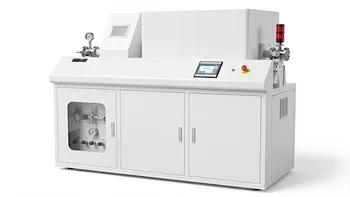
The role of tube furnace annealing in preparing photocatalytic grade titanium dioxide ($TiO_2$) is to precisely drive the phase transformation from amorphous material into the highly active anatase crystalline phase. By providing a controlled thermal environment—typically around 400°C under an inert atmosphere like Argon—the tube furnace ensures the material reaches a high anatase mass fraction while maintaining a small grain size and high specific surface area.
Core Takeaway: Tube furnace annealing is the critical step that converts inactive, amorphous $TiO_2$ into a high-performance photocatalyst by balancing crystalline purity, nanometer-scale grain control, and surface defect engineering.
Driving the Phase Transition to Anatase
Converting Amorphous Structures
As-synthesized or sputtered titanium dioxide is often amorphous and exhibits negligible photocatalytic activity. Tube furnace annealing provides the thermal energy required to rearrange lattice atoms into the anatase crystalline phase.
Achieving High Phase Purity
At temperatures of approximately 400°C, the process can achieve an anatase mass fraction of 97%. This phase is preferred for photocatalysis because it typically demonstrates higher activity than the rutile phase for organic degradation.
Optimizing Crystallinity
Controlled heating and holding cycles minimize structural disorder and reduce Urbach energy. This optimization of the crystal lattice enhances charge transport characteristics, which is vital for preventing the recombination of electron-hole pairs.
Morphological and Atmosphere Control
Regulating Grain Size
The tube furnace allows for precise control over the average grain size, typically maintaining it at approximately 15 nanometers. Keeping grains at the nanoscale ensures a high specific surface area, providing more active sites for chemical reactions.
Atmosphere-Dependent Surface Engineering
Unlike standard furnaces, a tube furnace allows for a stable Argon (Ar) protective atmosphere or a reducing environment. Using a pure hydrogen flow at higher temperatures (e.g., 600°C) can generate oxygen vacancies ($O_v$) and $Ti^{3+}$ centers.
Creating Active Sites for Co-catalysts
These induced structural defects serve as critical active sites for anchoring single atoms, such as platinum. This facilitates the formation of intermetallic single-atom alloys, which significantly boosts the catalytic efficiency of the $TiO_2$ base.
Improving Mechanical and Electrical Connectivity
Sintering and Particle Connection
Annealing at temperatures around 450°C promotes sintering connections between nano-$TiO_2$ particles. This creates a robust electrical contact network that reduces interfacial resistance and facilitates the flow of photo-generated electrons.
Enhancing Substrate Adhesion
Thermal treatment strengthens the mechanical adhesion between $TiO_2$ layers and conductive substrates like Fluorine-doped Tin Oxide (FTO). This is essential for the durability and longevity of photocatalytic thin films and electrodes.
Removal of Organic Impurities
High-temperature annealing effectively removes organic additives, such as polyethylene glycol, used during the initial synthesis or slurry preparation. Clearing these impurities ensures that the active surface of the $TiO_2$ is fully exposed to the target reactants.
Understanding the Trade-offs
Balancing Temperature and Surface Area
While higher temperatures improve crystallinity, they also trigger grain growth. If the temperature exceeds the optimal range, the specific surface area will decrease, potentially reducing the overall photocatalytic reaction rate despite better crystal quality.
Phase Stability Risks
Excessive heating can cause the anatase phase to transform into the rutile phase. While rutile is stable, it often possesses lower photocatalytic activity for specific applications, making precise temperature dwell-time control in the tube furnace mandatory.
Atmosphere Sensitivity
Small fluctuations in the gas flow or purity within the tube can lead to inconsistent surface defects. Incomplete reduction or unintended oxidation can alter the electronic properties of the semiconductor, leading to batches with varying performance levels.
How to Apply This to Your Project
Recommendations for Targeted Outcomes
- If your primary focus is maximum photocatalytic activity: Use an inert Argon atmosphere at 400°C to maximize anatase phase purity while keeping grain sizes near 15nm.
- If your primary focus is creating single-atom catalysts: Utilize a hydrogen-reducing atmosphere at 600°C to intentionally create oxygen vacancies for metal anchoring.
- If your primary focus is thin-film durability: Prioritize a sintering schedule at 450°C with a slow heating rate (1-2°C/min) to enhance adhesion to the substrate and minimize lattice defects.
Properly calibrated tube furnace annealing transforms raw titanium dioxide from a dormant powder into a highly efficient, structurally optimized photocatalytic engine.
Summary Table:
| Feature | Role in TiO2 Preparation | Key Outcome |
|---|---|---|
| Phase Transition | Converts amorphous TiO2 to anatase | High photocatalytic activity (97% anatase) |
| Grain Control | Limits grain growth to ~15nm | High specific surface area & more active sites |
| Atmosphere Control | Uses Argon or Hydrogen environments | Induces oxygen vacancies for co-catalyst anchoring |
| Thermal Precision | Controlled sintering & impurity removal | Enhanced substrate adhesion & electrical connectivity |
Elevate Your Photocatalysis Research with KINTEK Precision
Achieving the perfect anatase phase requires uncompromising thermal and atmospheric control. KINTEK specializes in advanced laboratory equipment, offering a comprehensive range of tube furnaces, vacuum furnaces, and atmosphere-controlled systems tailored for high-performance material synthesis.
Whether you are optimizing thin-film adhesion or engineering complex oxygen vacancies, our customizable high-temperature solutions provide the stability and precision your research demands.
Ready to transform your TiO2 synthesis results? Contact KINTEK today for a customized furnace solution!
References
- Beata Tryba, Rafał J. Wróbel. The Superiority of TiO2 Supported on Nickel Foam over Ni-Doped TiO2 in the Photothermal Decomposition of Acetaldehyde. DOI: 10.3390/ma16155241
This article is also based on technical information from Kintek Furnace Knowledge Base .
Related Products
- Controlled Inert Nitrogen Hydrogen Atmosphere Furnace
- 1200℃ Controlled Inert Nitrogen Atmosphere Furnace
- Vacuum Sealed Continuous Working Rotary Tube Furnace Rotating Tube Furnace
- Vertical Laboratory Quartz Tube Furnace Tubular Furnace
- 1400℃ High Temperature Laboratory Tube Furnace with Alumina Tube
People Also Ask
- How does hydrogen furnace annealing assist in preparing mechanically alloyed powders for compaction?
- How does atmospheric annealing in a controlled hydrogen furnace affect the cold compaction behavior of metal powders?
- What are the characteristics and uses of hydrogen atmosphere in furnaces? Achieve Superior Surface Purity and Bonding
- What are the characteristics and uses of hydrogen atmospheres in furnaces? Unlock Clean Metal Processing
- What controlled-atmosphere furnace conditions are required for sintering powder metallurgy copper alloy compacts? Ideal Setup