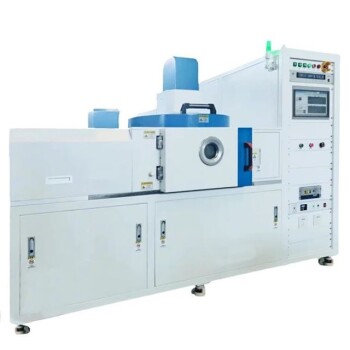
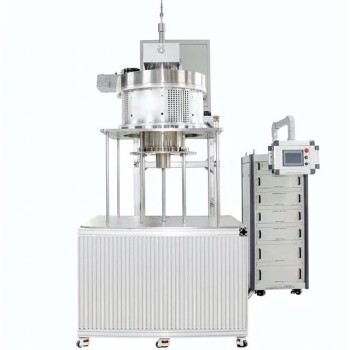
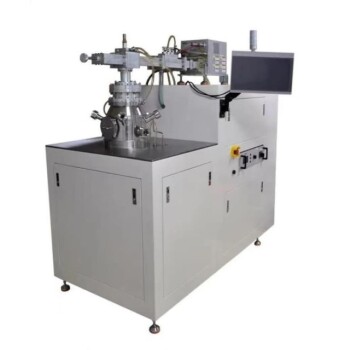
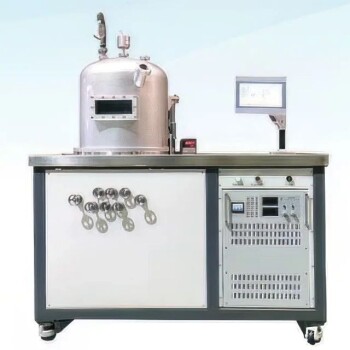
A Plasma Enhanced Chemical Vapor Deposition (PECVD) system is the primary mechanism for depositing porous carbon-doped silicon oxide (p-SiOCH) films with ultra-low dielectric constants. By utilizing plasma energy to excite diethoxymethylsilane (DEMS) and porogen precursors at relatively low temperatures, the system enables the in-situ formation of nanoporous structures directly onto silicon substrates. This technology is critical for precisely tuning film porosity and achieving specific dielectric properties, such as a dielectric constant ($k$) near 2.560.
The core role of a PECVD system in p-SiOCH preparation is to provide a low-temperature, highly controllable environment where plasma energy drives the chemical reaction of precursors to create complex nanoporous thin films. This allows for the engineering of "ultra-low-$k$" materials essential for modern microelectronics.
The Mechanics of Plasma-Driven Deposition
Low-Temperature Chemical Activation
Unlike traditional CVD, which relies on high thermal energy, a PECVD system uses high-frequency electric fields to create a plasma state.
This excitation allows chemical reactions to occur at significantly lower substrate temperatures, typically around 400 °C.
Maintaining low temperatures is vital for protecting the underlying layers of the silicon substrate and ensuring the amorphous structure of the thin film remains intact.
Precursor Excitation and Co-Deposition
The system processes specific chemical precursors, primarily diethoxymethylsilane (DEMS) and porogen materials.
The plasma energy decomposes these gases, facilitating the in-situ deposition of carbon-doped silicon oxide.
The porogen acts as a temporary place-holder within the film matrix, which is later removed to leave behind the nanoporous structures that define p-SiOCH.
Precision Control of Film Properties
Adjusting Porosity and Dielectric Constants
The primary advantage of using PECVD is the ability to fine-tune the film's physical characteristics through plasma discharge parameters.
By modulating radio frequency (RF) power and gas flow rates, engineers can precisely control the volume and distribution of pores within the film.
This level of control is what allows the fabrication of films with ultra-low dielectric constants (approximately 2.560), which are necessary to reduce parasitic capacitance in high-speed circuits.
Uniformity and Structural Integrity
PECVD provides high-throughput production capabilities while maintaining a high degree of film uniformity across large-area substrates.
The system ensures that the phosphorus or other dopants are distributed evenly, which is essential for consistent electrical performance.
Furthermore, the technology allows for the management of internal stress within the layer, a feature often used to prevent film cracking or to enable self-rolling micro-structures.
Understanding the Trade-offs
Mechanical Strength vs. Dielectric Performance
A significant challenge in preparing p-SiOCH films is the inverse relationship between porosity and mechanical strength.
As the PECVD system increases porosity to lower the dielectric constant, the film typically becomes more fragile and susceptible to damage during subsequent manufacturing steps.
Engineers must balance the RF power settings to maximize "low-$k$" performance without compromising the structural integrity required for chemical mechanical polishing (CMP).
Process Complexity and Contamination
The use of porogen precursors introduces additional complexity into the deposition environment.
Residual porogen or incomplete plasma decomposition can lead to unwanted carbon contamination, which may negatively impact the film's leakage current and reliability.
Precise calibration of the gas flow rates is required to ensure that the chemical composition remains stable and reproducible.
Making the Right Choice for Your Goal
When configuring a PECVD system for p-SiOCH preparation, your specific project requirements will dictate the optimal parameters.
- If your primary focus is achieving the lowest possible dielectric constant: Prioritize high porogen flow rates and optimized RF power to maximize the volume of nanopores within the SiOCH matrix.
- If your primary focus is mechanical durability for multi-layer integration: Optimize the plasma energy to create a more robust silicon-oxide backbone, even if it results in a slightly higher $k$ value.
- If your primary focus is high-throughput microelectronic fabrication: Utilize the PECVD’s ability for rapid in-situ doping and uniform large-area deposition to maintain consistency across batches.
The PECVD system remains the definitive tool for p-SiOCH preparation, offering the unique ability to engineer material density at the molecular level through precise plasma control.
Summary Table:
| Feature | Role in p-SiOCH Preparation |
|---|---|
| Plasma Energy | Drives chemical reactions at low temperatures (~400 °C) to protect substrates. |
| Precursor Utilization | Efficiently decomposes DEMS and porogens for in-situ nanoporous structures. |
| RF Power Control | Allows fine-tuning of film porosity and dielectric constants (k ≈ 2.560). |
| Uniformity | Ensures consistent electrical performance and phosphorus distribution across large areas. |
Transform Your Material Science with KINTEK Precision
Achieving the perfect balance between porosity and mechanical strength in p-SiOCH films requires world-class equipment. KINTEK specializes in advanced laboratory solutions, offering a comprehensive range of PECVD and CVD systems, alongside customizable high-temperature furnaces (muffle, tube, vacuum, and atmosphere) tailored to your specific research needs.
Our technology empowers you to engineer ultra-low-k materials with unparalleled uniformity and control. Contact our experts today to find the ideal high-temp solution for your laboratory!
References
- Yi-Lung Cheng, Jau-Shiung Fang. Electrical Characteristics and Reliability of Nitrogen-Stuffed Porous Low-k SiOCH/Mn2O3−xN/Cu Integration. DOI: 10.3390/molecules24213882
This article is also based on technical information from Kintek Furnace Knowledge Base .
Related Products
- RF PECVD System Radio Frequency Plasma Enhanced Chemical Vapor Deposition
- Slide PECVD Tube Furnace with Liquid Gasifier PECVD Machine
- Inclined Rotary Plasma Enhanced Chemical Deposition PECVD Tube Furnace Machine
- Inclined Rotary Plasma Enhanced Chemical Deposition PECVD Tube Furnace Machine
- 915MHz MPCVD Diamond Machine Microwave Plasma Chemical Vapor Deposition System Reactor
People Also Ask
- What is RF in PECVD? A Critical Control for Plasma Deposition
- What is the role of RF power in PECVD and how does the RF-PECVD process work? Master Thin Film Deposition Control
- What are the applications of plasma enhanced chemical vapor deposition? Key Uses in Electronics, Optics & Materials
- What are the key advantages of PECVD technology? Achieve Low-Temperature, High-Quality Thin Film Deposition
- How are deposition rates and film properties controlled in PECVD? Master Key Parameters for Optimal Thin Films