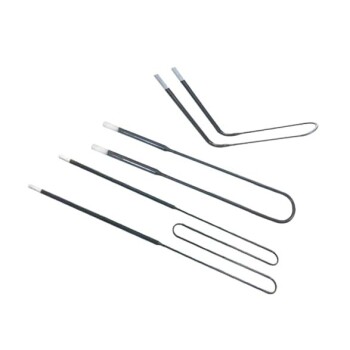
At their core, molybdenum disilicide (MoSi2) heating elements are indispensable in industries that demand exceptionally high and stable process temperatures. The most prominent users are the glass industry, manufacturers of advanced ceramics, high-temperature metallurgy and heat treatment facilities, and semiconductor fabrication plants.
While many sectors use electric heat, molybdenum disilicide elements are specifically chosen for mission-critical applications demanding extreme operating temperatures, often up to 1800°C (3272°F), combined with long-term stability in oxidizing atmospheres.
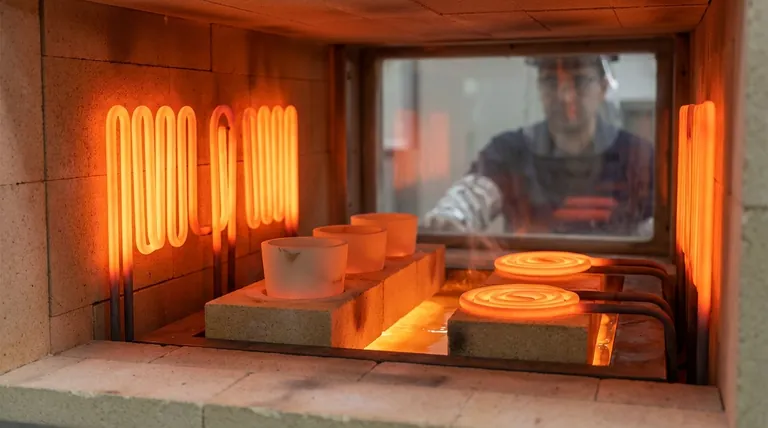
Why MoSi2 Excels in Extreme Environments
The selection of a heating element is dictated by its material properties. MoSi2 is not a universal solution; it is a specialist material engineered for the most demanding thermal processes.
Unmatched High-Temperature Capability
MoSi2 elements can operate reliably in air at furnace temperatures up to 1800°C.
This is significantly higher than most metallic heating elements and even surpasses the typical limits of other common ceramic elements like Silicon Carbide (SiC).
Self-Healing Oxidation Resistance
When heated in an oxidizing atmosphere, MoSi2 forms a thin, non-conductive, and protective layer of quartz glass (SiO2) on its surface.
This passive layer prevents further oxidation of the underlying material, giving the element a remarkably long service life even with repeated cycling to high temperatures.
Process Stability and Efficiency
These elements offer excellent thermal stability, ensuring uniform and repeatable heating, which is critical for product quality in industries like semiconductor manufacturing.
They also have a high power density, allowing for rapid furnace heating rates that can significantly shorten process cycles and improve throughput.
Key Industrial Applications in Detail
The unique properties of MoSi2 make it the go-to solution for specific, high-value industrial processes.
The Glass Industry
Manufacturing glass requires melting raw materials and holding the molten bath at sustained, uniform temperatures, often exceeding 1500°C. MoSi2 elements provide the necessary heat and longevity for these furnaces.
Ceramics and Sintering
Firing advanced technical ceramics, dental zirconia, and sintering powdered metals requires precise temperature control at very high levels. MoSi2 ensures these materials reach the required density and structural integrity.
Metallurgy and Heat Treatment
Industries use high-temperature furnaces for processes like annealing, brazing, and hardening specialized alloys. MoSi2 elements provide the clean, high-heat environment required for these metallurgical transformations.
Semiconductor and Electronics Manufacturing
Diffusion furnaces, which are essential for creating silicon wafers, rely on an ultra-clean, stable, and high-temperature environment. MoSi2 elements meet these stringent requirements without introducing contaminants.
Understanding the Trade-offs and Limitations
No material is without its challenges. Understanding the limitations of MoSi2 is critical for its successful implementation.
Brittleness at Low Temperatures
MoSi2 is a ceramic-metallic composite and is extremely brittle at room temperature. It must be handled with great care during installation and maintenance to avoid fracture from mechanical shock.
Susceptibility to "Pesting"
In a specific low-temperature range (approximately 400°C to 700°C), MoSi2 can be vulnerable to accelerated oxidation, a phenomenon known as "pesting." Furnaces must be designed to move through this temperature range quickly during both heat-up and cool-down.
Higher Initial Cost
Compared to more common metallic elements (like Kanthal) or even Silicon Carbide, MoSi2 heating elements and their associated power control systems represent a higher initial investment. This cost is justified by their unique performance at extreme temperatures.
Making the Right Choice for Your Goal
Selecting a heating element requires matching the material to the specific thermal and atmospheric demands of your process.
- If your primary focus is extreme temperatures above 1600°C: MoSi2 is often the only reliable and long-lasting choice for operating in an air atmosphere.
- If your process operates between 1200°C and 1600°C: You must carefully compare MoSi2 with Silicon Carbide (SiC) elements, as factors like cost, atmosphere, and thermal cycling will influence the best option.
- If your temperatures are below 1200°C and your main concern is cost: Traditional metallic resistance elements are typically more economical and mechanically robust.
Ultimately, choosing molybdenum disilicide is a decision driven by the uncompromising need for high, stable, and clean process heat.
Summary Table:
| Property | MoSi2 Heating Elements |
|---|---|
| Max Operating Temperature | Up to 1800°C in air |
| Key Industries | Glass, Ceramics, Metallurgy, Semiconductors |
| Advantages | High-temperature stability, self-healing oxidation resistance, uniform heating |
| Limitations | Brittle at low temperatures, susceptible to pesting, higher initial cost |
Upgrade your laboratory with KINTEK's advanced high-temperature furnace solutions! Leveraging exceptional R&D and in-house manufacturing, we provide diverse labs with reliable heating systems tailored to your needs. Our product line includes Muffle, Tube, Rotary Furnaces, Vacuum & Atmosphere Furnaces, and CVD/PECVD Systems, all backed by strong deep customization to meet unique experimental requirements. Contact us today to enhance your process efficiency and achieve superior results with our expert solutions!
Visual Guide

Related Products
- Molybdenum Disilicide MoSi2 Thermal Heating Elements for Electric Furnace
- Silicon Carbide SiC Thermal Heating Elements for Electric Furnace
- Molybdenum Vacuum Heat Treat Furnace
- Vacuum Heat Treat Sintering Furnace Molybdenum Wire Vacuum Sintering Furnace
- 1400℃ Muffle Oven Furnace for Laboratory
People Also Ask
- What are the typical application temperatures for molybdenum disilicide (MoSi2) heating elements? Master High-Temp Performance
- What is the primary use of molybdenum disilicide? Ideal for High-Temp Heating Elements
- What are the characteristics of molybdenum disilicide heating elements? Unlock High-Temp Performance
- What are the properties of molybdenum disilicide (MoSi2) that make it suitable for high-temperature applications? Discover Its High-Temp Resilience
- What are the applications of molybdenum disilicide heating elements? Achieve Extreme Heat Stability for Industrial Processes