
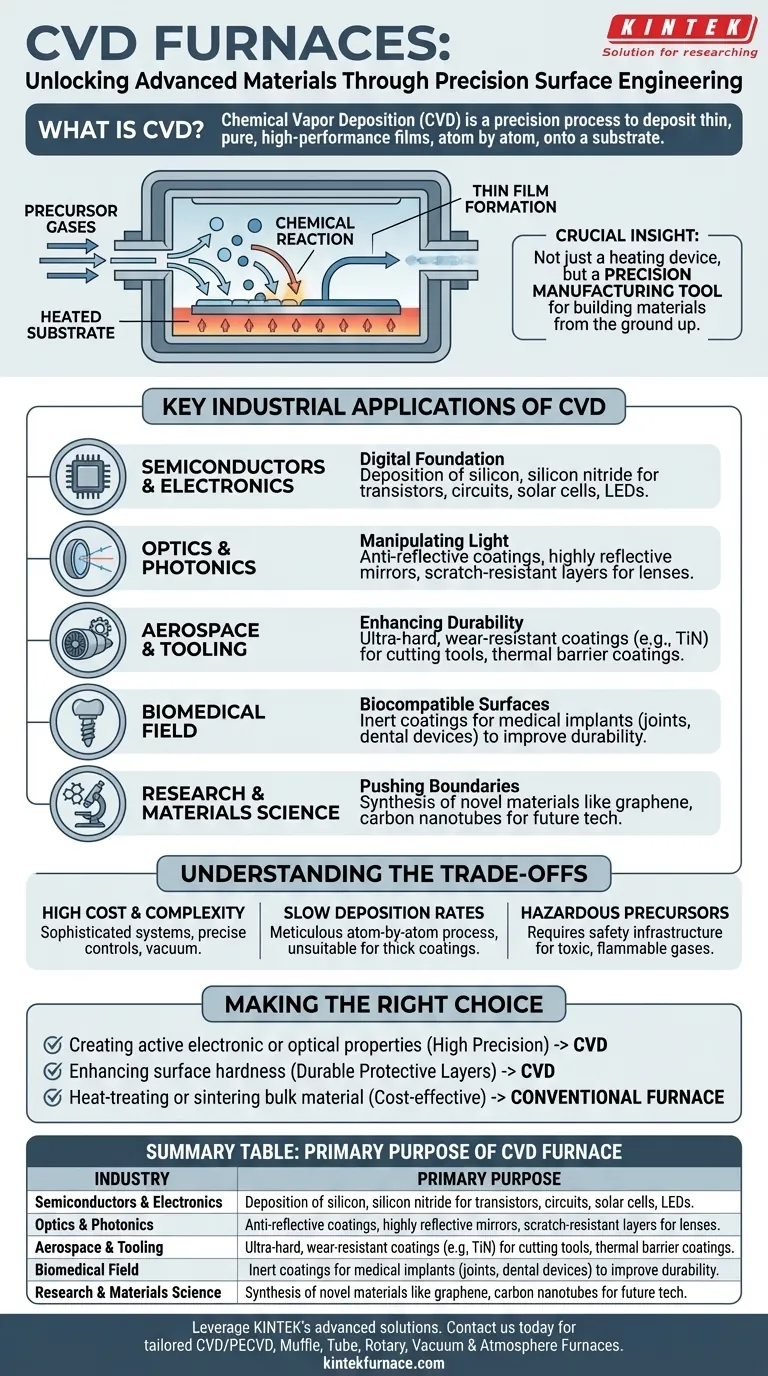
In short, Chemical Vapor Deposition (CVD) furnaces are primarily used in the semiconductor, optics, and aerospace industries. Their purpose is to deposit exceptionally thin, pure, and high-performance films of material onto a substrate, atom by atom, to create components with specific electronic, optical, or mechanical properties.
The crucial insight is that a CVD furnace is not just a heating device; it's a precision manufacturing tool. Industries turn to CVD when they need to build a material with a specific function from the ground up, creating coatings that are often impossible to produce by any other method.

The Core Principle: Why CVD is Different
A standard furnace simply heats a material to change its properties, such as for annealing or sintering. A CVD furnace, however, is a key part of a system that performs a more complex task: building a new, solid material directly onto a surface.
How Chemical Vapor Deposition Works
The process involves introducing reactive precursor gases into a heated chamber (the furnace). When these gases come into contact with the hot surface of a substrate, a chemical reaction occurs. This reaction causes a solid material to "deposit" or grow on the substrate, forming an extremely thin and uniform film.
Control at the Atomic Level
This method allows for incredible control over the film's thickness, purity, and structure. It is this atomic-level precision that makes CVD indispensable for creating high-technology components where material properties are paramount.
Key Industrial Applications of CVD
The ability to engineer surfaces with specific functions makes CVD technology a cornerstone of several advanced industries.
Semiconductors and Electronics: The Digital Foundation
This is the largest and most critical application. CVD is used to deposit the foundational layers of silicon, silicon nitride, and other materials that form transistors and circuits on a silicon wafer. It is also essential for producing thin films for solar cells (photovoltaics) and LEDs. Without CVD, modern microchips would not exist.
Optics and Photonics: Manipulating Light
Precise control over thickness and refractive index is vital in optics. CVD is used to apply anti-reflective coatings on lenses for cameras and eyeglasses, create highly reflective mirrors for lasers, and produce protective, scratch-resistant coatings for optical components.
Aerospace and Tooling: Enhancing Durability
In aerospace and high-performance automotive applications, components are subjected to extreme temperatures and wear. CVD is used to deposit ultra-hard, wear-resistant coatings (like titanium nitride) on cutting tools, drill bits, and engine components, drastically increasing their lifespan and performance. It's also used to create thermal barrier coatings that protect turbine blades from intense heat.
Biomedical Field: Creating Biocompatible Surfaces
Medical implants, such as artificial joints or dental implants, must be accepted by the body without causing a negative reaction. CVD is used to apply inert, biocompatible coatings (like pyrolytic carbon) that improve durability and reduce the risk of rejection or wear inside the body.
Research and Materials Science: Pushing Boundaries
In laboratories, CVD furnaces are workhorses for developing the next generation of materials. Researchers use them to synthesize novel materials like graphene, carbon nanotubes, and other two-dimensional substances, exploring properties that could lead to future technological breakthroughs.
Understanding the Trade-offs
While powerful, CVD is a specialized process chosen for specific reasons. It is not a universal solution for all coating or heating needs.
High Cost and Complexity
CVD systems are expensive to build and operate. They require sophisticated vacuum systems, precise gas flow controllers, and careful management of high temperatures, making them more complex than standard industrial furnaces.
Slow Deposition Rates
Building a film atom by atom is a meticulous and often slow process. For applications requiring thick coatings on large parts, other methods like thermal spraying may be more practical and cost-effective.
Hazardous Precursor Materials
The gases used in CVD can be highly toxic, flammable, or corrosive. This necessitates significant safety infrastructure and specialized handling protocols, adding to the operational overhead.
Making the Right Choice for Your Goal
Selecting the right thermal process depends entirely on the desired outcome for your material.
- If your primary focus is creating active electronic or optical properties: CVD is often the only viable choice due to its precision in controlling film purity and thickness.
- If your primary focus is enhancing the surface hardness of a critical component: CVD is a leading option for creating thin, durable, and high-performance protective layers.
- If your primary focus is simply heat-treating or sintering a bulk material: A more conventional vacuum, retort, or tube furnace without the complex gas delivery systems is a more direct and cost-effective solution.
Ultimately, choosing CVD is a decision to engineer a material's surface for a specific, high-value function.
Summary Table:
| Industry | Primary Purpose of CVD Furnace |
|---|---|
| Semiconductors and Electronics | Deposit thin films for transistors, circuits, solar cells, and LEDs |
| Optics and Photonics | Apply anti-reflective, reflective, and protective coatings on lenses and mirrors |
| Aerospace and Tooling | Create wear-resistant and thermal barrier coatings for tools and engine parts |
| Biomedical Field | Apply biocompatible coatings on implants like joints and dental devices |
| Research and Materials Science | Synthesize novel materials such as graphene and carbon nanotubes |
Leverage KINTEK's exceptional R&D and in-house manufacturing for advanced high-temperature furnace solutions. Our diverse product line, including CVD/PECVD Systems, Muffle, Tube, Rotary, Vacuum & Atmosphere Furnaces, is backed by strong deep customization to precisely meet your unique experimental needs. Contact us today to enhance your lab's capabilities with tailored solutions! Get in touch now
Visual Guide
Related Products
- Custom Made Versatile CVD Tube Furnace Chemical Vapor Deposition CVD Equipment Machine
- Split Chamber CVD Tube Furnace with Vacuum Station CVD Machine
- Multi Heating Zones CVD Tube Furnace Machine for Chemical Vapor Deposition Equipment
- Slide PECVD Tube Furnace with Liquid Gasifier PECVD Machine
- Inclined Rotary Plasma Enhanced Chemical Deposition PECVD Tube Furnace Machine
People Also Ask
- Why are CVD tube furnace sintering systems indispensable for 2D material research and production? Unlock Atomic-Scale Precision
- What is a CVD tube furnace and what is its primary function? Discover Precision Thin-Film Deposition
- Which industries and research fields benefit from CVD tube furnace sintering systems for 2D materials? Unlock Next-Gen Tech Innovations
- How does CVD tube furnace sintering enhance graphene growth? Achieve Superior Crystallinity and High Electron Mobility
- What is the working principle of a CVD tube furnace? Achieve Precise Thin Film Deposition for Your Lab



















