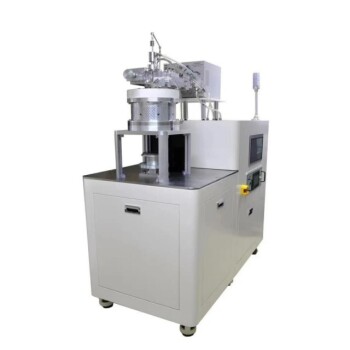
Chemical Vapor Deposition (CVD) provides a critical technical edge by enabling uniform, high-purity aluminide coatings on complex geometries. Unlike traditional line-of-sight or pack-based methods, CVD utilizes gas-phase reactions to penetrate deep into the intricate internal cooling channels and small holes of turbine blades. This ensures comprehensive protection against high-temperature oxidation and thermal corrosion across the component's entire surface area.
CVD equipment solves the fundamental challenge of protecting modern turbine blades by offering "superior throwing power" that coats internal cavities and external surfaces simultaneously. This process delivers a level of precision, purity, and adhesion that traditional methods cannot match, directly extending the service life of high-performance engine components.
Unmatched Coverage of Complex Geometries
The Advantage of Non-Line-of-Sight Deposition
Traditional methods like Physical Vapor Deposition (PVD) are largely "line-of-sight" processes, meaning they only coat what the source can "see."
CVD equipment overcomes this by using gas-phase chemical reactions that surround the entire substrate. This allows the coating to wrap around complex shapes and contoured surfaces with ease.
Protecting Internal Cooling Channels
Modern turbine blades rely on intricate internal channels to manage extreme heat during operation.
CVD's superior throwing power allows precursor gases to flow into these small cooling holes and deep cavities. This achieves simultaneous protection for both internal and external surfaces, a feat that is nearly impossible for pack cementation or PVD.
Precision Control and Coating Integrity
Atomic-Level Uniformity and Composition
CVD allows for precise control over the reaction atmosphere, temperature, and gas flow rates.
By adjusting the flow and activity of precursor gases, technicians can tailor the thickness and chemical composition of the aluminide layer. This results in a dense, uniform film that grows through molecular-level nucleation.
High Purity and Enhanced Adhesion
The gas-phase nature of CVD minimizes the risk of introducing solid impurities often found in pack cementation mixtures.
The resulting coatings are high-purity and defect-free, which is essential for high-performance materials in harsh environments. Furthermore, the high-temperature nature of the process facilitates strong metallurgical adhesion, ensuring the coating does not delaminate under thermal stress.
Understanding the Trade-offs
Precursor Management and Safety
CVD processes often involve the use of precursor gases that can be toxic, corrosive, or flammable.
This requires sophisticated gas delivery and scrubbing systems to ensure environmental safety and operator protection. These requirements can increase the complexity of the initial facility setup compared to simpler coating methods.
Thermal Considerations for Substrates
While CVD provides excellent adhesion, the process typically requires elevated temperatures to trigger the necessary chemical reactions.
Engineers must carefully monitor these temperatures to ensure they do not negatively alter the mechanical properties of the underlying turbine blade alloy. While some "low-temperature" CVD options exist, balancing deposition rates with substrate integrity remains a key technical challenge.
Making the Right Choice for Your Goal
Selecting the optimal coating method depends on the specific geometry of your turbine blades and the severity of their operating environment.
- If your primary focus is internal cooling efficiency: Use CVD equipment to ensure uniform protection within deep cavities and small cooling holes where other methods fail.
- If your primary focus is coating purity and adhesion: Leverage CVD’s controlled gas-phase reactions to achieve dense, contaminant-free layers that resist oxidation at extreme temperatures.
- If your primary focus is industrial scalability: Implement CVD for its ability to provide stable, repeatable quality across large-area substrates and mass-produced batches.
By moving beyond the limitations of traditional line-of-sight methods, CVD equipment provides the comprehensive protection necessary for the next generation of high-temperature gas turbine technology.
Summary Table:
| Feature | CVD Equipment | Traditional Methods (PVD/Pack) |
|---|---|---|
| Deposition Type | Non-line-of-sight (Gas-phase) | Line-of-sight or Solid-contact |
| Internal Channels | Full coverage of cooling holes | Poor or impossible coverage |
| Purity Level | High (controlled gas precursors) | Variable (potential solid impurities) |
| Adhesion | Strong metallurgical bonding | Variable; risk of delamination |
| Control | Atomic-level thickness precision | Limited thickness uniformity |
Optimize Your Coating Precision with KINTEK
Take your material performance to the next level with KINTEK’s advanced CVD and high-temperature furnace solutions. As specialists in laboratory equipment and consumables, we provide a comprehensive range of customizable thermal processing systems—including CVD, vacuum, atmosphere, and rotary furnaces—tailored to meet the rigorous demands of gas turbine and aerospace applications.
Whether you are protecting complex geometries or require atomic-level coating uniformity, KINTEK delivers the reliability and technical edge your research or production requires. Contact our experts today to discuss your unique project needs and see how our customizable laboratory solutions can enhance your efficiency and component lifespan.
References
- Ahlam Hamid Jasim, Nabaa Sattar Radhi. Review on Improvement the Turbine Oxidation and Hot Resistant against Corrosion by Nickel–Based Superalloy. DOI: 10.52209/2706-977x_2024_4_89
This article is also based on technical information from Kintek Furnace Knowledge Base .
Related Products
- Custom Made Versatile CVD Tube Furnace Chemical Vapor Deposition CVD Equipment Machine
- HFCVD Machine System Equipment for Drawing Die Nano Diamond Coating
- 915MHz MPCVD Diamond Machine Microwave Plasma Chemical Vapor Deposition System Reactor
- Multi Heating Zones CVD Tube Furnace Machine for Chemical Vapor Deposition Equipment
- Slide PECVD Tube Furnace with Liquid Gasifier PECVD Machine
People Also Ask
- Why are CVD tube furnace sintering systems indispensable for 2D material research and production? Unlock Atomic-Scale Precision
- What is a CVD tube furnace and what is its primary function? Discover Precision Thin-Film Deposition
- How does CVD tube furnace sintering enhance graphene growth? Achieve Superior Crystallinity and High Electron Mobility
- Which industries and research fields benefit from CVD tube furnace sintering systems for 2D materials? Unlock Next-Gen Tech Innovations
- What are the key features of CVD tube furnaces for 2D material processing? Unlock Precision Synthesis for Superior Materials