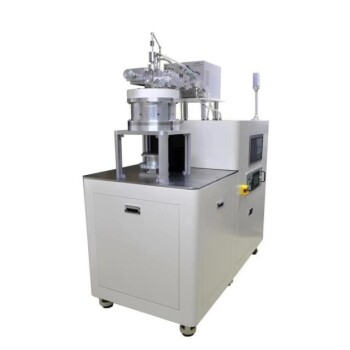
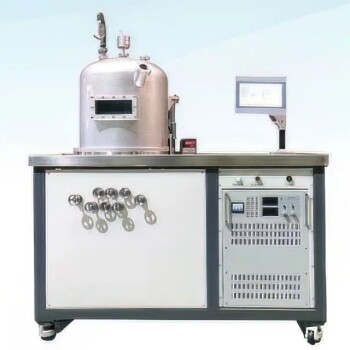
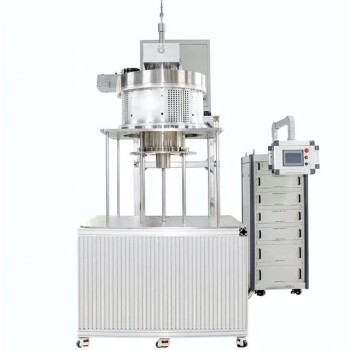
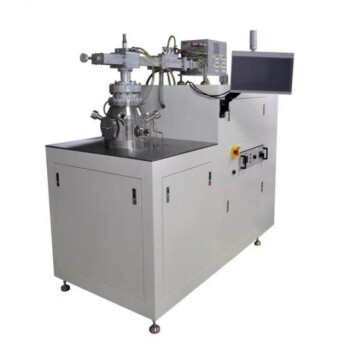
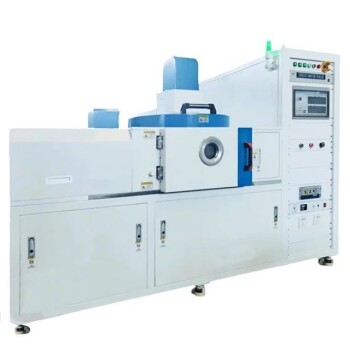
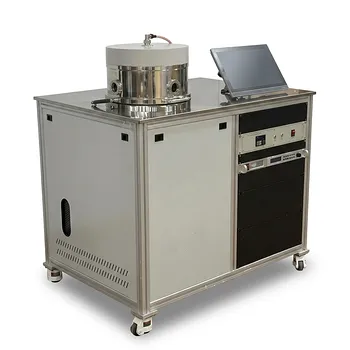
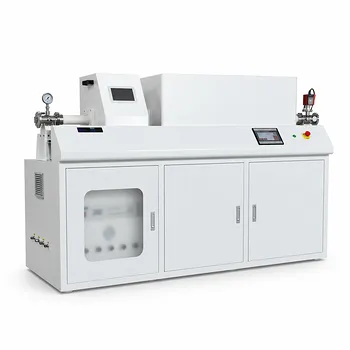
Thin-film doping through chemical vapor deposition is the cornerstone of modern high-temperature alloy surface engineering. Specifically, SB-MOCVD (Spouted Bed Metal-Organic Chemical Vapor Deposition) equipment is used to coat each particle of a pre-alloyed powder—like MCrAlY—with a uniform, nanometric layer of a performance-boosting element such as Ruthenium or Rhenium. The process takes place in a temperature-controlled reactor where an organometallic precursor gas decomposes, depositing the dopant directly onto the fluidized particle surfaces. This yields a homogeneous ~50 nm film that fundamentally upgrades the powder’s oxidation and creep resistance without the brittleness or cost of bulk alloying.
The core takeaway: CVD-based surface doping decouples a particle’s mechanical and surface properties. It gives engineers a precise, cost-effective lever to tailor the protective performance of thermal barrier coatings—especially in jet engine turbine blades—by applying a thin, uniform metallic “skin” of only a few nanometers.
Why Surface Doping Matters for Protective Coatings
The problem is not the bulk of the alloy powder; it’s the outermost atomic layers where exposure to oxygen and extreme heat begins. By engineering only that surface, you can dramatically improve how the entire particle behaves inside a thermal barrier coating.
The Limitation of Bulk Alloying
Adding expensive elements like Re or Ru throughout the entire volume of a powder is slow and wasteful. It also risks altering the ductility or thermal expansion coefficient in unwanted ways. Traditional mechanical mixing cannot guarantee uniform distribution at the individual particle level, leaving weak spots.
Performance Directed at the Surface
Oxidation resistance and high‑temperature creep strength are fundamentally governed by surface phenomena. A 50 nm dopant layer acts as a diffusion barrier, stabilizing the protective oxide scale. This targeted approach channels the expensive element exactly where it is needed, maximizing its impact per gram.
The Role of Thermal Barrier Coatings
In aeronautic applications, turbine blades rely on MCrAlY bond coats to anchor a ceramic top coat. Doping those bond coat powders with Ru or Re via CVD makes the entire system more resilient against spallation and hot corrosion—lengthening the time between overhauls in engines operating above 1000 °C.
How the SB-MOCVD Process Works
SB-MOCVD is not a simple dipping. It is a dynamic gas‑phase reaction inside a fluidized bed that turns every particle into its own microscopic substrate.
The Spouted Bed Reactor: Fluidizing Alloy Powders
The equipment uses a spouted bed design. A stream of inert carrier gas enters from the bottom, suspending the pre-alloyed powder in a controlled fountain‑like motion. This constant movement ensures that every single particle presents its entire surface to the gas phase, eliminating dead zones and enabling truly uniform coating.
Metal-Organic Precursor Chemistry
The dopant source is not a solid block but a volatile organometallic compound—for example, a Ruthenium carbonyl or Rhenium-containing precursor. This precursor is introduced into the reactor, often diluted with argon or nitrogen. Inside the heated zone, the molecule decomposes, freeing the metallic atoms.
Temperature-Controlled Deposition Kinetics
The reactor is held at a precise temperature—typically between 300 °C and 600 °C depending on the precursor. This thermal energy drives the chemical reaction without melting the base alloy powder. The decomposed metal atoms adsorb onto the particle surface and nucleate into a continuous, dense film roughly 50 nm thick. The thickness is controlled simply by adjusting deposition time and precursor flow rate.
An Economical Path to Performance
By operating on the powder stage—before any compaction or spraying—the SB-MOCVD process integrates directly into existing coating manufacturing chains. It replaces the need for pre-alloyed, high‑cost master alloys or secondary mechanical blending, which often result in inconsistent dopant distribution.
Understanding the Trade-offs
While SB-MOCVD offers unmatched uniformity and material efficiency, it is not without practical considerations. Ignoring these can lead to processing failures or inflated costs.
Precursor Cost and Handling
High‑purity organometallic precursors, especially for Ru and Re, are expensive and can be air‑ or moisture-sensitive. The handling infrastructure must be leak‑tight, and unreacted precursor must be safely scrubbed. This adds capital expenditure but is offset by the minimal amount of material actually consumed.
Batch Processing vs. Continuous Operation
Most spouted bed reactors operate in batch mode. Scaling up means either building larger reactors or running multiple shifts. The uniform fluidization of fine, cohesive alloy powders can also be a challenge—agglomerates must be prevented to maintain consistent coating quality.
Thickness Uniformity Limits
Achieving exactly 50 nm on every particle is possible, but only with strict control of gas flow dynamics. Any recirculation area or channelling inside the bed can lead to local over‑coating or uncoated patches, which would defeat the purpose of the surface layer.
Thermal Constraints on the Base Powder
The deposition temperature must stay below the sintering or phase‑transformation point of the alloy powder. If the powder begins to partially sinter in the bed, it loses its flowability and the coating becomes non‑uniform. This puts a ceiling on how quickly you can deposit certain elements.
Making the Right Choice for Your Goal
Surface doping via SB-MOCVD is a powerful tool, but the decision to use it should be driven by your specific performance and cost targets. Consider the following before selecting your route.
- If your primary focus is maximizing high‑temperature oxidation resistance: Use an SB-MOCVD process with a Ruthenium precursor to apply a ~50 nm layer on MCrAlY. The Ru-rich skin stabilizes alumina scale growth, far outperforming uncoated or mechanically mixed powders.
- If your primary focus is boosting creep strength in bond coats: Select a Rhenium‑based precursor. A uniform Re layer at the particle surface retards diffusion and resists creep deformation in the service-relevant temperature window.
- If your focus is process simplicity and throughput: Evaluate whether your part geometry and service environment can tolerate a less uniform but lower‑cost mechanical doping method. If the application demands absolute reliability—like in aircraft turbine blades—the uniformity of CVD remains the gold standard.
- If your focus is multi‑element doping: The SB-MOCVD equipment can be staged. You can run two sequential processes (e.g., Ru followed by Re) to build a layered nanometric stack, enabling a designed surface composition impossible through melt alloying.
The precise, layer‑by‑layer control of surface doping through CVD ultimately gives you the power to transform a commodity alloy powder into a high‑performance coating material—without rewriting the alloy’s core properties.
Summary Table:
| Process Aspect | SB-MOCVD Specification | Coating Performance Impact |
|---|---|---|
| Reactor Type | Spouted Bed (Fluidized Bed) | Ensures uniform 360° particle coating without dead zones |
| Dopant Layer | ~50 nm nanometric film (Ru, Re) | Decouples surface properties from bulk alloy dynamics |
| Deposition Temp | 300 °C – 600 °C | Prevents base powder sintering and phase changes |
| Key Application | Thermal Barrier Coating Bond Coats | Extends lifespan of aircraft turbine components above 1000 °C |
Upgrade Your Advanced Surface Engineering with KINTEK
Ready to achieve precise, nanometric surface doping for high-temperature alloy powders? KINTEK specializes in premium laboratory equipment and custom furnace solutions. From specialized CVD systems and rotary furnaces to vacuum, tube, and atmosphere high-temperature furnaces, our equipment is built to meet the rigorous demands of advanced material processing.
Why choose KINTEK?
- Tailored Precision: Fully customizable furnace designs engineered for exact temperature kinetics and gas flow dynamics.
- Reliable Performance: Superior thermal control to maximize process repeatability and coating quality.
- Expert Support: Dedicated solutions for laboratory research and production scaling.
Enhance your protective coating research and production today — Contact KINTEK Experts Now!
Related Products
- Custom Made Versatile CVD Tube Furnace Chemical Vapor Deposition CVD Equipment Machine
- Multi Heating Zones CVD Tube Furnace Machine for Chemical Vapor Deposition Equipment
- MPCVD Machine System Reactor Bell-jar Resonator for Lab and Diamond Growth
- HFCVD Machine System Equipment for Drawing Die Nano Diamond Coating
- 915MHz MPCVD Diamond Machine Microwave Plasma Chemical Vapor Deposition System Reactor
People Also Ask
- What is a CVD tube furnace and what is its primary function? Discover Precision Thin-Film Deposition
- Why are CVD tube furnace sintering systems indispensable for 2D material research and production? Unlock Atomic-Scale Precision
- Which industries and research fields benefit from CVD tube furnace sintering systems for 2D materials? Unlock Next-Gen Tech Innovations
- How does CVD tube furnace sintering enhance graphene growth? Achieve Superior Crystallinity and High Electron Mobility
- What are the practical applications of gate media prepared by CVD tube furnaces? Unlock Advanced Electronics and More