
A box-type annealing atmosphere furnace fundamentally expands material applications by creating an ultra-controlled processing environment that standard furnaces cannot replicate. This precision allows for the successful heat treatment, synthesis, and modification of advanced materials—such as titanium alloys, new energy components, and semiconductors—that would otherwise be damaged or improperly formed in a normal air atmosphere.
The true value of an atmosphere furnace is its ability to precisely and simultaneously control two critical variables: the chemical atmosphere and the thermal temperature. This dual control unlocks the potential to create, refine, and process materials that are simply incompatible with conventional heating methods.
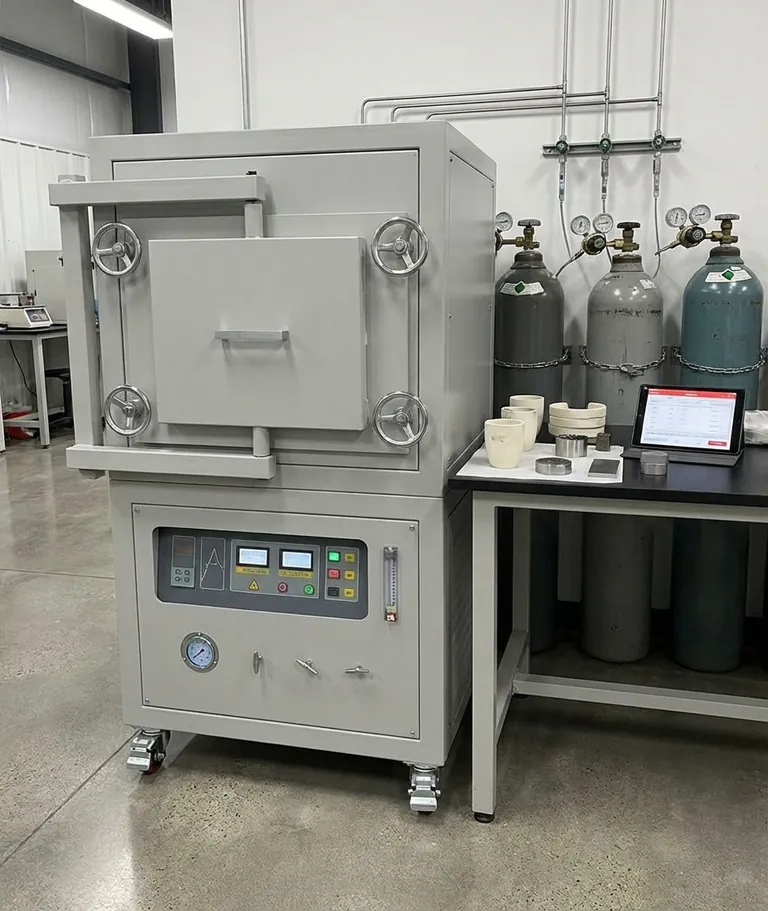
The Core Mechanisms: Atmosphere and Temperature Control
A material's final properties are determined by its microscopic structure, which is highly sensitive to the conditions during heat treatment. An atmosphere furnace provides the necessary control to dictate these outcomes.
Preventing Unwanted Reactions with Atmosphere Control
Many advanced materials react negatively with oxygen, nitrogen, or water vapor at high temperatures. This leads to oxidation, embrittlement, and a complete loss of desired properties.
An atmosphere furnace solves this by purging ambient air and replacing it with a controlled gas. This could be an inert gas like argon to prevent any reaction, or a specific reactive gas to encourage a desired chemical change. A reliable sealing structure is critical to prevent leaks and maintain this pure environment.
Achieving Specific Properties Through Temperature Uniformity
The furnace is engineered for exceptional thermal performance. High-performance insulation materials like ceramic and aluminum silicate fibers minimize heat loss, ensuring a highly stable and uniform temperature throughout the chamber.
This precision, combined with rapid heating capabilities, allows operators to execute exact thermal profiles. This is essential for achieving the specific crystalline structures that define a material's strength, conductivity, or other critical characteristics.
Enabling High-Purity Material Synthesis
For new energy materials, such as lithium-ion battery cathodes or fuel cell electrolytes, the manufacturing process is a high-temperature chemical reaction.
The combination of a controlled, pure atmosphere and a precise temperature profile ensures that these solid-state reactions proceed correctly. This results in the synthesis of high-purity materials with superior electrochemical or photoelectric performance.
Expanding Applications Beyond Traditional Metals
The precise control offered by these furnaces unlocks processing capabilities across a vast range of modern industries, far beyond simple steel or aluminum annealing.
Advanced Alloys and High-Performance Metals
Materials like titanium alloys, high-temperature alloys, and stainless steel require a non-oxidizing environment for effective annealing or brazing. The furnace provides the ideal conditions to achieve the desired mechanical properties without surface contamination or degradation.
New Energy and Semiconductor Materials
This technology is critical for manufacturing next-generation components. It is used for doping and annealing silicon wafers to improve solar cell efficiency and for synthesizing cathode materials for lithium-ion batteries. It also supports the development of hydrogen storage materials and fuel cell components.
Non-Metallic and Composite Materials
The furnace's application is not limited to metals. Its stable and controlled environment is also used in the manufacturing of advanced ceramics and glass, as well as in the research and preparation of new materials like nanomaterials and composites.
Understanding the Practical Advantages
Beyond enabling new materials, the design of a modern box-type atmosphere furnace offers significant operational benefits that make these advanced processes more viable for production and research.
The Benefit of Increased Efficiency
Compared to traditional furnaces, these units can shorten annealing times by 30% to 50%. This is due to faster heating rates and superior insulation that maintains temperature with less energy. This increased throughput and lower energy consumption are major advantages in any production environment.
The Importance of Operational Safety
Handling specialty gases and high temperatures requires robust safety protocols. These furnaces are equipped with multiple protection systems, including overcurrent, overvoltage, and overheating cutoffs. Alarms and secure door seals prevent atmosphere leakage, protecting both the operator and the material being processed.
Considerations for Maintenance and Usability
Modern furnaces feature user-friendly interfaces for simple parameter setting and process monitoring. A modular design philosophy allows for easier maintenance and parts replacement, which minimizes downtime and improves the overall reliability of the equipment.
Making the Right Choice for Your Goal
The decision to use a box-type atmosphere furnace depends entirely on the specific requirements of your material and process.
- If your primary focus is research and development of novel materials: The furnace's precise control over atmosphere and temperature is essential for synthesizing and testing new compounds like battery cathodes or shape memory alloys.
- If your primary focus is improving production of sensitive metals: The furnace offers faster, more energy-efficient annealing and brazing for materials like titanium alloys while ensuring high-quality, contamination-free results.
- If your primary focus is semiconductor or electronics manufacturing: The ability to perform controlled doping and annealing on silicon wafers makes this a critical tool for enhancing component performance and yield.
Ultimately, this furnace transforms material processing from a simple heating exercise into a precise engineering discipline.
Summary Table:
| Key Aspect | Description |
|---|---|
| Atmosphere Control | Prevents oxidation and enables specific reactions with inert or reactive gases. |
| Temperature Uniformity | Ensures precise thermal profiles for consistent material properties. |
| Application Scope | Expands to advanced alloys, semiconductors, new energy materials, and composites. |
| Efficiency Gains | Reduces annealing times by 30-50% with faster heating and better insulation. |
| Safety Features | Includes overcurrent, overvoltage, and overheating protections for secure operation. |
Ready to elevate your material processing capabilities? KINTEK specializes in advanced high-temperature furnace solutions, including Muffle, Tube, Rotary, Vacuum & Atmosphere Furnaces, and CVD/PECVD Systems. With our strong R&D and in-house manufacturing, we offer deep customization to meet your unique experimental needs—whether you're developing new energy components, semiconductors, or advanced alloys. Contact us today to discuss how our tailored solutions can enhance your efficiency and innovation!
Visual Guide

Related Products
- Controlled Inert Nitrogen Hydrogen Atmosphere Furnace
- Mesh Belt Controlled Atmosphere Furnace Inert Nitrogen Atmosphere Furnace
- 1400℃ Controlled Inert Nitrogen Atmosphere Furnace
- 1200℃ Controlled Inert Nitrogen Atmosphere Furnace
- 1700℃ Controlled Inert Nitrogen Atmosphere Furnace
People Also Ask
- What are the characteristics and uses of hydrogen atmosphere in furnaces? Achieve Superior Surface Purity and Bonding
- What are the characteristics and uses of hydrogen atmospheres in furnaces? Unlock Clean Metal Processing
- Mechanism of Fe81Ga19 Secondary Recrystallization? High-Precision Furnace Control for Goss Grain Growth
- How does a controlled atmosphere furnace contribute to energy efficiency? Lower Costs with Advanced Thermal Management
- Why is controlled atmosphere capability important in an atmosphere furnace? Unlock Precise Material Processing













