The relationship is direct and powerful: In high-temperature pressure-assisted sintering (hot pressing, HIP), the densification rate skyrockets as powder grain size decreases. Under applied pressure, the dominant densification mechanisms are diffusional—lattice diffusion and grain boundary diffusion—and their rates scale inversely with grain radius. Specifically, lattice diffusion densification scales as 1/a² and grain boundary diffusion as 1/a³, meaning even a modest reduction in grain size can slash the required processing temperature or hold time in your lab furnace.
The core insight: When your furnace applies uniaxial or isostatic pressure, diffusional mass transport becomes the primary path to full density. Because diffusion distances shrink and grain boundary area explodes with finer powders, you can achieve near-theoretical density at significantly lower temperatures or in shorter cycles—provided you prevent premature grain growth.
The Mechanisms Behind the Acceleration
Pressure-assisted sintering in a lab furnace activates several densification pathways, but only diffusion is strongly grain-size-sensitive. Understanding which mechanism rules your process unlocks the full advantage of powder selection.
Plastic Flow and Power‑Law Creep Are Independent of Grain Size
When the applied pressure is extremely high or temperatures push a material close to its melting point, plastic deformation and power‑law creep can drive densification. These mechanisms are grain‑size independent—they do not speed up merely because the starting powder is finer. However, for most oxide, carbide, and nitride ceramics processed in typical lab hot presses, diffusion remains the bottleneck, so particle size still takes center stage.
Diffusion Rules Under Moderate Pressure and Typical Lab Temperatures
The densification you observe in a lab hot press or HIP vessel is almost always controlled by two diffusional creep processes:
- Lattice diffusion (Nabarro–Herring creep): Vacancies flow through the crystal lattice.
- Grain boundary diffusion (Coble creep): Vacancies flow along the grain boundaries themselves.
Both processes accelerate dramatically with smaller grain radii because the vacancy‑diffusion distance between a pore and a grain‑boundary sink shrinks. In pressure‑assisted sintering, the externally applied stress adds a chemical potential gradient that further amplifies diffusion fluxes—but it is the fine grain structure that truly multiplies the effect.
Why the Exponents Are Lower Under Pressure
The primary reference highlights a critical nuance: under pressure, the grain‑size exponents are 1/a² (lattice) and 1/a³ (grain boundary), compared with 1/a³ and 1/a⁴ in pressureless sintering. The applied stress effectively reduces the sensitivity to grain size, yet fine powders remain the single most powerful lever for increasing densification rate. Using 0.5 µm instead of 2 µm powder can easily cut the required peak temperature by 100–200 °C or halve the soak time.
Why Finer Grains Are a Strategic Advantage in the Lab
When you load a die for hot pressing or seal a can for HIP, the powder’s particle size determines how efficiently the furnace’s thermal and mechanical input translates into density.
Shorter Transport Paths Mean Faster Pore Closure
A pore sitting between fine grains is surrounded by a dense network of active diffusion sinks. Vacancies need travel only a fraction of a micron to reach a grain boundary and disappear. This geometric effect drives the densification rate upward according to the inverse‑square and inverse‑cube laws, translating directly into a steeper density‑vs.‑time curve on your furnace log.
More Active Grain Boundaries Act as Vacancy Highways
Fine powders pack with an enormous density of grain boundary area per unit volume. Each boundary acts as a fast diffusion path. At lower furnace temperatures, grain boundary diffusion (1/a³) dominates because its activation energy is typically smaller. By keeping grains in the submicron range, you push the system into a regime where Coble creep can efficiently consolidate the body before significant coarsening occurs.
Consolidate at Lower Temperatures, Preserve Microstructure
The ability to reach near‑theoretical density without running the furnace to its extreme limits is not just about energy savings. A lower peak temperature suppresses exaggerated grain growth during the hold. The result is a dense, fine‑grained microstructure that delivers superior mechanical properties—exactly what you want from a lab‑scale feasibility run before scaling up.
Understanding the Trade‑offs and Pitfalls
Finer is not always better without qualification. Several factors can undermine the benefits if not managed properly.
Premature Grain Growth Can Neutralize the Advantage
Finer powders possess a higher driving force for grain growth. If your heating rate is too slow or your hold time too long, grains can coarsen before full density is achieved. Once grains grow, the diffusion distance increases, and the densification rate plummets. Your lab furnace cycle must therefore balance rapid heating with precise temperature control to lock in the fine‑grain condition.
Fine Powders Are More Difficult to Handle and Compact Uniformly
Submicron powders tend to agglomerate and exhibit poor flowability. Non‑uniform packing creates density variations that lead to differential shrinkage and residual porosity. Time spent on dispersion, granulation, or colloidal processing before pressing becomes a critical upfront investment.
If Plastic Flow Dominates, Grain Size Fades in Importance
In some furnace setups—extremely high pressure, soft metallic powders, or very high homologous temperatures—plastic deformation can become the main densification mechanism. In such cases, selecting a finer powder will not improve the densification rate. Always map your material’s dominant mechanism using creep diagrams before attributing a sluggish run solely to powder choice.
How to Apply This to Your Sintering Runs
The optimal powder size depends on the material, your furnace’s pressure‑temperature envelope, and your final property target. Use the following goal‑oriented guidance to decide.
- If your primary focus is achieving maximum density at the lowest possible temperature: Start with the finest, non‑agglomerated powder you can reliably handle. This pushes diffusional creep rates high enough to close porosity well before grain coarsening sets in.
- If your primary focus is shortening cycle time for throughput: Combine fine powders with a moderate temperature boost. The accelerated diffusion will let you reach terminal density in a fraction of the usual hold, without needing to push the furnace to its thermal limits.
- If your primary focus is controlling final grain size for mechanical performance: Choose a fine starting powder but design a two‑step profile: a fast ramp to a lower hold where grain boundary diffusion completes densification, then a rapid cool to arrest growth.
- If your primary focus is processing a material that deforms plastically under pressure: Shift your attention away from grain size. Invest instead in pressure calibration, die design, and temperature uniformity to exploit the pressure‑independent flow.
Master the inverse‑square and inverse‑cube influence of grain size, and your lab furnace becomes a precision instrument for microstructural engineering, not just a high‑temperature box.
Summary Table:
| Mechanism | Scaling Exponent (Inverse Radius) | Sensitivity to Grain Size | Practical Impact on Sintering |
|---|---|---|---|
| Grain Boundary Diffusion | $1/a^3$ | Extremely High | Dominates at lower temps; dramatically speeds up pore closure. |
| Lattice Diffusion | $1/a^2$ | High | Accelerates vacancy transport through grains under pressure. |
| Plastic Flow & Creep | $1/a^0$ (Independent) | None | Driven purely by high stress/temperature, independent of particle size. |
Optimize Your Sintering Workflows with KINTEK High-Temperature Furnaces
Achieving theoretical material density while preserving fine microstructures requires exceptional thermal precision and control. KINTEK specializes in advanced laboratory equipment and high-temperature furnaces engineered to meet the stringent demands of modern materials research.
Whether you need precise heating profiles to suppress premature grain growth or customizable atmosphere controls for specialized sintering, our expert team provides tailored thermal solutions:
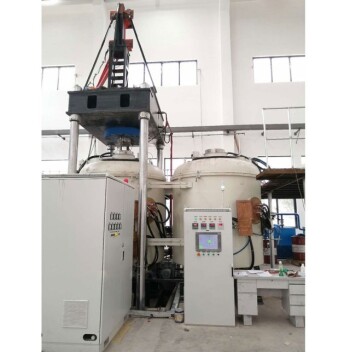
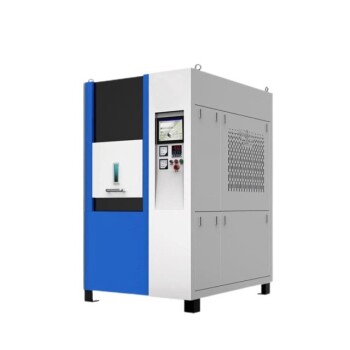
- Hot Press, Vacuum & Atmosphere Furnaces for advanced pressure-assisted densification
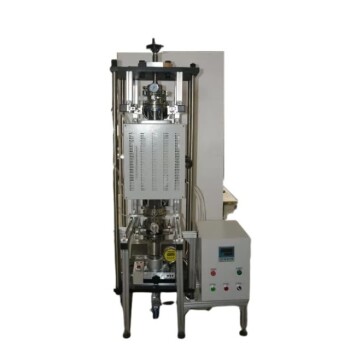
- Tube, Muffle, and Rotary Furnaces for consistent thermal processing
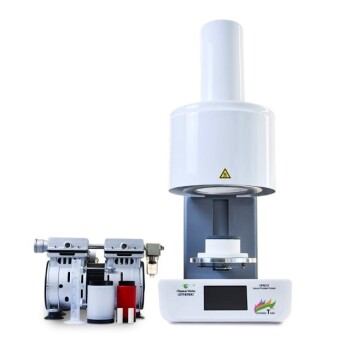
- CVD, Dental, and Induction Melting Furnaces customized to your exact operational targets
Empower your lab with high-reliability equipment built for maximum performance and energy efficiency.
👉 Contact KINTEK Experts Today for Custom Sintering Furnace Solutions
Related Products
- High Temperature Muffle Oven Furnace for Laboratory Debinding and Pre Sintering
- 2200 ℃ Tungsten Vacuum Heat Treat and Sintering Furnace
- 9MPa Air Pressure Vacuum Heat Treat and Sintering Furnace
- 2200 ℃ Graphite Vacuum Heat Treat Furnace
- 600T Vacuum Induction Hot Press Vacuum Heat Treat and Sintering Furnace
People Also Ask
- What thermal phenomena occur during polymer binder burnout in ceramic green bodies? Lab Furnace Guide
- What role does a high-temperature muffle furnace play in STFO synthesis? Achieve Pure Perovskite Results
- Why is controlled heat treatment in a muffle furnace necessary for calcined clay? Achieve Optimal Pozzolanic Activity
- How does a high-temperature muffle furnace facilitate the formation of LaNbxAl1−xO3+δ perovskite structures? Key Roles
- What role does a high-temperature muffle furnace play in the multi-stage synthesis of Li0.5MnFe1.5O4? Key to Pure Spinel