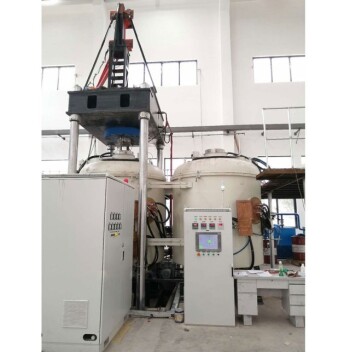
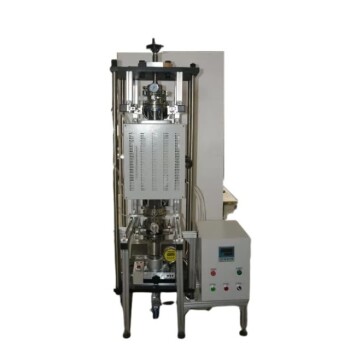
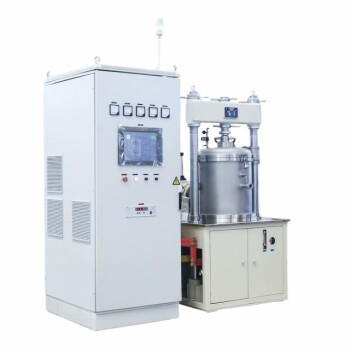
Magnesium oxide doesn't just dope alumina—it orchestrates a microstructural pas de deux between pores and grain boundaries, ensuring densification wins over abnormal growth.
At optimized low concentrations (~0.25 wt%), dissolved MgO segregates to alumina grain boundaries, creating a solute drag effect that dramatically reduces boundary mobility. This keeps migrating boundaries attached to pores long enough for diffusion to eliminate porosity and achieve near-theoretical density. Controlled heating in high-temperature furnaces is the critical enabler: uniform thermal profiles ensure consistent solute segregation and suppress the thermal gradients that would otherwise trigger localized, runaway grain growth.
The core insight is that abnormal grain growth is not a thermal inevitability—it’s a mobility mismatch. By using MgO to slow down grain boundaries and precise furnace control to maintain thermal uniformity, you keep pores on the boundaries where they can be removed, producing fully dense, fine‑grained alumina.
How MgO Locks the Grain Boundaries
The Solute-Drag Mechanism, Not Simple Pinning
Dissolved Mg²⁺ ions segregate to alumina grain boundaries because the ionic size mismatch and electrostatic interactions relieve lattice strain.
These segregated solutes create a drag force on the boundary, drastically lowering its mobility. This is a solute-drag effect—fundamentally different from second‑phase particle pinning by spinel precipitates.
Why Dissolved Mg²⁺ is So Effective
At the typical sintering temperatures (above 1400 °C), the equilibrium solubility of MgO in α‑alumina is low but sufficient for a monolayer of dopant to form.
That segregation layer lowers grain boundary energy and mobility just enough to keep pace with pore mobility, preventing pore‑boundary separation.
The Peril of Pore‑Boundary Separation
If grain boundaries move too fast, they detach from pores, trapping the pores inside grains.
Once isolated, those pores cannot be removed by volume diffusion—they become permanent defects that limit density and mechanical integrity.
MgO doping prevents this scenario by ensuring boundaries never outrun the pores until full densification is complete.
The Role of Precise Temperature Control
Uniform Thermal Profiles Drive Uniform Segregation
The extent of solute segregation depends on local temperature because diffusion coefficients and solubility change with temperature.
In a high‑temperature laboratory furnace, maintaining a tight, uniform thermal profile ensures that every grain boundary receives the same protective layer of segregated Mg²⁺.
Without this uniformity, some regions would have insufficient dopant coverage, leaving them vulnerable to abnormal grain growth.
Avoiding Thermal Gradients That Wreck Microstructure
Temperature gradients across a ceramic compact drive differential densification and stress.
In a gradient, the hotter zones may undergo rapid grain boundary migration before pores can be eliminated, causing localized abnormal grain growth even if the average temperature seems optimal.
Precise, slow ramping and soak control in furnaces (muffle, tube, or atmosphere) eliminate these gradients, letting the solute drag mechanism work consistently throughout the part.
The Critical Sintering Window
For MgO‑doped alumina, dense, fine‑grained microstructures are typically obtained between 1400 °C and 1600 °C, depending on powder particle size and green density.
Too high a temperature increases intrinsic boundary mobility beyond what the solute drag can compensate for; too low a temperature fails to activate sufficient diffusion to remove pores.
Controlled heating with intermediate dwells can help tailor the profile to stay within this sensitive window.
Understanding the Trade‑offs and Misconceptions
Solute Drag vs. Spinel Pinning – Which Mechanism Actually Works?
At the classic 0.25 wt% MgO addition, MgO remains fully dissolved during sintering; solute drag is the primary mechanism.
A few reports describe spinel (MgAl₂O₄) nanocrystals pinning boundaries, but this occurs only when MgO exceeds the solubility limit or during specific phase transitions in nanoparticle precursor systems.
For most high‑temperature sintering of coarse‑grained alumina, relying on pinning from precipitates is less reliable and can degrade other properties; the solute‑drag route is the proven path.
Impurity Interactions and Over‑Doping Risks
Trace impurities like silicon and calcium form intergranular liquid films that drastically lower boundary mobility and catalyze abnormal grain growth.
MgO helps by scavenging these impurities, but over‑doping (excessive MgO) can form unwanted spinel phases, which may coarsen at high temperatures and create their own microstructural heterogeneities.
A delicate balance is required: enough MgO to segregate and lock boundaries, but not so much that it precipitates into a separate phase.
Why High Pressure or Low Temperature Alone Won’t Fix It
Using high pressure to lower sintering temperature can suppress grain growth, but it often fails to eliminate the pore‑boundary separation problem because the underlying mobility mismatch remains.
Without a solute‑drag agent like MgO, even low‑temperature sintering can produce abnormal grains if thermal gradients or impurities exist.
The combination of MgO doping and precise thermal control addresses the root cause, not just the symptom.
Making the Right Choice for Your Ceramic Process
- If your primary focus is achieving near‑theoretical density and translucency: Use approximately 0.25 wt% MgO, rely on solute drag, and enforce a heating profile with long, uniform soaks in a well‑calibrated furnace to ensure full pore elimination without grain coarsening.
- If your primary focus is sub‑micron grain size and high fracture toughness: Fine‑tune the MgO concentration within the soluble range and sinter at the lowest possible temperature that still achieves pore closure, then use controlled rapid cooling to freeze the fine microstructure.
- If your primary focus is robust, defect‑free production with less‑pure raw materials: Slightly increase MgO content to compensate for silica impurities, but verify with thermal analysis that no liquid phases form, and maintain strict furnace temperature uniformity to avoid localized over‑heating.
- If you are scaling up from lab‑scale to production furnaces: Invest in multiple‑zone heating elements and real‑time monitoring to replicate the uniform thermal environment of a laboratory muffle furnace—because even minor gradients will undermine the MgO solute‑drag effect.
Mastering MgO doping and precise thermal control isn’t about adding complexity; it’s about giving you the power to transform alumina from a porous, erratic structure into a reliable, high‑performance ceramic that meets your exact specifications.
Summary Table:
| Aspect | Mechanism / Function | Microstructural Impact |
|---|---|---|
| Solute Drag (MgO) | Mg²⁺ segregates to boundaries, reducing mobility | Prevents pore-boundary separation; ensures high density |
| Thermal Uniformity | Eliminates thermal gradients across the ceramic compact | Ensures even dopant segregation and prevents runaway grain growth |
| Controlled Ramp & Soak | Holds temperature in the optimal window (1400°C–1600°C) | Maximizes pore elimination before intrinsic mobility increases |
Ready to achieve maximum density and eliminate microstructural defects in your ceramic processes? KINTEK specializes in high-performance laboratory equipment and consumables, offering a comprehensive range of high-temperature furnaces—including muffle, tube, rotary, vacuum, CVD, atmosphere, dental, and induction melting furnaces—all fully customizable to meet your unique research and production needs.
Ensure exact thermal uniformity and consistent material results—contact KINTEK today to customize your high-temperature furnace!
Related Products
- 1400℃ High Temperature Laboratory Tube Furnace with Alumina Tube
- 1700℃ High Temperature Laboratory Tube Furnace with Alumina Tube
- 1800℃ High Temperature Muffle Oven Furnace for Laboratory
- 1700℃ High Temperature Muffle Oven Furnace for Laboratory
- 1200℃ Muffle Oven Furnace for Laboratory
People Also Ask
- How does zone-melting in tube furnaces synthesize bismuth micro-wires? Master Single-Crystal Thermoelectric Growth
- How are high-temp tube furnaces used to measure diffusion coefficients per Fick's law? Master Precision Annealing
- How do high-temperature laboratory tube furnaces ensure environmental stability? Precision Thermal Reduction Tips
- How are high-temperature laboratory tube furnaces applied in long-term vacuum homogenization heat treatments for intermetallic samples?
- How are high-temperature tube furnaces applied in testing ceramic-supported alloy membranes? Insights