The answer comes down to a fundamental thermodynamic dictate: curved surfaces in a powder compact create localized differences in vapor pressure and vacancy concentration that drive sintering. Convex surfaces (e.g., particle tips) develop higher vapor pressure but lower vacancy concentration than flat surfaces. Concave surfaces (e.g., neck regions between particles) experience exactly the opposite—lower vapor pressure and a significantly higher equilibrium vacancy concentration. These opposite gradients supply the kinetic engine for both vapor-phase transport and solid-state diffusion inside high-temperature furnaces.
Sintering is a race to reduce interfacial energy. Curvature-induced gradients in vapor pressure and vacancy concentration are the steering wheel and accelerator—vapor pressure moves material without shrinking the compact, while vacancy diffusion directly delivers densification. Controlling the balance between them is how you achieve a fully dense, defect-free component.
The Thermodynamic Basis of Curvature-Induced Gradients
Surface curvature isn’t just a geometric detail—it locally modifies the chemical potential of atoms and vacancies. That shift is what fires up material transport.
Positive (Convex) Curvature: Higher Vapor Pressure, Fewer Vacancies
- A convex particle surface with a small positive radius of curvature forces atoms into a higher energy state.
- According to the Gibbs‑Thompson (Kelvin) relationship, the equilibrium vapor pressure over that curved surface is given by
$p = p_\infty \left(1 + \frac{2\gamma V_m}{RTr}\right)$.
As the radius $r$ shrinks, $p$ rises significantly above the flat‑surface value $p_\infty$. - At the same time, the equilibrium vacancy concentration beneath a convex surface falls below that of a flat surface, following
$C_v = C_{ov} \exp!\left(-\frac{\gamma_{SV} K \Omega}{kT}\right)$, where positive $K$ reduces $C_v$.
Negative (Concave) Curvature: Lower Vapor Pressure, Higher Vacancy Concentration
- In concave regions—like the saddle‑shaped necks where particles first bond, or along triple‑line pores—the curvature $K$ becomes negative.
- The vapor pressure here is lower than over a flat surface; the same Gibbs‑Thompson equation predicts a reduction because the radius sign is effectively negative.
- Crucially, the vacancy concentration skyrockets. The exponent $-\gamma_{SV}K\Omega/(kT)$ flips positive, creating a surplus of vacancies relative to both flat and convex areas. This is the primary source of the vacancy gradient that drives densification.
How These Gradients Drive Material Transport
The gradients do the physical work of sintering through two distinct, coexisting pathways. Knowing which one dominates determines whether your compact simply reshapes or truly densifies.
Vapor Pressure Gradients and Evaporation‑Condensation
- A vapor pressure mismatch from convex tips to concave necks pushes material into the vapor phase from the tips and re‑condenses it at the necks.
- This mechanism builds neck size and can smooth pore surfaces, but because it simply relocates mass without reducing pore volume, it does not cause shrinkage or full densification.
- High‑temperature atmosphere control (e.g., using vacuum or specific gas species) can suppress this path when solid‑state diffusion is needed for compaction.
Vacancy Concentration Gradients and Solid‑State Diffusion
- The large vacancy concentration gradient—high beneath concave necks, low near grain boundaries—drives a vacancy flux ($J_L$) from pore surfaces toward grain boundaries.
- When vacancies are annihilated at fixed sinks (grain boundaries), the lattice responds by moving inward. This is the direct mechanism of volume shrinkage and densification.
- Consistent vacancy diffusivity ($D_v$) is essential. Even minor temperature fluctuations alter $kT$ in the exponential factor, swinging diffusion rates and potentially creating uneven grain growth or trapped porosity.
Understanding the Trade‑offs
Objective sintering design requires you to weigh the benefits and risks of each curvature‑driven transport mode.
- Evaporation‑condensation boosts neck strength but stalls densification. It’s valuable in early‑stage sintering for building mechanical integrity, yet if it remains the dominant path, your part will never reach full density.
- Vacancy‑driven diffusion delivers densification but is exquisitely sensitive to temperature. A poorly controlled furnace with hot spots or cycling can warp microstructure, coarsen grains prematurely, or lock in porosity.
- Curvature‑induced stress fields can cause local damage. Negative pressures in sharp concave notches may nucleate new cavities if the vacancy flux outpaces atomic rearrangement.
- Surface energy anisotropy is real. Real‑world powder particles are rarely spherical; facets and edges create complex curvature fields that can cause asymmetric neck growth and non‑uniform shrinkage.
Leveraging Curvature Control for Your Sintering Goals
Precise furnace management lets you tip the balance between these competing mechanisms.
- If your primary focus is maximum densification: Program a temperature profile that sustains high vacancy diffusivity while suppressing evaporation‑condensation by maintaining a high‑purity inert or vacuum atmosphere. This pushes mass transport into the volume‑diffusion lane, where every vacancy annihilation shrinks the body.
- If your primary focus is neck formation with controlled grain size: Operate in a slightly active atmosphere (e.g., a low partial pressure of a carrier gas) to exploit vapor‑phase transport early on. Then switch to a reducing or inert environment for the final sintering stage to initiate vacancy‑driven shrinkage.
- If your primary focus is eliminating residual porosity in complex geometries: Rely on your furnace’s strict thermal uniformity to flatten temperature gradients. This keeps $C_v$ gradients smooth and prevents local hot spots from triggering runaway grain growth before pores can close.
Master the interplay between curvature, vapor pressure, and vacancy concentration, and you transform the furnace into a precision architect—building a dense, reliable microstructure atom by atom.
Summary Table:
| Surface Curvature | Vapor Pressure ($p$) | Vacancy Concentration ($C_v$) | Dominant Transport Pathway | Effect on Powder Compact |
|---|---|---|---|---|
| Convex ($K > 0$) (e.g., Particle Tips) |
Higher than flat surface | Lower than flat surface | Evaporation–Condensation | Builds neck strength; no shrinkage |
| Concave ($K < 0$) (e.g., Particle Necks/Pores) |
Lower than flat surface | Significantly Higher | Solid-State Vacancy Diffusion | Drives mass transport; full densification |
Master Your Sintering Microstructure with KINTEK
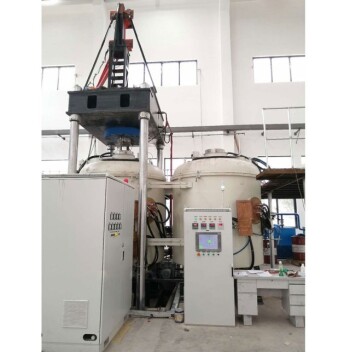
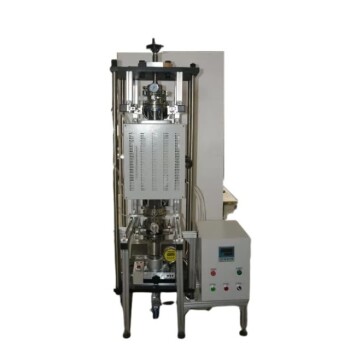
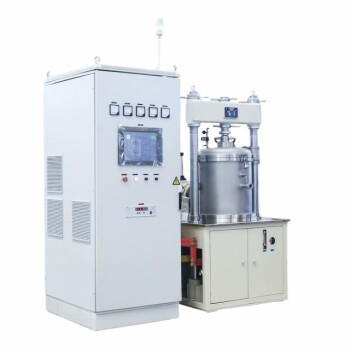
Achieving peak component density requires precise control over thermal uniformity and furnace atmosphere to manage curvature-driven vacancy diffusion. KINTEK offers a comprehensive range of high-temperature laboratory furnaces—including vacuum, atmosphere, tube, muffle, CVD, and customizable systems—designed to eliminate hot spots and provide the stable thermal profiles your sintering processes demand.
Whether you are refining ceramic compacts or advanced metal alloys, KINTEK engineers equipment tailored to your exact research and production specs.
Contact KINTEK today to customize your high-temperature furnace solution!
Related Products
- 1400℃ High Temperature Laboratory Tube Furnace with Alumina Tube
- 1700℃ High Temperature Laboratory Tube Furnace with Alumina Tube
- 1800℃ High Temperature Muffle Oven Furnace for Laboratory
- 1700℃ High Temperature Muffle Oven Furnace for Laboratory
- 1200℃ Muffle Oven Furnace for Laboratory
People Also Ask
- How does zone-melting in tube furnaces synthesize bismuth micro-wires? Master Single-Crystal Thermoelectric Growth
- How do high-temperature laboratory tube furnaces ensure environmental stability? Precision Thermal Reduction Tips
- How are high-temperature laboratory tube furnaces applied in long-term vacuum homogenization heat treatments for intermetallic samples?
- How are high-temp tube furnaces used to measure diffusion coefficients per Fick's law? Master Precision Annealing
- How are high-temperature tube furnaces applied in testing ceramic-supported alloy membranes? Insights