Vacuum hot pressing attacks microstructural swelling and contamination at their source—before the ceramic ever leaves the furnace.
By combining external mechanical pressure with a near-perfect vacuum, the process forcibly extracts volatile gases from the compact, eliminates oxidation, and suppresses carbon pickup from graphite tooling. This dual action ensures that insoluble gases cannot become trapped and expand into disruptive voids, while the absence of reactive atmospheres preserves the cleanliness of grain boundaries and particle interfaces.
The key to preventing ceramic swelling (bloating) is to evacuate trapped gases before pores seal shut—a feat made possible by the vacuum environment. Simultaneously, the absence of oxygen and the suppression of carbonaceous impurities safeguard the final microstructure against contamination, yielding a part with exceptional high-temperature stability.
The Root Cause of Microstructural Swelling in Ceramics
Why Trapped Gases Turn into Voids
During sintering, insoluble gases—water vapor, nitrogen, CO, and CO₂—can become sealed inside residual pores as the compact densifies. The internal pressure of these trapped gases increases with temperature, causing the pores to expand or coalesce. This phenomenon, known as ceramic bloating, leads to a sudden increase in porosity and a catastrophic drop in density.
The Role of Residual Impurities
Even trace amounts of carbon or sulfur left from organic binders can oxidize later in the process. They form insoluble gases like CO₂ or SO₂ that cannot escape once the pore network closes, fueling late-stage swelling and creating weak, gas-filled defects.
Why External Pressure Alone Is Not Enough
Applying mechanical force speeds up densification, but without a vacuum it can simply trap gases faster. The pore channels close while volatile species are still inside, locking in the very contamination that will later cause blistering during high-temperature service.
How Vacuum Hot Pressing Prevents Swelling
Efficient Gas Evacuation Before Pore Closure
A vacuum high-temperature furnace continuously pumps away volatiles from the instant the heating cycle begins. During the critical open-porosity stage, water vapor, oxygen, nitrogen, and decomposition gases are drawn out. The low-pressure environment makes it thermodynamically unfavorable for gases to remain adsorbed on particle surfaces, driving complete degassing.
Timing the Pore‑Closure Window
Hot pressing applies uniaxial pressure that dramatically accelerates densification, but the vacuum ensures that by the moment pores are about to seal, they are essentially empty. The resulting residual porosity remains extremely low and free of pressurized gas, so the dense ceramic exhibits no swelling during subsequent heat treatments or in‑service thermal exposure.
Breaking the Bloating Cycle
Without a vacuum, small pores with high internal pressure can feed gas into larger pores via grain‑boundary diffusion, causing coalescence and macroscopic bloating. Vacuum hot pressing interrupts this cycle at its root by removing the gas source entirely, so no diffusion‑driven pore growth can occur.
Eliminating Contamination for Cleaner Interfaces
Preventing Oxidation and Carburization
Graphite pressing dies are essential tooling, but in air they oxidize and shed carbon contamination onto the ceramic surface. Under vacuum, these oxidation reactions are stifled. Additionally, the vacuum prevents carburization of any metal phase in a ceramic‑matrix composite, preserving the intended chemistry and interface strength.
Deep Degassing and Oxide Removal
The vacuum environment strips away not only adsorbed humidity but also residual oxygen and nitrogen that would otherwise form surface oxide layers on powder particles. This removal allows direct, unhindered bonding between ceramic grains or between metal and ceramic phases, producing a pristine, high‑integrity interface free of weak inclusions.
Minimizing Carbonaceous Impurity Contamination
Even when graphite tooling is unavoidable, the vacuum environment dramatically reduces the mobility of carbon‑rich species that could otherwise diffuse into the workpiece. The result is a cleaner ceramic microstructure with superior high‑temperature mechanical stability.
Synergistic Benefits: Fine Grain Preservation and Higher Density
Lower Temperatures, Less Grain Growth
The applied pressure generates a driving force for densification that far exceeds the intrinsic sintering stress, enabling full consolidation at temperatures much lower than those required for pressureless sintering. Shorter thermal cycles inhibit excessive grain coarsening, maintaining a fine, uniform grain size that further resists structural degradation.
Enhancing Densification of Reactive and Nano‑Powders
Nanometer‑sized powders have high surface energy and a tendency to grow rapidly at elevated temperatures. Vacuum hot pressing completes densification before significant grain growth can occur, preserving the nanostructured benefits and maximizing transformation‑toughening effects in materials like zirconia nanocomposites.
Uniform Microstructure Through Constant Pressure
Precise pressure control during the holding phase fills remaining voids and suppresses abnormal grain growth. The resulting fine and uniformly distributed microstructure improves hardness, fracture toughness, and long‑term dimensional stability.
Understanding the Trade‑offs and Limitations
Cost and Equipment Complexity
Vacuum hot press furnaces are sophisticated systems demanding precise vacuum levels, temperature uniformity, and ram force control. For ceramics that sinter to full density in air without swelling, the added expense and slower cycle times may not be justified.
Risk of Stoichiometry Shifts
In some oxide ceramics (such as certain perovskites or ferrites), an aggressive vacuum can cause oxygen loss that alters electrical or magnetic properties. A controlled low‑pressure inert gas (e.g., argon) may be preferable if reduction must be avoided, while still preventing oxidation.
Die Compatibility and Residual Contamination
While vacuum minimizes carbon contamination, a pure graphite die can still react with highly reactive ceramic compositions. Using boron nitride coatings or alternative die materials is sometimes necessary to achieve the ultimate interface cleanliness.
How to Select the Right Sintering Environment for Your Application
- If your primary focus is preventing swelling in high‑temperature structural ceramics: Use vacuum hot pressing to strip all volatile species before pore closure; this guarantees dimensional stability under thermal cycling.
- If your primary focus is achieving contamination‑free interfaces in metal‑ceramic composites: The vacuum environment prevents oxidation and carburization from graphite tooling, ensuring a strong, defect‑free bond.
- If your primary focus is retaining a nano‑crystalline or ultra‑fine grain structure: Vacuum hot pressing’s lower sintering temperature and shorter dwell time lock in the fine‑grain advantages without sacrificing densification.
- If your application tolerates minor porosity and the ceramic is non‑reactive in air: You may not need the complexity of vacuum; conventional hot pressing in a controlled atmosphere could suffice—but always test for hidden gas entrapment that may lead to late‑stage bloating.
By choosing vacuum hot pressing, you command the twin forces of pressure and vacuum to forge ceramics that are dense, clean, and inherently resistant to the microstructural flaws that undermine long‑term reliability.
Summary Table:
| Processing Mechanism | Action in Vacuum Hot Pressing | Key Ceramic Benefit |
|---|---|---|
| Early Gas Evacuation | Extracts volatile gases before pores seal | Prevents internal void formation and structural swelling (bloating) |
| Impurity Suppression | Stifles oxidation and carbon pickup from graphite tooling | Ensures clean, high-integrity grain boundaries and interfaces |
| Uniaxial Pressure + Vacuum | Accelerates densification at lower sintering temperatures | Retains ultra-fine/nano grain structures while achieving near-theoretical density |
Achieve Defect-Free Ceramic Processing with KINTEK
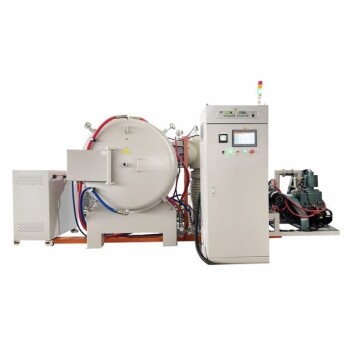
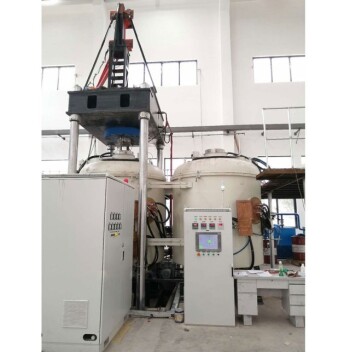
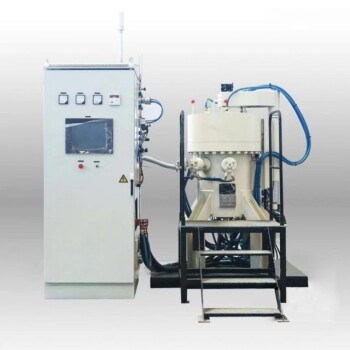
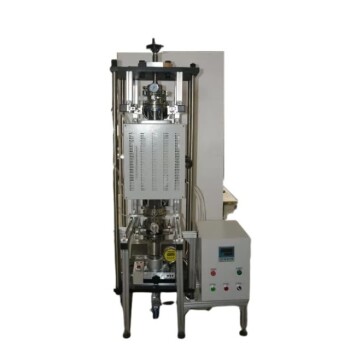
Eliminate late-stage swelling and grain boundary contamination in your high-temperature applications. KINTEK specializes in premium laboratory equipment and consumables, offering a comprehensive range of fully customizable high-temperature furnaces—including vacuum hot press furnaces, muffle, tube, rotary, CVD, and controlled-atmosphere furnaces—engineered to meet your exact material synthesis demands.
Whether you need precise pressure control, deep vacuum evacuation, or customized thermal profiles, our technical experts are here to support your laboratory's success. Contact KINTEK today to discuss your custom furnace needs!
Related Products
- 2200 ℃ Tungsten Vacuum Heat Treat and Sintering Furnace
- 2200 ℃ Graphite Vacuum Heat Treat Furnace
- Molybdenum Vacuum Heat Treat Furnace
- Vacuum Heat Treat Sintering Furnace Molybdenum Wire Vacuum Sintering Furnace
- High Pressure Laboratory Vacuum Tube Furnace
People Also Ask
- How does a tungsten-heated vacuum sintering furnace prepare (TbxY1-x)2O3 ceramics? Achieve 99%+ Density & Purity
- How do compaction pressure and vacuum sintering optimize porous ceramics? Maximize Density & Toughness
- What wear-resistance enhancements are achieved by powder coating? The Role of Vacuum Sintering Furnaces
- What role does a high-temperature vacuum sintering furnace play in the densification of WC-10(Ni, Ni/Co) alloys?
- How does high-temp vacuum sintering influence Y-TZP mechanical properties? Achieve Max Toughness