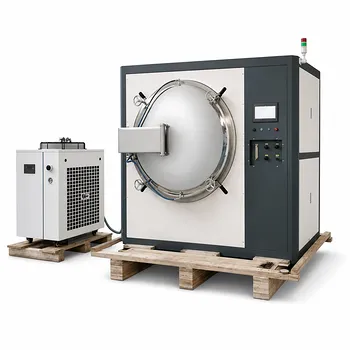
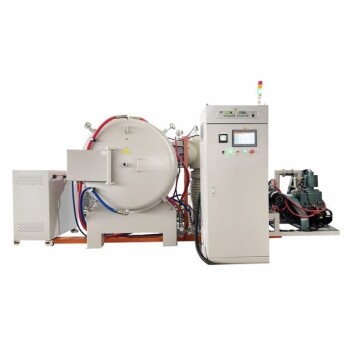
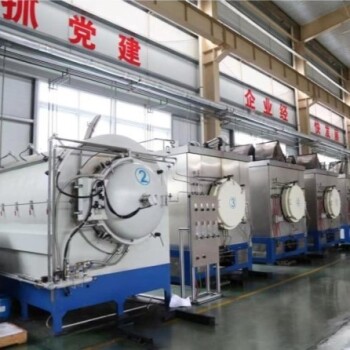
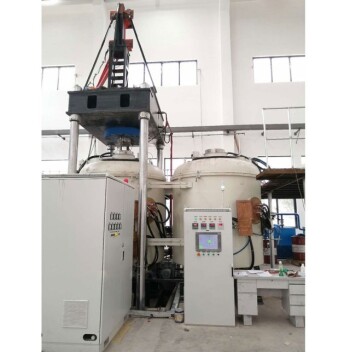
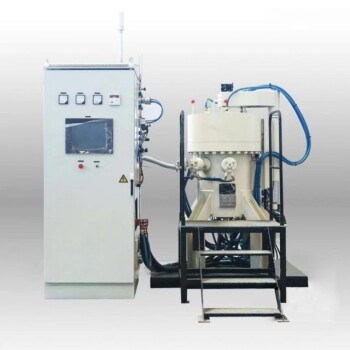
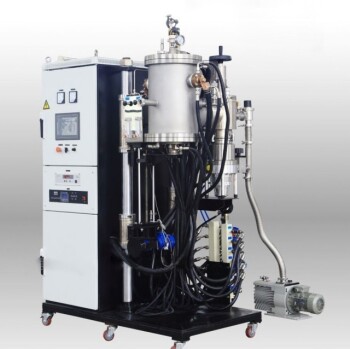
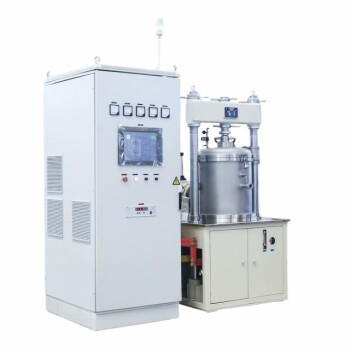
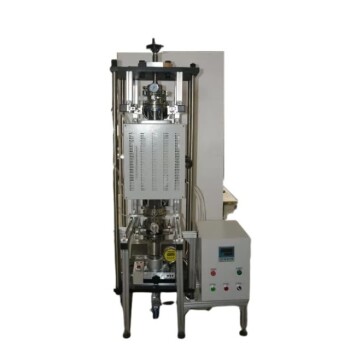
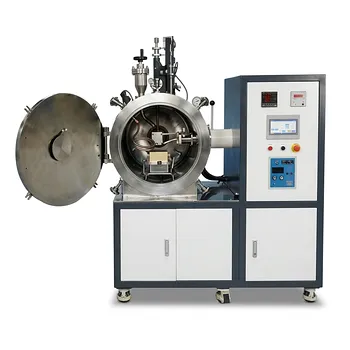
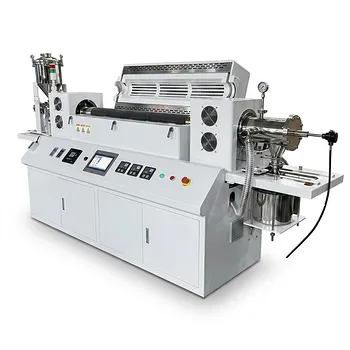
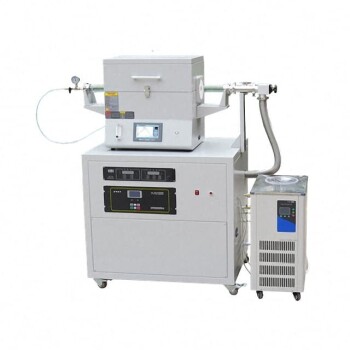
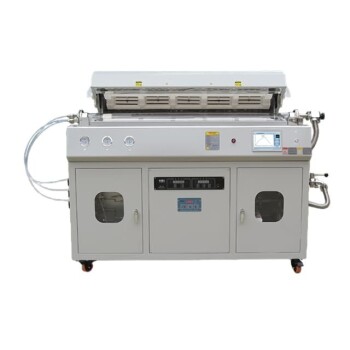
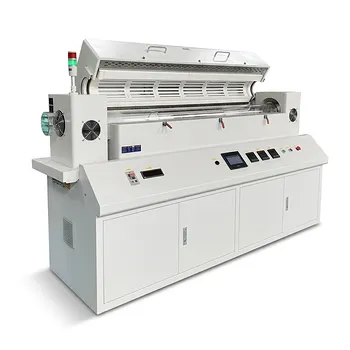
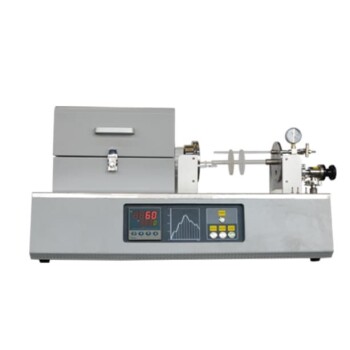
The fundamental optimization comes down to controlled thermal history and atmospheric integrity. Post-process heat treatment in atmosphere and vacuum furnaces transforms the coarse, stressed, and anisotropic microstructure of as-built Directed Energy Deposition (DED) metal parts into a refined, stress-free, and isotropic material system. By precisely managing heating, soaking, and cooling within a sealed environment, these furnaces dissolve unwanted phases, release locked-in thermal stress, and prevent harmful surface contamination, directly translating to enhanced strength, ductility, and fatigue resistance.
As-printed DED parts suffer from internal strain and brittle microstructures caused by rapid, localized melting. A post-process furnace resolves this by undertaking three critical, simultaneous actions: relieving residual stress to prevent distortion and cracking, homogenizing the microstructure to erase anisotropic weak points, and in the case of vacuum, degassing and densifying the metal to eliminate embrittlement and porosity. The choice between an inert atmosphere and a vacuum defines the purity and ultimate performance ceiling of the component.
The As-Built Problem: Why DED Parts Need the Furnace
Post-processing is not a superficial finish; it is a corrective therapy for the inherent flaws of the DED process. The extreme temperature gradients create a material state that is fundamentally unstable and mechanically compromised.
The Origin of Destructive Residual Stress
The high-powered laser or electron beam creates a tiny, superheated melt pool. As this pool rapidly cools and solidifies, it contracts against the previously deposited, cooler layers. This sequence locks powerful internal tensile and compressive stresses into the part, which can lead to geometric warping or premature failure under load.
Anisotropy and Microstructural Weakness
The directional layering of DED creates columnar grains that grow along the build direction. These elongated grains result in anisotropic mechanical properties, meaning the part will have lower ductility and fracture toughness when stressed perpendicular to the build direction. A chaotic, non-uniform microstructure also often contains brittle, undesirable phases.
The Mechanisms of Mechanical Property Optimization
The furnace re-engineers the material from the inside out. It’s not just about applying heat; it’s about applying a meticulously controlled thermal recipe in a protective environment that enables specific physical and chemical changes.
Process I: Relaxing the Matrix with Controllable Stress Relief
The furnace elevates the part's temperature to a specific point below its critical transformation range, then holds it, and slowly cools it. This allows the metal's crystal lattice to reconfigure through atomic diffusion, effectively "unlocking" the internal stresses without changing the overall part geometry. The controlled environment ensures no surface oxidation or scaling occurs during this critical relaxation, preserving dimensional stability for tight-tolerance components like gears or bearings.
Process II: Engineering Isotropic Strength Through Recrystallization
At higher annealing temperatures, the elongated, stressed grains from the DED process are replaced by a new set of uniform, equiaxed grains through a process of recovery, recrystallization, and grain growth. This erases the anisotropic behavior, producing a part with uniform mechanical properties in all directions. The furnace's precise temperature control is non-negotiable here; it dictates the final grain size, which is the master lever for balancing strength and toughness.
Process III: Vacuum-Specific Densification and Chemical Purification
This is where a vacuum furnace surpasses a standard inert atmosphere. The vacuum creates a negative pressure environment that triggers two critical transformations:
- Heat-Induced Densification: The high-temperature soak allows diffusion bonding across internal voids and micro-porosity, significantly increasing material density. This directly enhances tensile strength, hardness, and fatigue resistance.
- Vacuum Degassing: The vacuum efficiently extracts dissolved gases, particularly hydrogen, from the solid metal lattice. By eliminating sources of hydrogen embrittlement, the process fundamentally improves the material's plasticity, toughness, and fatigue strength—a benefit an inert atmosphere alone cannot provide.
Understanding the Trade-offs: Inert Atmosphere vs. Vacuum
The choice of furnace environment is a strategic decision balancing cost, performance, and metallurgical requirements.
The Purity-Surface Interaction
An inert gas atmosphere using argon or nitrogen protects reactive alloys like titanium from oxidation. However, trace impurities in the gas or minor leaks can still cause alpha-case formation or slight discoloration, which may require secondary removal. A vacuum, conversely, provides the highest level of chemical inertness, leaving a perfectly clean, bright surface finish due to the degassing effect.
Cost, Complexity, and Part Geometry
Vacuum furnaces represent a higher capital investment and require longer cycle times to pump down and heat through radiation alone. For simple structural steels where surface finish is secondary, a controlled atmosphere furnace offers a more economical and faster throughput. For mission-critical parts like aerospace titanium or medical cobalt-chrome implants, the superior cleanliness and structural integrity from a vacuum furnace are mandatory.
Making the Right Choice for Your Goal
Your post-process heat treatment strategy must align directly with the component's final application requirements.
- If your primary focus is maximum fatigue life and toughness: A vacuum furnace is non-negotiable. The combination of deep internal degassing to eliminate hydrogen embrittlement and densification to close porosity directly governs a part's ability to withstand cyclic loading without crack initiation.
- If your primary focus is eliminating distortion and correcting anisotropy: Both inert atmosphere and vacuum furnaces can achieve this via precise stress-relief and annealing cycles. The key is the furnace's ability to control slow, ramp-soak profiles without exceeding the alloy's critical temperature, which would degrade strength.
- If your primary focus is surface integrity and chemical purity for reactive alloys: A vacuum furnace is the definitive solution. It prevents surface oxidation and creates a clean, contamination-free surface layer, an outcome unachievable by even the highest-purity inert gas environment.
Ultimately, the post-process furnace transforms a rough, internally strained DED print into a genuine engineering component, and your choice of atmospheric control precisely defines the final level of metallurgical integrity you are willing to pay for.
Summary Table:
| Feature / Process | Inert Atmosphere Furnace | Vacuum Heat Treatment Furnace |
|---|---|---|
| Primary Mechanism | Inert gas shielding (Argon/N2) | High-vacuum thermal soaking & degassing |
| Key Benefits | Stress relief & recrystallization for isotropic grains | Deep degassing (H2 removal), pore closure & zero oxidation |
| Surface Quality | Minimizes scaling and heavy oxidation | Completely bright, contamination-free surface |
| Best For | Economical stress-relief for structural steel parts | Mission-critical aerospace parts & medical implants |
Elevate the mechanical integrity and fatigue performance of your 3D-printed metal components with KINTEK. As leaders in laboratory equipment and consumables, KINTEK offers a comprehensive range of high-temperature furnaces—including advanced atmosphere, vacuum, muffle, tube, rotary, CVD, and induction melting systems—all fully customizable to meet your unique metallurgical goals. Whether you need precise stress relief or high-purity vacuum degassing for mission-critical parts, our experts provide reliable, engineered solutions tailored to your process. Contact us today to optimize your heat treatment performance!
Related Products
- Vacuum Heat Treat Furnace with Ceramic Fiber Liner
- 2200 ℃ Graphite Vacuum Heat Treat Furnace
- Molybdenum Vacuum Heat Treat Furnace
- 2200 ℃ Tungsten Vacuum Heat Treat and Sintering Furnace
- Vacuum Heat Treat Sintering and Brazing Furnace
People Also Ask
- How does vacuum heat treating affect the grain structure of metal alloys? Achieve Precise Microstructure Control
- What are the benefits of using vacuum heat treating furnaces for metal alloys? Achieve Superior Metal Properties and Performance
- What is one of the most important uses of vacuum heat treating furnaces in aerospace? Achieve Superior Strength in Aircraft Alloys
- How does a vacuum heat treat furnace work? Achieve Pristine, High-Performance Results
- What is the difference between heat treat and vacuum heat treat? Achieve Superior Metal Properties with Pristine Finishes