
At its core, a porcelain furnace is the critical final step in fabricating a dental restoration. It uses precisely controlled heat to transform a fragile, chalky ceramic or porcelain structure into a final product with the strength, durability, and aesthetic properties required to function successfully in the oral environment.
The quality of a dental restoration—its strength, fit, and appearance—is not determined by the material alone. It is directly forged by the furnace, which provides the controlled thermal environment necessary to achieve the material's intended physical and aesthetic properties.
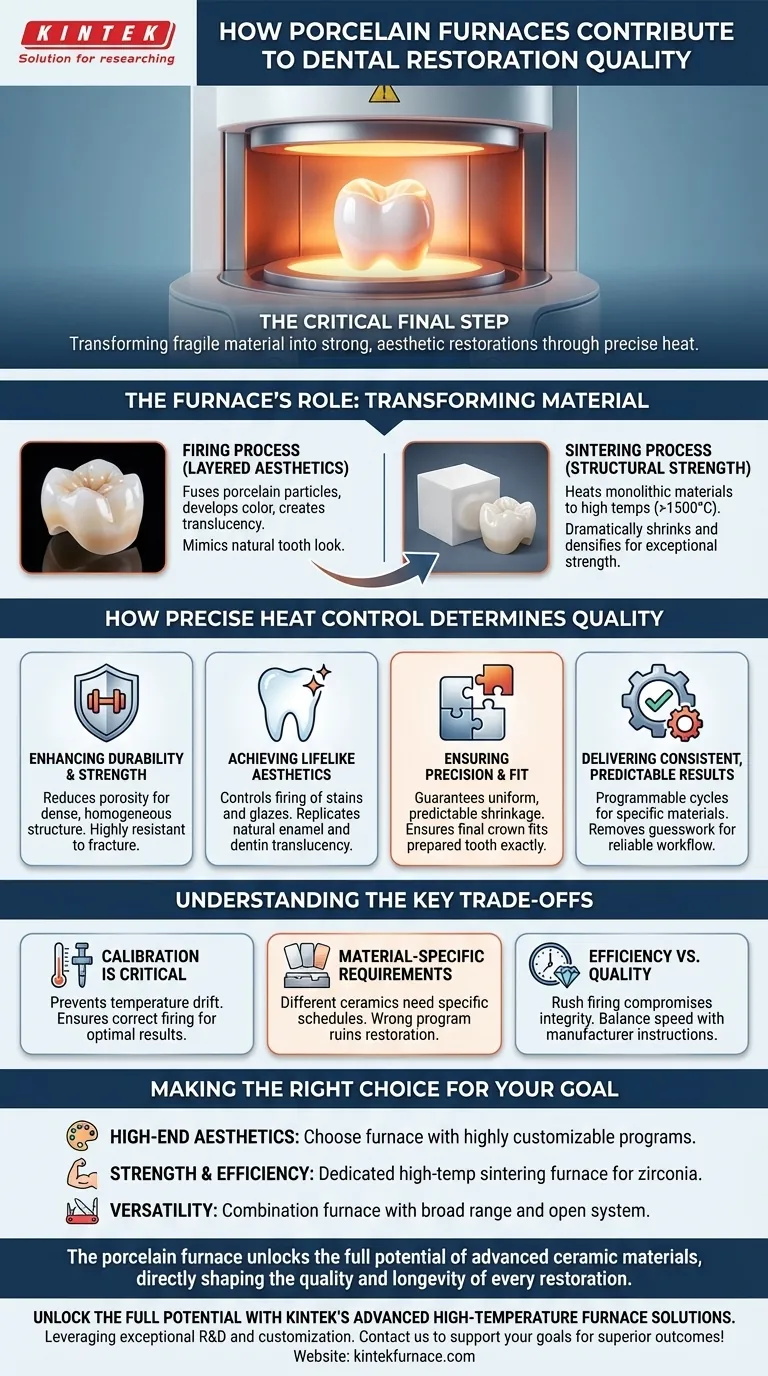
The Furnace's Role: Transforming Material into Restoration
A porcelain furnace isn't simply an oven; it's a precision instrument that performs two primary thermal processes: firing and sintering. The quality of the final restoration is entirely dependent on the accuracy of these processes.
The Firing Process for Layered Aesthetics
Firing is used for traditional layered porcelain restorations. This involves applying layers of porcelain powder onto a core (like metal or zirconia) and heating them.
Each firing cycle fuses the porcelain particles, develops color, and creates translucency. The furnace's ability to follow a precise temperature curve is essential for mimicking the complex look of a natural tooth.
The Sintering Process for Structural Strength
Sintering is primarily used for monolithic materials like zirconia. A restoration is first milled from a pre-sintered, chalk-like block.
The sintering furnace then heats it to very high temperatures (often over 1500°C). This process dramatically shrinks the material, closing the pores between its particles and transforming it into a dense, exceptionally strong final form.
How Precise Heat Control Determines Quality
The furnace's performance has a direct and measurable impact on the clinical success of the restoration. Each attribute of a high-quality crown or veneer can be traced back to the furnace's function.
Enhancing Durability and Strength
The primary goal of sintering is to reduce porosity. An accurate furnace creates a dense, homogenous material structure that is highly resistant to fracture and the immense chewing forces within the mouth.
Inaccurate temperature or heating rates can result in an incompletely sintered restoration that is weak, porous, and prone to premature failure.
Achieving Lifelike Aesthetics
A natural tooth has a complex structure of enamel and dentin with varying levels of translucency and color. A furnace replicates this by enabling technicians to control the firing of stains and glazes.
Precise heat management ensures the glaze flows correctly for a smooth, natural-looking surface and that stains achieve their target shade without burning out. This is how a restoration can be made to blend undetectably with adjacent teeth.
Ensuring Precision and Fit
Ceramic materials shrink during heating. This shrinkage must be perfectly uniform and predictable to ensure the final crown fits the prepared tooth exactly.
A furnace with accurate temperature control and even heat distribution guarantees consistent shrinkage. A poor fit not only compromises aesthetics but can also lead to decay and periodontal issues.
Delivering Consistent, Predictable Results
Modern dental furnaces feature programmable cycles for specific materials. This automation removes guesswork and ensures that every restoration of a certain type is processed under identical conditions.
This consistency is the foundation of a reliable workflow, giving the dental lab and clinician confidence that the final product will meet established quality standards every time.
Understanding the Key Trade-offs
While essential, a furnace is not a magic bullet. Its effectiveness is dependent on proper management and understanding its limitations.
The Critical Role of Calibration
A furnace's temperature accuracy can drift over time. Without regular calibration, a furnace set to 900°C might only be reaching 880°C, leading to under-fired porcelain that is opaque and weak.
Regular calibration is non-negotiable for maintaining quality and ensuring predictable outcomes.
Material-Specific Requirements
Different ceramics, such as zirconia and lithium disilicate, have vastly different and highly specific sintering and firing schedules. Using the wrong program will ruin the restoration.
A lab's choice of furnace must align with the materials it intends to use. Versatile furnaces offer flexibility, but dedicated furnaces can optimize results for a single material type.
Efficiency vs. Quality
Faster heating cycles can improve a lab's productivity, but "rush firing" can introduce thermal stress that compromises the material's integrity or aesthetic result.
The ideal cycle balances efficiency with the material manufacturer's validated instructions to ensure quality is not sacrificed for speed.
Making the Right Choice for Your Goal
The furnace is the cornerstone of quality control in restorative dentistry. Your choice and use of this equipment should align directly with your primary clinical or business objectives.
- If your primary focus is high-end aesthetics: Invest in a furnace with highly customizable programs for precise control over layering, staining, and glazing cycles.
- If your primary focus is strength and efficiency: A dedicated, high-temperature sintering furnace is essential for processing monolithic zirconia restorations reliably.
- If your primary focus is versatility: Select a combination furnace with a broad temperature range and an open system to accommodate a wide variety of ceramic materials.
Ultimately, the porcelain furnace is what unlocks the full potential of advanced ceramic materials, directly shaping the quality and longevity of every restoration you create.
Summary Table:
| Aspect | Impact on Restoration Quality |
|---|---|
| Durability | Reduces porosity for stronger, fracture-resistant materials |
| Aesthetics | Enables precise color and translucency control for natural looks |
| Fit | Ensures uniform shrinkage for accurate tooth adaptation |
| Consistency | Provides repeatable results with programmable cycles |
Unlock the full potential of your dental restorations with KINTEK's advanced high-temperature furnace solutions. Leveraging exceptional R&D and in-house manufacturing, we offer Muffle, Tube, Rotary Furnaces, Vacuum & Atmosphere Furnaces, and CVD/PECVD Systems tailored for dental labs. Our strong deep customization capability ensures precise alignment with your unique experimental needs, enhancing quality and efficiency. Contact us today to discuss how we can support your goals for superior dental restoration outcomes!
Visual Guide
Related Products
- Dental Porcelain Zirconia Sintering Ceramic Vacuum Press Furnace
- Chairside Dental Porcelain Zirconia Sintering Furnace with Transformer for Ceramic Restorations
- Vacuum Dental Porcelain Sintering Furnace for Dental Laboratories
- High Temperature Muffle Oven Furnace for Laboratory Debinding and Pre Sintering
- 2200 ℃ Graphite Vacuum Heat Treat Furnace
People Also Ask
- What factors determine the quality of sintered zirconia restorations? Master Material, Equipment, and Technique
- How do conventional vs rapid sintering in dental furnaces affect zirconia? Optimize Efficiency Without Sacrificing Strength
- What is the purpose of dental sintering furnaces? Transform Zirconia into Durable, High-Quality Dental Restorations
- What precautions should be taken when sintering zirconia in the Fast Slow Dental Sintering Furnace? Master Key Steps for Perfect Results
- What temperature range is used for sintering zirconia ceramics? Achieve Optimal Strength and Translucency



















