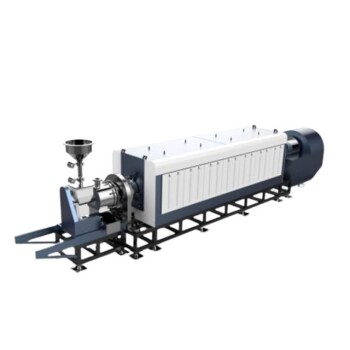
For determining the ash content of biomass, a high-temperature muffle furnace is typically set to 600°C. This temperature facilitates the complete thermal oxidation and volatilization of organic components, leaving behind only the inorganic mineral residues.
The core objective of this process is to isolate the non-combustible inorganic fraction of the biomass through controlled oxidation. By maintaining a stable, high-temperature environment, the muffle furnace ensures that all carbon-based matter is removed, allowing for the precise quantification of residual ash.
The Mechanism of Ash Determination
Thermal Oxidation and Volatilization
The primary mechanism involves the complete combustion of organic elements such as carbon, hydrogen, oxygen, and nitrogen. Under the atmospheric pressure and high heat of the furnace, these elements react with oxygen to form gases that are released into the environment.
Isolation of Inorganic Residues
As the organic matrix decomposes, the inorganic minerals (such as silica, calcium, and magnesium) remain in the porcelain crucible. This stable residue is what we define as ash, and its weight relative to the original sample provides the ash content percentage.
Heat Circulation and Uniformity
A muffle furnace is essential because it provides a controlled oxidative environment with uniform heat distribution. This consistency prevents "cold spots" that could lead to incomplete combustion, which would artificially inflate the recorded ash content.
The Significance of the 600°C Threshold
Optimizing Organic Removal
At 600°C, the energy provided is sufficient to break the chemical bonds of complex organic polymers found in biomass, such as lignin and cellulose. This ensures that the material remaining is purely mineral and free of residual carbon.
Evaluating Fuel Quality
Determining ash content is a critical metric for assessing biomass fuel quality. High ash levels directly correlate to lower heating values and provide early indicators of potential operational issues in industrial boilers.
Impact on Downstream Processing
For applications like activated carbon production, knowing the ash content is vital for evaluating deashing treatments. It allows technicians to determine the purity of the carbon and the effectiveness of the refinement process.
Understanding the Trade-offs and Pitfalls
Volatilization of Essential Minerals
Setting the temperature too high (e.g., above 750°C) can cause the loss of volatile elements such as phosphorus, potassium, and sulfur. This leads to an underestimation of the total mineral content and inaccurate chemical analysis.
Carbonate Decomposition
At extreme temperatures, carbonates within the biomass may decompose and later reabsorb carbon dioxide during the cooling phase. This chemical fluctuation can lead to inconsistent weight measurements and unreliable data.
Incomplete Calcination
Conversely, if the temperature is too low or the duration is too short, unburned carbon may remain in the sample. This results in a "false high" ash reading, which misrepresents the inorganic profile of the biomass.
How to Apply This to Your Analysis
When configuring your muffle furnace for biomass testing, your specific goals should dictate the precise temperature and protocol.
- If your primary focus is standard fuel quality assessment: Set the furnace to 600°C to ensure the total removal of organic matter for a standard ash weight.
- If your primary focus is preserving volatile minerals (P, K, S): Consider a lower setting of 550°C to minimize the volatilization of these specific elements while still achieving oxidation.
- If your primary focus is assessing boiler slagging potential: Use the ash residue to analyze the chemical composition of the minerals to predict how they will behave under high-heat combustion.
Accurate ash determination through precise temperature control is the foundation for reliable biomass energy evaluation and equipment maintenance planning.
Summary Table:
| Parameter | Standard Setting | Key Mechanism / Purpose |
|---|---|---|
| Standard Temperature | 600°C | Complete thermal oxidation of organic components |
| Primary Mechanism | Volatilization | Converts C, H, O, N into gases, leaving inorganic minerals |
| Residual Material | Inorganic Ash | Isolated minerals like silica, calcium, and magnesium |
| Upper Limit Risk | >750°C | Risk of losing volatile elements (P, K, S) |
| Lower Limit Risk | <550°C | Risk of incomplete calcination and unburned carbon |
Optimize Your Biomass Analysis with KINTEK Precision
Achieving accurate ash content determination requires consistent, uniform heating that only high-quality equipment can provide. KINTEK specializes in advanced laboratory equipment and consumables, offering a comprehensive range of high-temperature furnaces—including muffle, tube, rotary, vacuum, CVD, atmosphere, and induction melting furnaces—all of which are fully customizable to meet your unique research requirements.
Whether you are assessing fuel quality or evaluating deashing treatments for activated carbon, our furnaces ensure the thermal stability and precision necessary for reliable data.
Ready to upgrade your lab's efficiency? Contact KINTEK today to find the perfect thermal solution for your application!
References
- David Ojo Akindele, Oluwafemi Festus Olaiyapo. Harnessing the Thermal Potentials of Bitter Kola Tree Using Thermo- Gravimetric Analysis (TGA) Method. DOI: 10.59324/ejtas.2023.1(5).55
This article is also based on technical information from Kintek Furnace Knowledge Base .
Related Products
- 1700℃ High Temperature Muffle Oven Furnace for Laboratory
- 1800℃ High Temperature Muffle Oven Furnace for Laboratory
- 1200℃ Muffle Oven Furnace for Laboratory
- 1400℃ Muffle Oven Furnace for Laboratory
- High Temperature Muffle Oven Furnace for Laboratory Debinding and Pre Sintering
People Also Ask
- What is the primary function of a high-temperature laboratory muffle furnace in chemical synthesis? Achieve Precision.
- How does a high-temperature laboratory muffle furnace affect material properties? Transform Anodic Oxide Films Fast
- What role does a muffle furnace play in BCZY712 electrolyte powder production? Achieve Perfect Phase Purity
- What role does a muffle furnace play in sintering photocathodes? Enhance Electrode Conductivity & Catalytic Activity
- How does a muffle furnace impact Ni/MgAl2O4 catalysts? Optimize Stability and Catalytic Performance