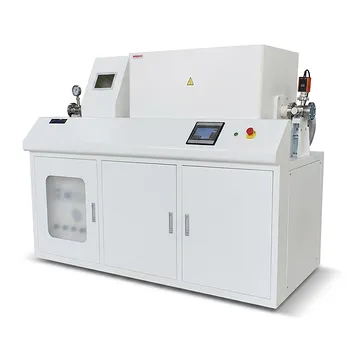
SPS is the only thermal consolidation method fast and low-temperature enough to densify the powder matrix around a 3D-printed metal lattice without destroying the very lattice you built.
When you combine 3D additive manufacturing with Spark Plasma Sintering, you are trying to solve a thermal paradox: fully densify a matrix powder while preventing any microstructural damage to an intricate, pre-built metallic framework. Conventional sintering or hot pressing would require hours at high temperature, causing the lattice struts to coarsen, degrade, or collapse long before the powder matrix reaches acceptable density. SPS breaks this trade-off by using pulsed electric current and uniaxial pressure to achieve near-theoretical density in minutes at much lower temperatures, preserving the lattice’s original geometry, grain structure, and mechanical performance.
The core advantage is time-at-temperature control. SPS’s extremely rapid heating (up to 1000°C/min) and short dwell times (often 5–10 minutes) allow full matrix consolidation while effectively freezing the pre-existing microstructure of the 3D-printed skeleton, avoiding grain coarsening, phase degradation, and harmful interfacial reactions that would otherwise ruin the composite.
The Fundamental Challenge of Hybrid Lattice-Matrix Composites
You begin with a delicate, high-surface-area metallic lattice fabricated by Electron Beam Melting or another additive process. This lattice carries precisely engineered geometry and a microstructure born from rapid solidification—typically fine grains and high dislocation densities. You then surround it with a metal or ceramic powder matrix. The challenge is to make that loose powder a dense, strong solid without turning your lattice into a blurry, annealed shadow of itself.
Why Traditional Sintering Fails the Lattice
Conventional pressureless sintering requires hours at elevated temperatures. Prolonged exposure drives atomic diffusion across the lattice struts, causing grain coarsening and loss of the fine strengthening features that make the lattice valuable.
Long thermal cycles also promote unwanted interfacial reactions between the lattice material and the matrix, creating brittle intermetallic phases that weaken the composite’s bonding. In extreme cases, thermal degradation can even distort or partially melt the thin struts, compromising the architectured design.
The matrix itself may not densify fully unless the temperature is pushed high enough. So you’re caught between a melting, coarsening lattice and a porous, under-sintered matrix. Traditional methods simply cannot resolve that conflict.
How SPS Solves the Densification Versus Degradation Paradox
Spark Plasma Sintering takes a completely different approach. It doesn’t rely on external furnace heating alone. Instead, it passes a high pulsed DC current directly through the die and, in conductive powders, through the material itself while applying uniaxial mechanical pressure.
The Mechanisms That Protect the Lattice
Joule heating localizes heat generation. The current flows preferentially through particle contacts, creating microscopic hot spots that accelerate neck formation and mass transport right where it’s needed. The bulk temperature of the pre-printed lattice can remain far lower than in a furnace, because heat isn’t being rammed in from the outside for hours.
The extreme heating rate (up to 1000°C/min) slashes the time spent at dangerous temperatures. The lattice sees high heat for only a few minutes, not hours. This is the critical insight: grain boundary migration, precipitate coarsening, and element diffusion are kinetic processes. You starve them of time, and they simply don’t happen at a meaningful scale.
Mechanical pressure enhances densification at lower temperatures. Applying 20–60 MPa or more collapses pores, enables plastic flow, and drives particle rearrangement. This pushes the matrix to 97–99%+ theoretical density while the SPS system operates hundreds of degrees below the temperature that would coarsen the lattice.
Inhibiting Specific Failure Modes
Grain coarsening is suppressed. The rapid cycle keeps the lattice struts’ fine grain structure intact, preserving the high strength and hardness they were designed to provide.
Harmful interfacial reactions are minimized. Reduced contact time at high temperature means carbon or ceramic fibers, or in this case the metal lattice surface, do not have time to form thick, brittle interdiffusion layers. The interface remains clean and mechanically sound.
Thermal decomposition is avoided. If the lattice material contains temperature-sensitive phases (like certain intermetallics or metastable nanostructures), the short dwell time prevents them from dissolving or transforming.
Microstructural integrity is preserved at all scales. From nano-scale precipitates to macro-scale strut geometry, what you printed is what you get in the final composite—now surrounded by a fully dense matrix.
Understanding the Scale of Temporal Advantage
Supplementary studies show that SPS can densify metal-matrix composites like stainless steel–TiB₂ to 97–99% relative density at 1100°C in minutes, while a similar conventional cycle would take hours and yield a coarser structure. For Mo-Cr-Y composites, heating rates of 100°C/min combined with very short sintering times inhibit molybdenum grain coarsening entirely, keeping second-phase dispersoids finely distributed.
In reactive SPS systems, chemical reactions occur simultaneously with densification under pulsed current, resulting in nanoscale reinforcement particles (100–200 nm) that pin grain boundaries. This demonstrates the unique ability of SPS to produce fine microstructures even while densifying—the exact scenario needed when your lattice itself contains fine features you cannot afford to lose.
Trade-offs and Practical Considerations
SPS is not a magic bullet. Its advantages are real, but they come with process-specific requirements that must be respected.
Temperature control is non-negotiable. Too low a sintering temperature (e.g., 1000°C for some stainless steel composites) leads to under-sintering and high porosity (10–18%). Only an optimal threshold (often 1100°C or higher) achieves full density. But that threshold must be hit and held for just the right minimum time—no more. Any overshoot risks the very coarsening you are trying to avoid.
Die size and geometry limit part dimensions. SPS is typically a near-net-shape process inside a graphite die. Complex, very large 3D-printed lattices may be difficult to accommodate, and pressure uniformity across angular geometries can be a challenge.
Electric current distribution matters. If the lattice itself is highly conductive and continuous, current may shunt through it unpredictably, altering heating uniformity. Process design must account for this electrical pathway.
Cycle time is short, but preparation is not. Loading the lattice, backfilling powder, and ensuring uniform packing can be time-intensive. SPS is fast once the current flows, but the overall manufacturing pace depends on pre-processing steps.
Making the Right Choice for Your Composite
Your design goal dictates whether SPS is the right consolidation route for your architectured composite.
If your primary focus is preserving the original microstructure of the 3D-printed lattice: SPS is your only practical choice because it limits thermal exposure so drastically that grain coarsening and phase transformations become negligible.
If your primary focus is achieving near-theoretical density in the matrix without distorting the lattice: SPS’s combination of pressure and rapid heating achieves full consolidation at lower temperatures than any conventional furnace technique.
If your primary focus is avoiding brittle interfacial reaction products: The short time-at-temperature window of SPS is a proven method to suppress diffusion and keep the lattice-matrix interface clean.
If your primary focus is geometric complexity over microstructural preservation: Assess whether the lattice can survive short pressure-assisted heating; if not, you may need to redesign the lattice or accept a less aggressive consolidation approach, but SPS remains the best starting point.
The bottom line is that SPS solves the fundamental thermal conflict of combining a pre-built metal lattice with a densified powder matrix. Its speed freezes the good structure you already have, while its unique energy delivery gives you the dense composite you need.
Summary Table:
| Feature / Parameter | Conventional Sintering | Spark Plasma Sintering (SPS) |
|---|---|---|
| Sintering Dwell Time | Hours | Minutes (typically 5–10 min) |
| Heating Rate | Slow (5–20°C/min) | Ultra-fast (up to 1000°C/min) |
| Densification Mechanism | Thermal diffusion only | Pulsed current + Uniaxial pressure |
| Lattice Microstructure | Coarsened grains, lost fine features | Preserved original geometry & grain structure |
| Interfacial Degradation | High risk of brittle intermetallics | Minimized due to short time-at-temperature |
| Matrix Relative Density | Often low without excessive heat | Near-theoretical (97–99%+) |
Push the Boundaries of Advanced Material Sintering with KINTEK
Looking to achieve near-theoretical matrix density without compromising delicate 3D-printed microstructures? KINTEK specializes in advanced laboratory equipment and high-temperature furnaces designed for precise material processing.
From high-performance Spark Plasma Sintering (SPS) systems to customizable vacuum, atmosphere, tube, and muffle furnaces, we provide cutting-edge thermal solutions tailored to your exact research and production needs.
Ready to enhance your lab's sintering capabilities and solve complex thermal paradoxes? Contact KINTEK today to consult with our experts!
Related Products
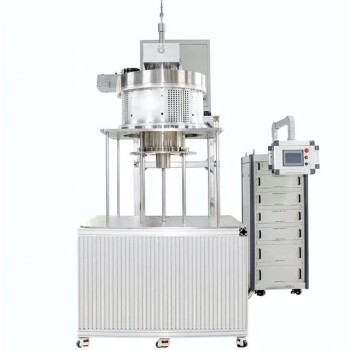
- Spark Plasma Sintering SPS Furnace
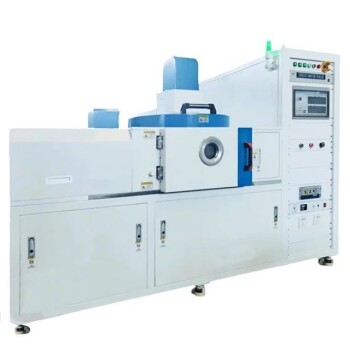
- 915MHz MPCVD Diamond Machine Microwave Plasma Chemical Vapor Deposition System Reactor
- RF PECVD System Radio Frequency Plasma Enhanced Chemical Vapor Deposition
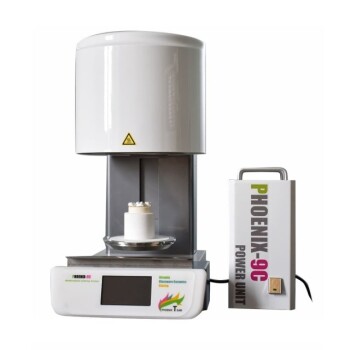
- Vacuum Heat Treat Sintering Furnace with Pressure for Vacuum Sintering
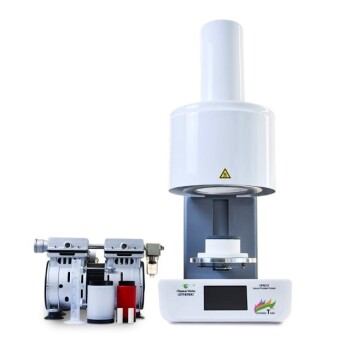
- 9MPa Air Pressure Vacuum Heat Treat and Sintering Furnace
People Also Ask
- How does the heating mechanism of Spark Plasma Sintering (SPS) function? Enhance TiC/SiC Composite Fabrication
- Why is it necessary to maintain a high vacuum environment during the SPS of SiC? Key to High-Density Ceramics
- What are the technical advantages of using an SPS sintering furnace? Elevate Al2O3-TiC Material Performance
- What are the advantages of Spark Plasma Sintering (SPS)? Achieve Superior Microstructures
- What are the steps in the discharge plasma sintering process? Master Fast, High-Density Material Consolidation