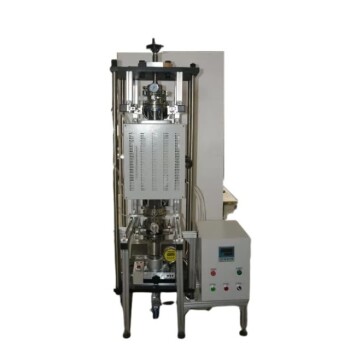
Precise temperature control isn't just a refinement—it's the fundamental gatekeeper of alloy integrity. When sintering binary precious metal alloy powders like gold-platinum (Au-Pt) systems, exact thermal management dictates whether you form a homogeneous, defect-free part or a two-phase, mechanically compromised mass. The Gold-Platinum system features a complex phase diagram with composition-dependent miscibility gaps, solid-state phase transitions, and a shifting liquidus-solidus boundary. Straying outside its narrow thermodynamic windows triggers phase separation, incomplete diffusion, or unexpected incipient melting, all of which destroy the uniform solid-solution structure required for high-performance applications.
The deep challenge of sintering binary precious alloys lies in their extreme sensitivity to thermal history. Even small excursions can push the material into a thermodynamically unstable region, leading to irreversible segregation or mechanical failure. Accurate, programmable furnace control is not optional—it is the only way to remain within the optimal processing window and deliver a fully alloyed, pore-free component with consistent properties.
The Unique Thermodynamic Landscape of Binary Precious Alloys
Navigating Miscibility Gaps and Phase Boundaries
The Au-Pt binary system is not a simple “melt and mix” case. At certain atomic compositions and temperature ranges, the two metals become immiscible, forming a miscibility gap where the alloy separates into two distinct solid phases. Sintering inside or near this region without precise control causes the gold and platinum atoms to cluster separately instead of forming a uniform substitutional solid solution.
Phase separation is irreversible once it nucleates. The resulting microstructure contains regions of differing composition and lattice parameter, acting as stress concentrators that reduce strength and ductility. Only by mapping the exact phase boundaries and holding the sintering temperature in the stable single-phase field can you guarantee a homogeneous alloy.
Understanding Liquidus-Solidus Sensitivity
Binary precious metal alloys show a significant temperature interval between solidus and liquidus lines that shifts with composition. A seemingly safe sintering temperature for one Au-Pt ratio may be perilously close to the solidus for another. Without high-precision measurement and control, the furnace may cross the liquidus threshold at peak temperature.
Incipient melting is disastrous. Even a tiny liquid fraction pools at grain boundaries, creating voids upon cooling, embrittling the part, and ruining surface finish. Precise thermal management—using digital PID controllers and uniform heating elements—keeps the peak temperature securely below the solidus for the given composition, eliminating this risk.
Enforcing Complete Diffusion and Solid-Solution Formation
Sintering is a diffusion-driven process. Atoms must migrate across particle boundaries to eliminate porosity and achieve metallurgical bonding. In binary systems, this diffusion must also create a chemically uniform random solid solution rather than a layered or core-shell structure.
Temperature is the master variable for diffusion. An under-temperature of just 20-30°C slows interdiffusion exponentially, leaving behind unalloyed gold-rich or platinum-rich cores. These compositional gradients weaken the final part and make it susceptible to galvanic corrosion. Precision control ensures the entire compact spends exactly the right time at a temperature high enough to produce complete chemical homogenization.
Why Heating Rate and Homogeneity Are Non-Negotiable
Preventing Thermal Gradients and Heterogeneity
The uniformity of the thermal zone is just as important as the setpoint. High-temperature laboratory furnaces with multiple-zone heating and advanced PID algorithms flatten temperature profiles so the entire powder compact experiences the same history.
Local hot or cold spots skew the outcome. A slightly hotter region may enter the miscibility gap or prematurely melt, while a cooler region fails to densify. This produces a component with variable grain size, residual porosity, and inconsistent mechanical properties. Controlling heating rate and soak uniformity is the only way to eliminate such spatial variations.
The Kinetic Dimension: Time at Temperature Matters
Binary alloy formation follows kinetic pathways that are sensitive to how quickly the system reaches the target temperature. Even when the final temperature is correct, an excessively fast ramp rate can trap the compact in a transitory phase field long enough to nucleate secondary phases before solid-state diffusion can erase them.
Slow, deliberate heating profiles give interdiffusion time to keep pace with temperature change. For Au-Pt powders, this means ramping at rates that avoid bypassing the narrow single-phase window where true alloying occurs. Programmable furnaces let you design multi-step profiles that gently guide the system through critical phase transitions without destabilizing the microstructure.
Understanding the Trade-offs
The Risk of Over-Sintering
Higher temperatures are not always better. Pushing the temperature too close to the solidus, even without full melting, can trigger grain coarsening. Excessive grain growth reduces strength and can trap residual porosity inside the growing grains, making it impossible to eliminate during subsequent steps.
In precious metal systems, oversintering also wastes valuable material and energy, while potentially altering the surface composition through preferential evaporation. The precise control that avoids melting also caps the maximum grain size, maintaining the fine-grained, high-strength structure that is often desired in precision components.
The Pitfall of Under-Treatment
Insufficient temperature or soak time leads to incomplete neck formation between particles and poor densification. The part remains porous, with low hardness and tensile strength. In binary alloys, under-sintering also leaves chemical inhomogeneities that can later cause phase transformation during service or heat treatment.
Striking the balance requires mapping the process window experimentally. Only a furnace with a proven digital PID controller and calibrated thermocouples can repeatedly hit the narrow thermal target that gives full density without grain coarsening.
Common Equipment-Related Failures
Even the best sintering theory falls apart with drifted thermocouples or aging heating elements. A +/- 5°C discrepancy may seem minor, but for an Au-Pt alloy, that shift can be the difference between a single-phase solid solution and a two-phase microstructure.
Regular calibration and using furnaces with uniform, low-mass insulation help maintain accuracy over time. Shortcuts like relying on simple on-off controllers instead of PID logic introduce temperature overshoot that can transiently melt boundaries, leave behind detectable defects, and compromise reproducibility.
Making the Right Choice for Your Alloy System
The key to success is matching your thermal process to the exact phase diagram and diffusion kinetics of your binary precious metal system. Here is how to align your sintering strategy with your primary goal:
- If your primary focus is achieving a chemically homogeneous solid solution: Prioritize a furnace with multi-zone PID control and validate the thermal profile with a compositional mapping technique. Select a temperature safely within the single-phase field and use a slow ramp to avoid passing through miscibility gaps too quickly.
- If your primary focus is maximizing mechanical properties: Design a sintering cycle that provides sufficient time for full densification while limiting grain growth. Use a controlled cooling step to freeze the fine-grained microstructure, and verify hardness and density on a witness sample before committing full production.
- If your primary focus is process consistency and batch-to-batch reproducibility: Calibrate your thermocouples regularly, map the thermal uniformity of the work zone, and document the exact soak temperature with a tolerance of ±2°C. Small variations in initial powder composition must be met with a pre-planned temperature adjustment derived from the phase diagram.
With the right thermal discipline, sintering a gold-platinum powder compact becomes a predictable pathway to a dense, homogenous alloy—no phase separation, no unintended liquid phase, just a clean solid solution ready for its final application.
Summary Table:
| Sintering Factor | Thermal Deviation / Poor Control | Microstructural & Material Impact | Solution / Control Strategy |
|---|---|---|---|
| Phase Boundary Control | Sintering within the miscibility gap | Irreversible phase separation, segregation, stress points | Hold stable setpoint inside single-phase solid solution field |
| Liquidus-Solidus Proximity | Exceeding solidus temperature | Incipient melting, boundary voids, part embrittlement | Precision PID control to stay safely below peak solidus |
| Diffusion Kinetics | Thermal under-shoot (-20°C to -30°C) | Incomplete interdiffusion, unalloyed cores, galvanic corrosion risk | Extended, accurately monitored thermal soak profiles |
| Thermal Homogeneity | Spatial hot/cold spots across compact | Inconsistent grain growth, local porosity, variable hardness | Multi-zone heating furnaces with low-mass uniform insulation |
Achieve Flawless Precious Alloy Sintering with KINTEK
Navigating complex phase diagrams and miscibility gaps in binary precious metal systems requires absolute thermal discipline. KINTEK specializes in advanced laboratory equipment and high-temperature furnaces—including precision muffle, tube, vacuum, controlled atmosphere, and custom multi-zone furnaces—engineered to deliver precise PID temperature control, superior thermal uniformity, and repeatable heating profiles.
Don't let thermal drift compromise your alloy integrity. Whether you are conducting cutting-edge metallurgical research or scaling precision manufacturing, our high-temperature solutions can be fully customized to meet your exact processing parameters.
Contact KINTEK today to discuss your furnace requirements with our technical experts!
Related Products
- 2200 ℃ Tungsten Vacuum Heat Treat and Sintering Furnace
- 2200 ℃ Graphite Vacuum Heat Treat Furnace
- Vacuum Heat Treat Sintering Furnace Molybdenum Wire Vacuum Sintering Furnace
- Spark Plasma Sintering SPS Furnace
- Controlled Inert Nitrogen Hydrogen Atmosphere Furnace
People Also Ask
- How does a tungsten-heated vacuum sintering furnace prepare (TbxY1-x)2O3 ceramics? Achieve 99%+ Density & Purity
- How do compaction pressure and vacuum sintering optimize porous ceramics? Maximize Density & Toughness
- What wear-resistance enhancements are achieved by powder coating? The Role of Vacuum Sintering Furnaces
- What role does a high-temperature vacuum sintering furnace play in the densification of WC-10(Ni, Ni/Co) alloys?
- How does high-temp vacuum sintering influence Y-TZP mechanical properties? Achieve Max Toughness