
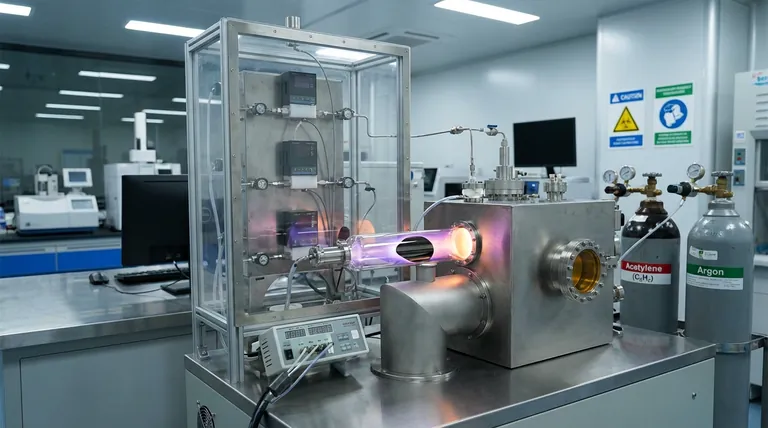
The combination of high-purity graphite targets and acetylene gas is utilized to create a hybrid deposition environment that offers superior control over the coating's atomic structure. This dual approach allows engineers to precisely adjust the ratio of sp2 to sp3 hybridized carbon atoms, which directly dictates the functional performance of the Diamond-Like Carbon (DLC) layer.
By integrating physical sputtering with chemical vapor deposition elements, this process enables the production of an amorphous carbon film that balances high hardness with low friction and excellent chemical inertness.
The Roles of the Components
Graphite: The Physical Carbon Source
High-purity graphite targets serve as the foundational material for the coating. Through a process known as sputtering, carbon atoms are physically ejected from these targets to build the bulk of the film.
Acetylene: The Chemical Regulator
Acetylene (C2H2) gas is introduced into the system via Chemical Vapor Deposition (CVD) components. While it contributes carbon, its primary function is regulatory.
The presence of acetylene helps control the internal structure of the coating. It creates a mechanism to fine-tune the film's properties beyond what simple sputtering could achieve alone.
Controlling the Microstructure
Tuning the sp2/sp3 Ratio
The defining characteristic of a DLC coating is its hybridization ratio. This is the balance between sp2 (graphite-like) and sp3 (diamond-like) carbon bonds.
Using both graphite and acetylene allows for the precise adjustment of this ratio. The operator can dial in the specific mixture to favor the desired characteristics of the final layer.
Resulting Physical Properties
When this ratio is optimized, the result is an amorphous carbon film.
This specific structure provides a low friction coefficient, essential for reducing wear in moving parts. Simultaneously, it maintains high hardness, protecting the substrate from abrasive damage.
Critical Trade-offs to Consider
Process Sensitivity
The primary challenge of this hybrid method is the requirement for precise adjustment. Because the properties rely on a specific ratio of gases and sputtered material, the process window can be narrow.
Balancing Hardness and Toughness
While high hardness is often the goal, a coating that is too hard can be brittle.
The introduction of acetylene helps regulate toughness. Deviating from the optimal gas flow could disrupt this balance, resulting in a coating that is either too soft (lacking durability) or too brittle (prone to cracking).
Making the Right Choice for Your Goal
This hybrid deposition method is best suited for applications requiring a specific "recipe" of physical properties.
- If your primary focus is Wear Resistance: Ensure the process parameters prioritize a higher sp3 ratio to maximize hardness.
- If your primary focus is Component Longevity: Focus on the acetylene regulation to optimize toughness and chemical inertness to prevent environmental degradation.
The synergy between graphite targets and acetylene gas turns a simple coating process into a tunable engineering solution for high-performance surfaces.
Summary Table:
| Component | Role in DLC Deposition | Primary Benefit |
|---|---|---|
| High-Purity Graphite | Physical Sputtering Source | Provides bulk carbon for film growth |
| Acetylene (C2H2) | Chemical Vapor Regulator | Fine-tunes sp2/sp3 ratio and toughness |
| Hybrid Process | Synergistic Deposition | Balances extreme hardness with low friction |
Elevate Your Material Performance with KINTEK Precision
Unlock the full potential of your Diamond-Like Carbon coatings with our specialized deposition technology. Backed by expert R&D and manufacturing, KINTEK offers high-performance Muffle, Tube, Rotary, Vacuum, and CVD systems—all fully customizable to meet your unique thin-film and heat-treatment requirements.
Whether you are optimizing for wear resistance or component longevity, our systems provide the precise control needed for professional-grade results. Contact our specialists today to find the perfect solution for your lab or production facility!
References
- Eneko Barba, J.A. Garcı́a. Study of the Industrial Application of Diamond-Like Carbon Coatings Deposited on Advanced Tool Steels. DOI: 10.3390/coatings14020159
This article is also based on technical information from Kintek Furnace Knowledge Base .
Related Products
- 2200 ℃ Graphite Vacuum Heat Treat Furnace
- Magnesium Extraction and Purification Condensing Tube Furnace
People Also Ask
- Why are vacuum heat treating furnaces essential for aerospace? Ensure Superior Material Integrity for High-Stakes Applications
- What is the primary application of vacuum heat treating furnaces in aerospace? Enhance Component Performance with Precision
- How does a vacuum heat treating furnace improve the condition of metal alloys? Achieve Superior Metal Performance
- How does vacuum heat treating work in terms of temperature and time control? Master Precise Material Transformations
- What is the process of vacuum heat treating? Achieve Superior Metallurgical Properties

