
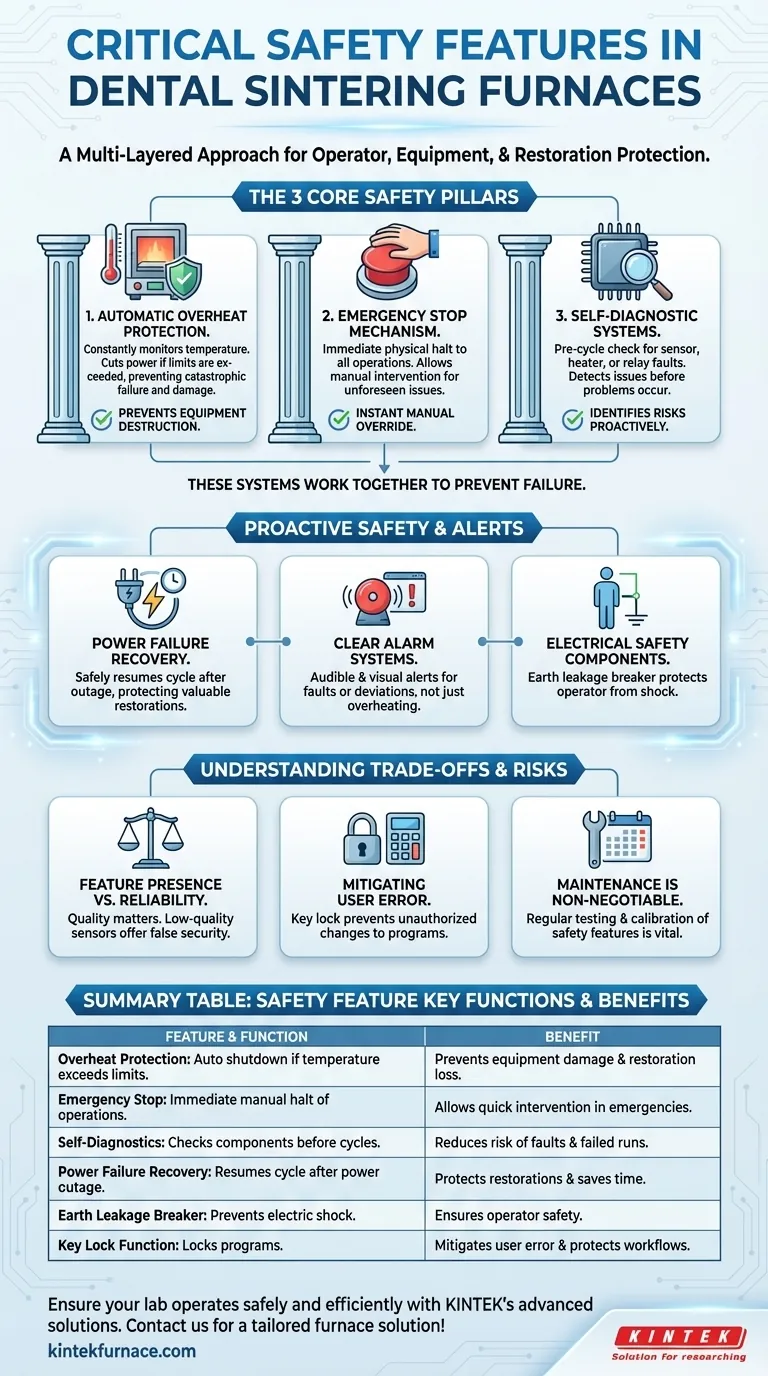
At a minimum, a dental sintering furnace must have three core safety features: automatic overheat protection to prevent catastrophic failure, an emergency stop mechanism for immediate manual intervention, and a self-diagnostic system to detect component faults before they cause a problem. These systems work together to protect the operator, the equipment, and the valuable restorations being processed.
The most critical takeaway is that furnace safety is not a single feature, but a multi-layered system. It combines automated protections against predictable failures like overheating with proactive diagnostics that identify risks before a cycle even begins, ensuring the safety of both personnel and lab assets.
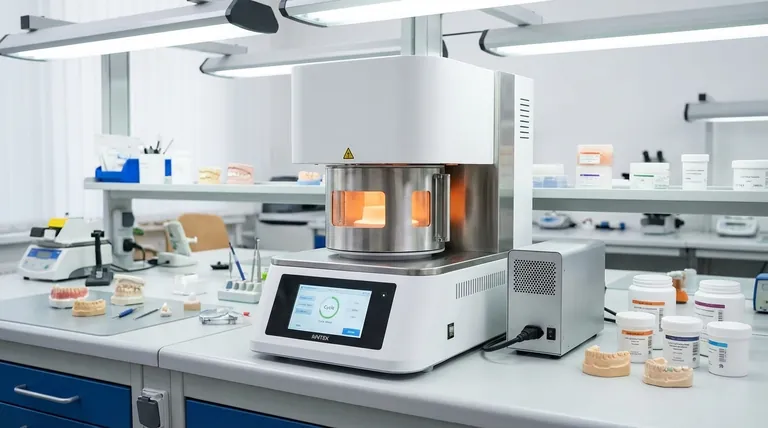
Core Safety Systems: Protecting Against Failure
The primary role of a furnace's safety system is to prevent catastrophic events. These features are non-negotiable and form the first line of defense.
Overheat Protection and Automatic Shutdown
This is the most fundamental safety feature. A dedicated sensor constantly monitors the chamber temperature, and if it exceeds a pre-set maximum safe limit, the system automatically cuts power to the heating elements.
This prevents the destruction of heating elements, damage to the furnace chamber, and the potential ruin of an entire batch of zirconia restorations.
Emergency Stop Mechanisms
An emergency stop is a physical, easily accessible button that immediately halts all furnace operations.
This allows an operator to intervene instantly if they observe a problem that the automated systems have not yet detected, such as unusual sounds, smoke, or physical damage. It provides an essential manual override in unforeseen circumstances.
Power Failure Recovery
A power outage mid-cycle can ruin an entire batch of restorations. A robust auto-recovery feature is crucial for operational safety and asset protection.
When power is restored, the furnace should be able to safely resume the sintering cycle from where it left off, preventing the financial loss and wasted time of a failed batch.
Proactive Safety: Diagnostics and Alerts
Modern furnaces go beyond simple failure prevention. They incorporate systems that proactively identify risks, alert the user, and protect the operator from electrical hazards.
Comprehensive Self-Diagnostic Functions
Think of this as a pre-flight check before every cycle. The furnace's internal software should automatically check for critical component errors.
Key checks include sensor errors, heater disconnections, and SSR (Solid State Relay) short circuits. Detecting these issues before starting a high-temperature cycle prevents failed runs and potential equipment damage.
Clear Alarm Systems
When a problem is detected, the furnace must alert the operator clearly and immediately. This includes both audible alarms and visual error messages on the display.
These alarms should not be limited to overheating but should trigger for any fault found during self-diagnostics or any deviation from the programmed cycle.
Electrical Safety Components
Operator safety is paramount. An earth leakage breaker is a vital component that protects the user from electric shock in the event of an electrical fault within the unit. This is a fundamental feature of any safe electrical appliance.
Understanding the Trade-offs and Risks
Simply having a list of safety features does not guarantee safety. The quality of implementation and user awareness are just as important.
Feature Presence vs. Reliability
Not all safety systems are created equal. A low-quality temperature sensor can fail, providing a false sense of security. When evaluating a furnace, the reliability and quality of these safety components are as important as their existence.
The Risk of User Error
Even the safest furnace cannot protect restorations from being programmed incorrectly. An operator setting the wrong temperature or ramp rate can still ruin a batch.
Features like a key lock function can mitigate this risk by preventing unauthorized or accidental changes to validated and stored sintering programs.
Maintenance Is Non-Negotiable
Safety features require periodic verification. Alarms, emergency stops, and especially temperature sensors need to be tested and calibrated regularly as part of a preventive maintenance schedule. A faulty safety feature is a significant hidden risk.
Evaluating a Furnace for Your Lab
Use the following points to assess if a furnace meets your lab's specific safety and operational needs.
- If your primary focus is operator and equipment safety: Prioritize furnaces with redundant overheat protection, a built-in earth leakage breaker, and comprehensive self-diagnostics that check for heater and sensor faults.
- If your primary focus is protecting your restorations and workflow: Ensure the furnace has a reliable power failure recovery system and a key lock function to prevent costly programming errors.
- If you are evaluating your current equipment: Schedule a service to test all alarms, emergency stop buttons, and sensor accuracy to confirm these critical safety systems are fully functional.
Making an informed decision on these features ensures you are investing in a tool that reliably protects your staff, your equipment, and your work.
Summary Table:
| Safety Feature | Key Function | Benefit |
|---|---|---|
| Overheat Protection | Automatically shuts down if temperature exceeds safe limits | Prevents equipment damage and restoration loss |
| Emergency Stop | Immediate manual halt of operations | Allows quick intervention in emergencies |
| Self-Diagnostics | Checks components like sensors and heaters before cycles | Reduces risk of faults and failed runs |
| Power Failure Recovery | Resumes cycle after power outage | Protects restorations and saves time |
| Earth Leakage Breaker | Prevents electric shock from electrical faults | Ensures operator safety |
| Key Lock Function | Locks programs to prevent unauthorized changes | Mitigates user error and protects workflows |
Ensure your dental lab operates safely and efficiently with KINTEK's advanced high-temperature furnace solutions. Leveraging exceptional R&D and in-house manufacturing, we offer Muffle, Tube, Rotary Furnaces, Vacuum & Atmosphere Furnaces, and CVD/PECVD Systems, all with strong deep customization to meet your unique needs. Protect your staff, equipment, and restorations—contact us today for a tailored solution!
Visual Guide
Related Products
- Vacuum Dental Porcelain Sintering Furnace for Dental Laboratories
- Dental Porcelain Zirconia Sintering Ceramic Vacuum Press Furnace
- Chairside Dental Porcelain Zirconia Sintering Furnace with Transformer for Ceramic Restorations
- High Temperature Muffle Oven Furnace for Laboratory Debinding and Pre Sintering
- Vacuum Heat Treat Sintering Furnace with Pressure for Vacuum Sintering
People Also Ask
- What is the purpose of dental sintering furnaces? Transform Zirconia into Durable, High-Quality Dental Restorations
- How does a dental vacuum porcelain furnace maintain restoration quality? Precision Sintering for Superior Esthetics
- How does a dental sintering furnace save time compared to traditional ceramic processing? Streamline Your Lab's Workflow
- What is the role of dental sintering furnaces in dental restorations? Transform Zirconia into Durable, Aesthetic Teeth
- What is a dental sintering furnace and what is its purpose? Achieve High-Strength Dental Restorations



















