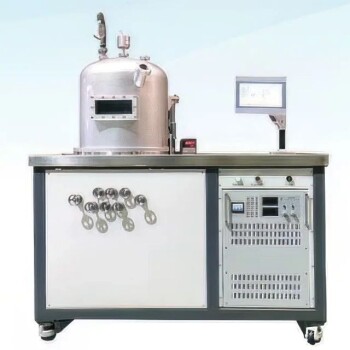
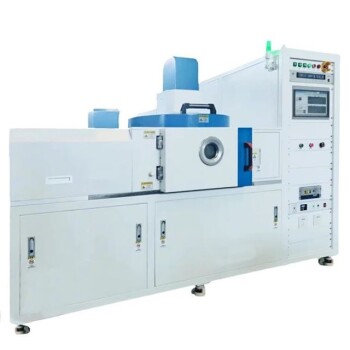
Fluidized bed chemical vapor deposition (CVD) serves as the critical engineering stage for applying a uniform pyrolytic carbon coating to natural graphite particles. By suspending the graphite in a dynamic gas stream, the system ensures that every individual particle surface is exposed to carbon source gases, such as acetylene. This process transforms raw graphite into a "core-shell" structure, which is essential for improving the durability and chemical stability of the material when used in battery anodes.
The fluidized bed CVD system is the primary tool for creating a high-performance core-shell structure in modified natural graphite. It achieves this by maintaining a suspended state of particles to ensure total surface coverage, which directly enhances the material's cyclic stability and compatibility with electrolytes.
The Mechanics of Particle Fluidization
Achieving Uniform Particle Suspension
In a fluidized bed CVD system, natural graphite particles are kept in a continuous state of motion through controlled upward airflow. This "fluidized" state prevents the particles from clumping or settling at the bottom of the reactor.
Because the particles behave like a fluid, the system eliminates the "shadowing" effect found in static reactors. This ensures that no part of the graphite surface remains untreated during the chemical reaction.
Maximizing Gas-Solid Contact
The dynamic motion within the bed facilitates rapid and uniform contact between the graphite and the precursor gases. As gases like acetylene or methane flow through the suspended powder, they decompose and deposit carbon evenly across the entire surface area.
This high-efficiency contact mode is what distinguishes fluidized bed CVD from traditional tube furnaces. It allows for a more consistent reaction rate across the entire batch of material.
Engineering the Core-Shell Structure
Creating the Pyrolytic Carbon Coating
The primary output of this process is a highly uniform layer of pyrolytic carbon. This layer acts as a "shell" that encapsulates the natural graphite "core."
The thickness and quality of this shell are precisely controlled by adjusting the system's temperature and the flow ratios of the carrier and precursor gases. This precision is vital for maintaining the high crystallinity required for efficient energy storage.
Strengthening Electrolyte Compatibility
One of the deepest needs addressed by this system is the stabilization of the graphite-electrolyte interface. The pyrolytic carbon shell prevents the electrolyte from penetrating the graphite layers, which would otherwise cause exfoliation.
By creating this protective barrier, the CVD process significantly improves the cyclic stability of the material. This ensures that the battery can undergo thousands of charge-discharge cycles without significant capacity loss.
Understanding the Trade-offs and Challenges
Energy and System Complexity
Maintaining a fluidized state requires precise control over gas velocity and pressure. If the flow is too low, the particles settle; if it is too high, they may be blown out of the reaction zone entirely.
The high-temperature environment, often reaching near 1000°C, demands significant energy input. Additionally, managing the exhaust of precursor gases requires sophisticated filtration and safety systems to handle flammable or toxic byproducts.
Particle Size Limitations
Not all graphite powders are suitable for fluidization. Very fine particles may become airborne too easily, while overly large or irregularly shaped particles may fail to fluidize uniformly.
Achieving the perfect balance of gas flow for a specific particle size distribution is a complex calibration task. If the distribution is too wide, the coating thickness may vary significantly between the smallest and largest particles in the batch.
How to Optimize Your CVD Process
A fluidized bed CVD system is a powerful tool, but its effectiveness depends entirely on the specific goals of your material modification.
- If your primary focus is maximizing cycle life: Prioritize the uniformity of the pyrolytic carbon shell by fine-tuning the gas-to-solid contact time within the fluidized bed.
- If your primary focus is high-rate performance: Optimize the thickness of the carbon coating to ensure it provides protection without creating an excessive barrier to lithium-ion diffusion.
- If your primary focus is industrial scalability: Look for systems that offer automated gas flow regulation and precise temperature zones to ensure batch-to-batch consistency.
By mastering the fluidization dynamics and gas chemistry, manufacturers can successfully bridge the gap between raw natural graphite and high-performance battery-grade materials.
Summary Table:
| Feature | Role in MNG Preparation | Key Benefit |
|---|---|---|
| Particle Fluidization | Suspends graphite in dynamic gas streams | Ensures 100% surface coverage without clumping |
| Core-Shell Coating | Deposits uniform pyrolytic carbon layer | Enhances chemical stability and cyclic life |
| Gas-Solid Contact | Maximizes precursor gas (e.g., Acetylene) interaction | Achieves consistent reaction rates across batches |
| Interface Control | Stabilizes graphite-electrolyte interface | Prevents exfoliation and capacity loss |
| Process Precision | Controls shell thickness and crystallinity | Optimizes lithium-ion diffusion and energy storage |
Elevate Your Material Engineering with KINTEK CVD Solutions
Are you looking to optimize your Modified Natural Graphite (MNG) production? KINTEK specializes in high-performance laboratory equipment, offering a comprehensive range of CVD systems, fluidized bed reactors, and high-temperature furnaces (including vacuum, tube, and atmosphere models) tailored for advanced battery research.
Our customizable systems provide the precision required to engineer perfect core-shell structures, ensuring superior electrolyte compatibility and cyclic stability for your anode materials.
Ready to scale your research or production? Contact our technical experts today to discuss your unique needs and discover how KINTEK’s precision heating solutions can drive your innovation forward.
References
- Rujie He. Research progress of carbon-based anode materials for lithium-ion batteries. DOI: 10.56028/aetr.12.1.776.2024
This article is also based on technical information from Kintek Furnace Knowledge Base .
Related Products
- HFCVD Machine System Equipment for Drawing Die Nano Diamond Coating
- Custom Made Versatile CVD Tube Furnace Chemical Vapor Deposition CVD Equipment Machine
- RF PECVD System Radio Frequency Plasma Enhanced Chemical Vapor Deposition
- Cylindrical Resonator MPCVD Machine System for Lab Diamond Growth
- Slide PECVD Tube Furnace with Liquid Gasifier PECVD Machine
People Also Ask
- What is Hot-filament Chemical Vapor Deposition (HFCVD)? Achieve High-Quality Thin Films with Precision Control
- What are the equipment for chemical vapor deposition? A Guide to the 5 Essential Components
- What is the significance of the vacuum pressure control system in the CVD coating process for powders?
- What is the function of high-purity Argon (Ar) gas during CVD? Optimize Your Thin Film Uniformity and Purity
- What are the advantages of using Chemical Vapor Deposition (CVD) for coating turbine blades? Enhance Life & Performance