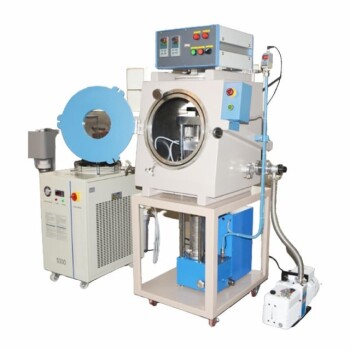
For a high-temperature laboratory furnace, the kinetic advantage of pressure-assisted sintering is far more profound than simply adding a push. Pressureless sintering relies solely on the intrinsic capillary pressure generated by surface curvature to drive densification. In contrast, methods like hot pressing superimpose a large external mechanical stress that dramatically accelerates diffusional creep and plastic flow at grain boundaries. This allows the material to reach near-theoretical density at significantly lower temperatures or in much shorter dwell times—effectively decoupling densification from the grain-coarsening kinetics that normally limit final properties.
The core kinetic advantage is that external pressure directly increases the thermodynamic driving force for densification without proportionally speeding up grain growth. This shifts the entire process into a regime where full consolidation occurs before excessive microstructural coarsening can take hold, making it the definitive route for hard-to-sinter, nanostructured, or thermally sensitive materials.
How Pressure Rewrites Sintering Kinetics
The Driving Force Equation Changes Fundamentally
In pressureless sintering, the total driving force for densification is governed by the local capillary pressure, which scales with the surface energy (( \gamma_s )) divided by the radius of curvature (( r )) at the pore surface. As the pores shrink, this driving force diminishes, causing the densification rate to taper off logarithmically.
When external pressure (( P_{appl} )) is applied—via a uniaxial hot press, gas pressure sintering, or hot isostatic pressing—the total effective pressure becomes ( P_t = \frac{\gamma_s}{r} + P_{appl} \cdot f(\rho, \text{geo}) ). The second term can be orders of magnitude larger than the capillary contribution. This radically increases the chemical potential gradient that drives atom transport, accelerating densification across all stages of sintering.
Creep Mechanisms Kick Into High Gear
Without external pressure, mass transport is dominated by surface diffusion and grain boundary diffusion, both of which have relatively high activation energies and are kinetically limited by the modest capillary stress. The addition of mechanical stress activates stress-induced grain boundary creep—primarily Nabarro‑Herring and Coble creep—along with plastic deformation and particle rearrangement.
These creep mechanisms are highly sensitive to applied stress and can move material into pores far faster than surface diffusion alone. The result is a densification rate that can be orders of magnitude higher, enabling the furnace operator to slash either the peak temperature or the hold time while still reaching the same final density.
Cracking the Diffusion–Grain‑Growth Trade‑off
The most frustrating limitation of pressureless sintering is that the high temperatures and long dwells needed to eliminate the last few percent of porosity inevitably drive uncontrolled grain growth. Grains coarsen by the same boundary-diffusion that closes pores, so you choose between a fully dense part with a coarse microstructure or a fine-grained part with residual voids.
Pressure-assisted sintering breaks this trade‑off. Because the applied pressure boosts the densification rate so drastically, the temperature can be lowered by hundreds of degrees Celsius or the hold time can be shortened to minutes instead of hours. The kinetics of densification outrun the kinetics of grain growth, locking in a fine, uniform grain size that translates directly into superior strength, hardness, and optical or thermal properties.
Overcoming the Gas‑Entrapment Ceiling
In conventional 1‑atm atmosphere sintering, inert gases trapped within pores create a back‑pressure that prevents complete closure. The maximum achievable density is limited by the equilibrium between capillary pressure and the internal gas pressure, especially when pores are large or outgassing is slow.
Applying an external pressure—typically around 100 atm (≈10 MPa) after pore isolation—forces those entrapped pores to collapse, allowing the material to break through the 95–98% density plateau and reach near‑100% theoretical density. Under lattice diffusion kinetics, the time required to reach full density becomes inversely proportional to the applied pressure, giving the lab technician precise control over the densification endpoint.
Pressure-Assisted Sintering Variants in the Lab
Unidirectional Hot Pressing (HP)
HP uses moderate pressures (20–50 MPa) delivered through graphite dies that also act as resistive heating elements. It is the workhorse for processing advanced ceramics like SiC, B₄C, and TiB₂, where the uniaxial stress not only accelerates densification but also helps break up oxide layers that would otherwise hinder bonding. Because the die limits shape to simple discs or blocks, it is best suited for research coupons or components that will be machined to final geometry.
Hot Isostatic Pressing (HIP)
HIP applies gas‑borne isostatic pressure up to ∼300 MPa, completely enveloping the part. This eliminates the anisotropic shrinkage seen in HP and can densify complex shapes, often as a post‑sintering step to heal residual porosity in castings, additively manufactured metals, or pre‑sintered ceramics. The uniform pressure field ensures that even internal cavities collapse without distorting the part.
Gas Pressure Sintering (GPS)
GPS operates at lower pressures (<10 MPa) and is particularly valuable for high‑vapor‑pressure materials like silicon nitride. It uses a two‑stage strategy: low pressure before pores are isolated to prevent decomposition, then elevated gas pressure after pore closure to drive full densification without the need for an encapsulating die. This makes GPS compatible with near‑net‑shape processing in laboratory batch furnaces.
Understanding the Trade‑offs
Pressure-assisted sintering is not a silver bullet. It must be chosen when its kinetic benefits outweigh its inherent constraints.
- Higher Capital and Tooling Cost: HP and HIP furnaces are significantly more expensive than standard muffle or tube furnaces. Graphite dies and high‑pressure gas handling add consumable and maintenance expenses.
- Shape Limitations and Anisotropy: Uniaxial HP produces anisotropic microstructures and restricts geometries to prismatic or disk‑like forms. Even HIP, while isostatic, requires canning for materials that interact with the pressurizing gas.
- Die Contamination and Reactions: Graphite dies can introduce carbon contamination into sensitive ceramics or carbides, affecting phase purity and electrical properties. The high‑pressure sintering environment can also accelerate undesirable reactions between the sample and the die liner.
- Batch Size and Throughput: Pressure-assisted techniques typically handle single pieces or small batches. Scaling to production volume requires a careful cost‑benefit analysis against the performance gains achieved.
These limitations explain why pressureless sintering remains the first choice for high‑volume, geometrically complex parts that can tolerate a few percent residual porosity or where grain size is not the prime concern.
Making the Right Choice for Your Sintering Goal
The lab furnace selection ultimately depends on whether the kinetic leap of pressure assistance aligns with your material’s intrinsic properties and your performance targets.
- If your primary focus is achieving near‑theoretical density in hard‑to‑sinter covalent ceramics: Prioritize hot pressing or HIP. The 10–50× increase in densification rate will overcome the sluggish self‑diffusion of materials like B₄C or SiC without resorting to grain‑coarsening temperatures.
- If your primary focus is preserving an ultrafine or nanostructured grain size: Use pressure‑assisted heating at the lowest temperature that still delivers full density. The shortened thermal cycle suppresses grain boundary migration and locks in the as‑processed nanometric microstructure.
- If your primary focus is eliminating porosity in complex, three‑dimensional parts: Consider gas pressure sintering or a HIP post‑treatment. The isostatic or near‑isostatic pressure field will collapse internal voids while maintaining dimensional fidelity.
- If your primary focus is routine, cost‑effective densification of oxide ceramics or common metals: Pressureless sintering in a well‑controlled atmosphere tube or muffle furnace remains the pragmatic choice, provided you can accept the final grain size and porosity that thermal energy alone can deliver.
Pressure-assisted sintering is the kinetic hammer that lets you forge materials to perfection before unwanted coarsening has a chance to set in—use it when the cost of a coarse grain is higher than the cost of the press.
Summary Table:
| Feature / Kinetic Metric | Pressureless Sintering | Pressure-Assisted Sintering (HP / HIP / GPS) |
|---|---|---|
| Primary Driving Force | Capillary pressure ($$\gamma_s / r$$) | External mechanical stress + Capillary pressure |
| Dominant Mass Transport | Surface & grain boundary diffusion | Stress-induced creep (Nabarro-Herring/Coble) & plastic flow |
| Densification vs. Grain Growth | Coupled (high heat causes grain coarsening) | Decoupled (rapid densification before grain growth) |
| Max Achievable Density | Typically 90–98% (gas entrapment ceiling) | Near-theoretical (up to ~100%) |
| Processing Window | Higher temperatures, longer dwell times | Lower temperatures, significantly shorter dwell times |
| Best Application | Complex geometries, routine oxide ceramics | Hard-to-sinter, nanostructured, or thermally sensitive materials |
Maximize Density and Microstructural Precision with KINTEK
Ready to overcome densification limits in your high-temperature research? KINTEK specializes in advanced laboratory furnaces and consumables tailored for demanding thermal processing. From muffle, tube, and vacuum systems to CVD, atmosphere, dental, and induction melting furnaces, our solutions are fully customizable to fit your unique sintering and material synthesis goals.
Contact our technical experts today to optimize your lab's sintering capabilities and find the ideal high-temperature furnace solution!
Related Products
- Vacuum Heat Treat Sintering Furnace with Pressure for Vacuum Sintering
- 9MPa Air Pressure Vacuum Heat Treat and Sintering Furnace
- Spark Plasma Sintering SPS Furnace
- 600T Vacuum Induction Hot Press Vacuum Heat Treat and Sintering Furnace
- Vacuum Hot Press Furnace Machine Heated Vacuum Press Tube Furnace
People Also Ask
- How does vacuum heat treating affect the grain structure of metal alloys? Achieve Precise Microstructure Control
- What are the benefits of using vacuum heat treating furnaces for metal alloys? Achieve Superior Metal Properties and Performance
- What is one of the most important uses of vacuum heat treating furnaces in aerospace? Achieve Superior Strength in Aircraft Alloys
- What are the key components of a vacuum sintering furnace? Essential Parts for Precision Material Processing
- What is the purpose of setting a mid-temperature dwell stage? Eliminate Defects in Vacuum Sintering