
At their core, Box Furnaces are versatile workhorses found in a wide range of demanding industries. They are essential equipment in aerospace, automotive, electronics, foundry, military, and mining, where they perform critical heat-treating processes on various materials and components.
The common thread across all these industries is not the industry itself, but the need for reliable, batch-based heat treatment. Box furnaces are the go-to solution for processing individual parts or small loads where precision and versatility are more important than continuous, high-volume throughput.
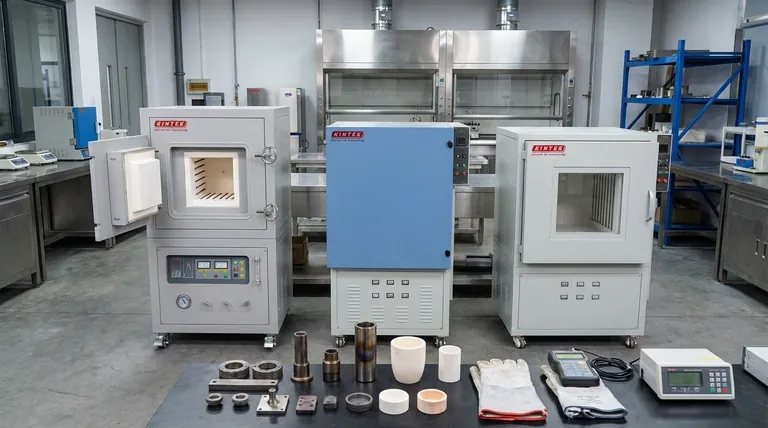
What Defines a Box Furnace Application?
To understand why these industries rely on box furnaces, it's crucial to look at the processes they enable rather than just the industries themselves. The furnace's design is ideal for specific types of work.
The Principle of Batch Processing
A box furnace, by its nature, is a type of batch furnace. This means parts are loaded in, the thermal cycle is run, and then the finished parts are unloaded.
This method is perfect for jobs where each part or group of parts requires a specific, controlled heating and cooling profile. It contrasts with continuous furnaces, where parts move constantly through different temperature zones.
A Hub for Diverse Heat Treatments
The true value of a box furnace is its ability to perform a wide variety of thermal processes. This versatility makes it a cornerstone piece of equipment.
Common applications include:
- Hardening: Increasing the strength and wear resistance of metals.
- Annealing: Softening metals to make them more workable or to relieve internal stresses.
- Tempering: Reducing the brittleness of a hardened part to increase its toughness.
- Stress Relieving: Removing internal stresses caused by welding, machining, or casting.
- Preheating: Warming parts, especially dies or large components, before a primary process like forging or casting.
- Curing: Thermally setting coatings, adhesives, or composite materials.
A Look at Key Industrial Use Cases
The general processes above translate into specific, critical applications within each industry.
Aerospace and Military
In these sectors, component failure is not an option. Box furnaces are used for the precision hardening and stress relieving of critical parts like landing gear components, engine turbine blades, and structural fasteners to ensure maximum strength and reliability.
Automotive and Foundry
The automotive industry uses box furnaces for annealing engine components, tempering gears, and preheating casting dies. In foundries, they are essential for treating cast parts to achieve the desired mechanical properties and relieve stresses from the casting process.
Electronics and Materials Science
Beyond metals, box furnaces are used for sintering technical ceramics, calcining materials to induce phase changes, and curing electronic components. Their precise temperature control is vital for developing and manufacturing advanced materials.
Understanding the Trade-offs
No single piece of equipment is perfect for every job. Understanding where a box furnace excels—and where it doesn't—is key to making an informed decision.
The Advantage: Simplicity and Versatility
For workshops, labs, or production lines that handle a variety of parts and processes, the box furnace is unparalleled. Its relatively simple design makes it cost-effective and adaptable for many different heat-treating tasks without requiring a dedicated setup for each one.
The Limitation: Throughput
The primary trade-off is volume. The batch-by-batch nature of a box furnace means it is not suited for high-volume, continuous production where thousands of identical parts must be processed per hour. For that, a conveyor or continuous furnace is necessary.
The Atmosphere Factor
A standard box furnace operates with a normal air atmosphere. While many can be equipped with systems to introduce inert gases like nitrogen or argon, they are not always the best choice for highly sensitive applications. Processes requiring pure, tightly controlled atmospheres may be better served by a dedicated tube furnace or a sealed retort furnace.
Making the Right Choice for Your Goal
Selecting the correct thermal processing equipment depends entirely on your specific objective.
- If your primary focus is versatility for small batches: A box furnace offers the best balance of capability and cost for a wide range of different heat treatments.
- If your primary focus is high-volume, repetitive production: You should investigate a conveyor or other continuous furnace designed for an assembly-line workflow.
- If your primary focus is processing under a highly sensitive atmosphere: A dedicated tube furnace or sealed retort furnace is the more appropriate and reliable solution.
Understanding these core applications and trade-offs empowers you to select the precise tool for your specific thermal processing objective.
Summary Table:
| Industry | Common Applications | Key Processes |
|---|---|---|
| Aerospace & Military | Hardening and stress relieving critical components | Precision heat treatment for reliability |
| Automotive & Foundry | Annealing engine parts, tempering gears, preheating dies | Improving mechanical properties and stress relief |
| Electronics & Materials Science | Sintering ceramics, curing components, calcining materials | Advanced material development with precise control |
| General Use | Batch processing of small loads | Versatile heat treatments in labs and workshops |
Ready to enhance your lab's capabilities with a custom box furnace? At KINTEK, we leverage exceptional R&D and in-house manufacturing to provide advanced high-temperature solutions tailored to your needs. Our product line includes Muffle, Tube, Rotary Furnaces, Vacuum & Atmosphere Furnaces, and CVD/PECVD Systems, all backed by strong deep customization to meet your unique experimental requirements. Contact us today to discuss how our furnaces can optimize your heat treatment processes and boost efficiency!
Visual Guide

Related Products
- Vacuum Hot Press Furnace Machine Heated Vacuum Press Tube Furnace
- Mesh Belt Controlled Atmosphere Furnace Inert Nitrogen Atmosphere Furnace
- Vacuum Heat Treat Sintering Furnace with Pressure for Vacuum Sintering
- 600T Vacuum Induction Hot Press Vacuum Heat Treat and Sintering Furnace
- Vacuum Hot Press Furnace Machine Heated Vacuum Press
People Also Ask
- Why use Vacuum Hot Press (VHP) for ZnS Ceramics? Achieve Superior IR Transparency and Mechanical Strength
- What safety features are incorporated in vacuum hot press furnaces? Ensure Operator and Equipment Protection
- What are the benefits of the vacuum environment system in a vacuum hot press furnace? Unlock High-Density Sintering
- How does the uniaxial pressure applied by a vacuum hot press furnace affect the microstructure of ZrC-SiC materials?
- What is the significance of the vacuum environment for sintering stainless steel? Unlock High-Density Purity



















