Selecting the right material for hybrid metal additive manufacturing comes down to two decisive factors: predicting its behavior under intense heat and planning its thermal rehabilitation from the start. Your material must not only be weldable during the additive printing phase but also structurally stable enough to survive the subsequent subtractive machining without distorting. The critical "secret" is that the process doesn't end on the build plate; a precisely designed post-processing heat treatment is the non-negotiable bridge between a rough, stressed print and a high-performance, precision component.
The core challenge isn't just melting metal—it's managing the internal chaos it creates. Hybrid AM's success depends on selecting an alloy whose thermal properties suit both deposition and cutting, then neutralizing the inevitable residual stresses through a meticulously controlled heat treatment cycle in a high-temperature furnace. This sequence is what transforms a brittle, unstable near-net shape into a reliable, mission-critical part for aerospace or medical use.
Design-Driven Material Selection
Your material choice dictates every downstream decision. In a hybrid process, you aren't just selecting a metal for its final properties; you are choosing a partner for a complex manufacturing dance of heating, cooling, and cutting. This selection must be guided by a deep understanding of thermal physics.
The Centrality of Thermal Properties
Melting point and thermal conductivity are your primary design parameters. High thermal conductivity alloys, like certain aluminum or copper grades, rapidly wick heat away from the melt pool. This can lead to lack-of-fusion defects during the additive stage.
Conversely, materials with low thermal conductivity, such as titanium or Inconel, trap heat. This is excellent for layer adhesion but dramatically increases the risk of residual stress buildup. You must design the part geometry to account for this intense, localized heat retention from the very beginning of the CAD phase.
Designing for a Dual-Process Material
The material you choose must be compatible with both laser-based printing and physical cutting tools. A material that is perfectly printable may be a nightmare to machine.
Nickel-based superalloys, for instance, readily work-harden during CNC machining. If your subtractive stage follows the additive one, you need to specify an annealed microstructure beforehand. The post-processing heat treatment step is your tool to reset the material’s hardness, ensuring the final cutting passes are precise and don't break expensive tooling.
Anticipating Distortion from the Start
Rapid thermal cycling creates a battlefield of internal forces within the part. Your design must consciously compensate for the expected deformation.
Uneven shrinkage is a law of physics, not a machine error. The center of a thick boss will cool slower than a thin, adjacent wall, creating a stress gradient. By selecting an alloy with a predictable coefficient of thermal expansion and modeling the process, you can use the subsequent heat treatment—specifically a stress-relief cycle—to let the part relax in a controlled way, rather than springing out of tolerance during machining.
The Non-Negotiable Thermal Process
The post-processing heat treatment is not a generic "cook and cool" step. It is a precisely defined metallurgical intervention executed in a high-temperature furnace to deconstruct the problematic history of the printed part and build a new, homogenous one.
The Critical Role of a Controlled Atmosphere Furnace
The type of furnace is as important as the temperature profile. You cannot achieve aerospace-grade results with an open-air kiln.
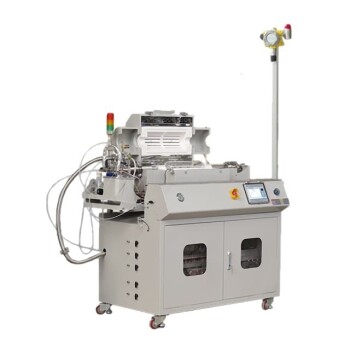
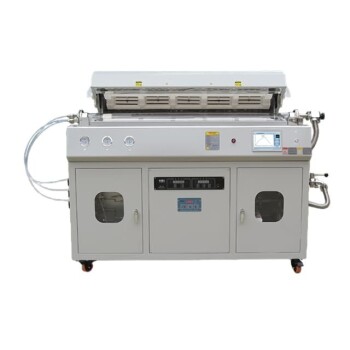
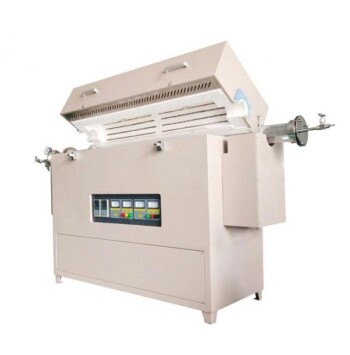
Atmosphere and vacuum furnaces are essential, not optional. For reactive metals like titanium, even trace oxygen at high temperatures causes alpha-case—a brittle, oxygen-rich surface layer that ruins mechanical properties. A vacuum or high-purity argon atmosphere furnace actively protects the printed component from oxidation, maintaining its chemical integrity while the microstructure heals.
Common Heat Treatment Procedures
The thermal recipe you choose is dictated by the alloy and the desired final state. This step directly enables the "hybrid" in hybrid manufacturing by making the part machinable.
Stress relieving is the fundamental first stage. By heating the part to a moderate temperature and holding it, you allow the locked-in thermal stresses from printing to dissipate without significantly changing the overall microstructure. This is the primary method for preventing distortion during subsequent CNC work.
Annealing is a full microstructural reset. This process eliminates the columnar, anisotropic grain structure of the as-printed part. It creates a new, uniform, and softer grain structure, which is ideal for maximizing machinability and restoring isotropy in mechanical properties.
Homogenization and Machinability
The thermal step is the bridge from a brittle, stressed state to a stable, cuttable one. It directly feeds the subtractive phase of the workflow.
A heat-treated, homogenized part behaves predictably under a cutting tool. The annealing process eliminates the hard zones that would cause the tool to chatter or the work-hardening spots that can destroy a cutting edge. This ensures that final precision milling and turning operations achieve the tight dimensional tolerances and surface finish required without producing another round of internal stress.
Understanding the Trade-offs
Objectively, integrating precision heat treatment is a major investment. Recognizing the pitfalls allows you to build a stronger business case and a more reliable production line.
- Cost and Lead Time: High-temperature vacuum furnaces are capital-intensive to operate. The hours-long cycle is a bottleneck. The trade-off is clear: you are delaying throughput and increasing per-part cost to guarantee structural integrity, a non-negotiable in certified applications.
- Risk of Over-Processing: The "more is better" fallacy can ruin a component. Excessive heat treatment for the sake of it can cause unwanted grain growth, significantly weakening the alloy. The goal is to target a specific ASTM standard for thermal processing, not just to "heat it until it's cooked."
- Geometry Distortion During Ramp: The very process meant to relieve stress can cause sagging if the part is not properly supported in the furnace. High-temperature creep is real; your furnace fixtures must be designed to cradle the part in its most vulnerable state, or you risk creating a perfectly heat-treated but hopelessly warped paperweight.
Making the Right Choice for Your Goal
Your final strategy must align the material, the heat treatment, and the machining sequence with your ultimate objective for the component.
- If your primary focus is maximizing dimensional accuracy: Begin with a stress-relief cycle in a controlled-atmosphere furnace to neutralize the worst forces, then perform the rough machining, and finish with a light stress-relief anneal to stabilize the part for final, mirror-finish cutting.
- If your primary focus is optimizing mechanical performance: Design for a full solution heat treatment and aging cycle. Use a vacuum furnace to prevent surface degradation, transforming the as-printed anisotropic microstructure into a fully homogenous, high-strength state before any final, light-touch post-machining.
- If your primary focus is machinability and tool life: Prioritize a full annealing process immediately after printing. Reset the metal to its softest, most ductile state to allow for aggressive, high-speed subtractive operations without the risk of work-hardening or catastrophic tool failure.
Mastering hybrid manufacturing means treating the material's thermal journey not as a barrier, but as a fundamental design parameter that you control from the CAD model to the final, high-temperature furnace cycle.
Summary Table:
| Stage / Consideration | Key Process & Parameters | Primary Objective & Benefit |
|---|---|---|
| Material Selection | Analyze melting point & thermal conductivity | Prevents lack-of-fusion defects and extreme heat retention |
| Stress Relief | Controlled heating in high-temp furnace | Dissipates internal thermal stress; prevents part warping during CNC machining |
| Annealing & Homogenization | Full thermal reset to uniform grain structure | Restores ductility and machinability; eliminates work-hardening spots |
| Controlled Environment | Vacuum or argon atmosphere processing | Prevents oxidation and alpha-case formation in reactive alloys (Titanium, Inconel) |
Maximize Precision in Your Hybrid Metal AM Workflow with KINTEK
Don't let residual stress or oxidation ruin your high-value metal prints. KINTEK specializes in advanced laboratory equipment and high-temperature furnace technology, offering a comprehensive range of vacuum, atmosphere, muffle, tube, and custom thermal processing furnaces designed specifically for high-performance metallurgy.
Whether you are processing reactive titanium for aerospace or heat-treating superalloys for medical applications, our fully customizable furnace solutions deliver precise thermal control to eliminate warping, optimize machinability, and achieve superior material strength.
Unlock peak part performance — Contact KINTEK's furnace experts today!
Related Products
- 1200℃ Controlled Inert Nitrogen Atmosphere Furnace
- 1400℃ Controlled Inert Nitrogen Atmosphere Furnace
- 1700℃ Controlled Inert Nitrogen Atmosphere Furnace
- Mesh Belt Controlled Atmosphere Furnace Inert Nitrogen Atmosphere Furnace
- Controlled Inert Nitrogen Hydrogen Atmosphere Furnace
People Also Ask
- What controlled-atmosphere furnace conditions are required for sintering powder metallurgy copper alloy compacts? Ideal Setup
- What are the core steps in powder metallurgy, and why is a controlled atmosphere furnace necessary for sintering metal alloys?
- What factors should be considered when choosing a controlled atmosphere furnace? Ensure Optimal Performance for Your Materials
- How do surface oxide layers on ceramic powders like silicon nitride affect sintering? Master Atmosphere Control
- How Sintering Temp Affects Density & Resistivity of Cu-Oxide Composites