
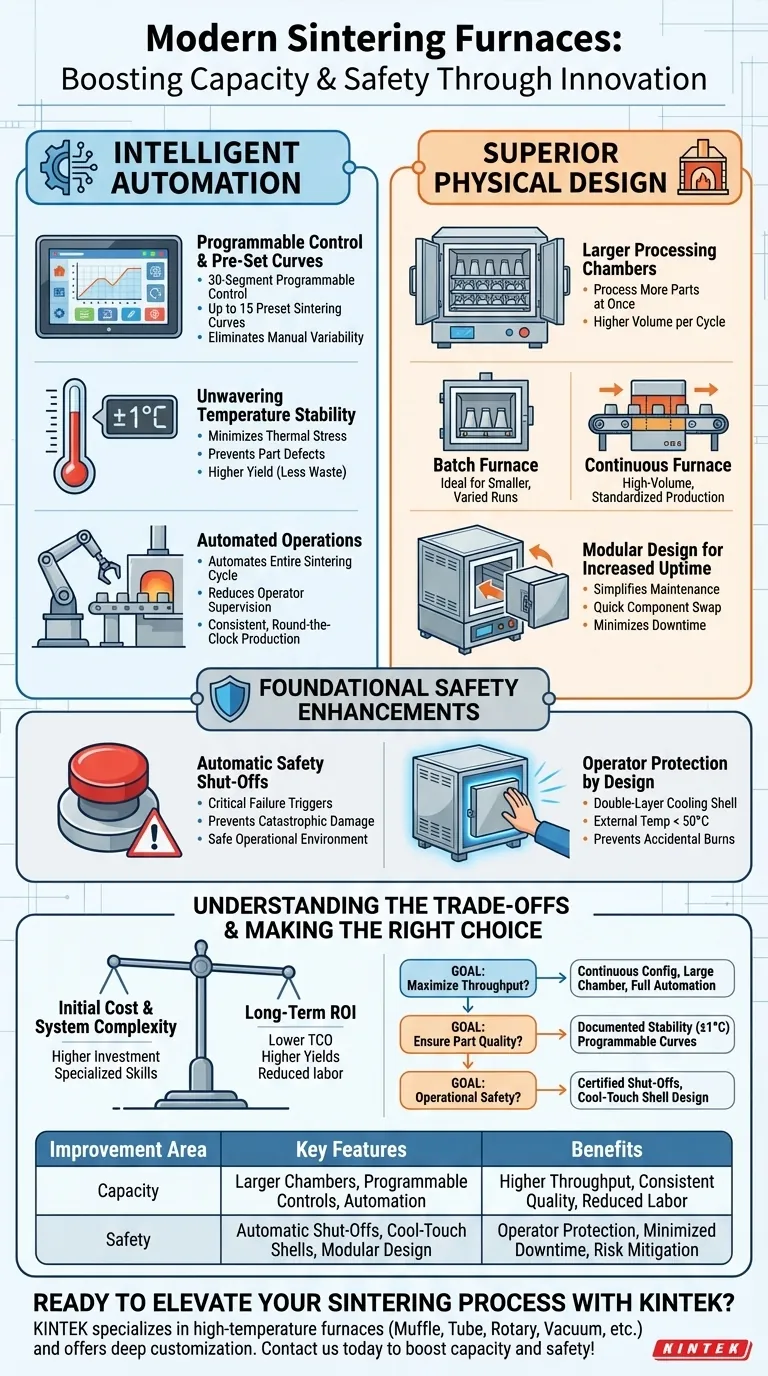
In short, modern sintering furnaces have seen significant capacity and safety improvements driven by two primary forces: intelligent automation and superior physical design. These advancements include larger processing chambers, highly precise control systems with programmable curves, and integrated safety mechanisms like automatic shut-offs and cool-touch external shells.
The core evolution in sintering furnaces is not just about making them bigger or safer in isolation. It's about integrating intelligent software controls with robust physical engineering to transform sintering from a high-variable art into a predictable, efficient, and reliable manufacturing science.
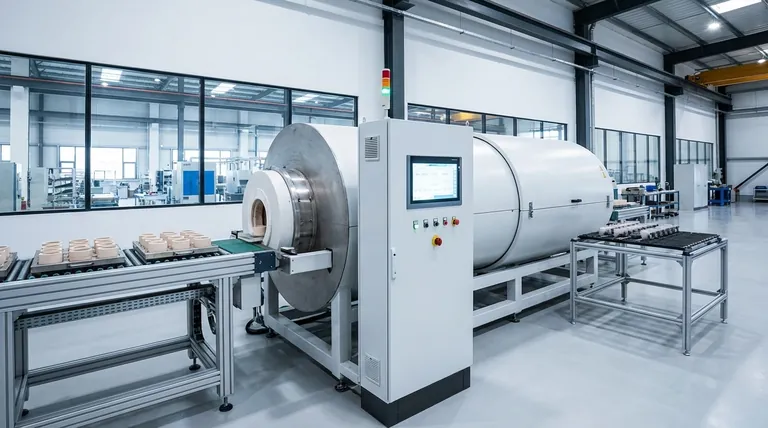
Boosting Capacity Through Intelligent Automation
The most significant leaps in productivity come from the furnace's ability to think and act with minimal human intervention. This ensures speed, repeatability, and a higher yield of quality parts.
Programmable Control and Pre-Set Curves
Modern furnaces feature advanced controllers, often operated via a simple color touchscreen. With capabilities like 30-segment programmable control and up to 15 preset sintering curves, operators can execute complex, multi-stage heating and cooling profiles with perfect consistency.
This dramatically reduces setup time and eliminates the variability that comes from manual adjustments, ensuring every batch is processed under ideal conditions.
Unwavering Temperature Stability
A key factor in production capacity is yield—the number of usable parts per cycle. Modern furnaces achieve exceptional temperature stability, often holding within ±1°C of the setpoint.
This precision minimizes thermal stress and prevents part defects, warping, or incomplete sintering. Fewer rejected parts means a higher effective output and less wasted material and energy.
Automated Operations
Intelligent control systems automate the entire sintering cycle, from initial pump-down in vacuum models to the final cooling stage. This reduces the need for constant operator supervision, freeing up skilled labor for other value-added tasks and enabling more consistent, round-the-clock production.
Enhancing Capacity with Superior Physical Design
Beyond the control system, the physical construction of the furnace is engineered for higher throughput and greater operational uptime.
Larger Processing Chambers
The most direct way to increase capacity is to process more parts at once. Manufacturers now offer furnaces with significantly larger internal chambers, allowing for a higher volume of product in a single sintering cycle, which directly increases productivity.
Batch vs. Continuous Configurations
Flexibility in design allows facilities to match the furnace to their specific workflow. Batch furnaces are ideal for smaller, varied production runs, while continuous furnaces are designed for high-volume, standardized manufacturing where parts move constantly through the heat zones.
Choosing the right configuration is critical for optimizing production flow and maximizing plant capacity.
Modular Design for Increased Uptime
Modern furnaces often feature a modular design. This simplifies maintenance, repair, and troubleshooting significantly.
When a component fails, it can be quickly swapped out, minimizing equipment downtime. More uptime directly translates to more production time and higher overall capacity.
Foundational Safety Enhancements
Alongside performance, operator safety has become a central design pillar. Modern furnaces integrate multiple layers of protection, moving from reactive alerts to proactive, automated safety systems.
Automatic Safety Shut-Offs
These furnaces are equipped with mechanisms that automatically shut down the system in the event of a critical failure. This includes triggers for over-temperature, over-pressure, or cooling water interruptions, preventing catastrophic equipment damage and ensuring a safe operational environment.
Operator Protection by Design
Physical engineering plays a crucial role in daily safety. Features like a double-layer cooling shell keep the furnace's external surface temperature below 50°C, even when internal temperatures are extreme. This design prevents accidental burns and makes the immediate work area safer for personnel.
Understanding the Trade-offs
While these advancements offer clear benefits, they require careful consideration.
Initial Cost vs. Long-Term ROI
Furnaces equipped with advanced automation, precision controls, and robust safety features carry a higher initial investment. The trade-off is a significantly lower total cost of ownership over the equipment's lifespan, driven by higher yields, reduced labor, lower energy consumption, and greater uptime.
System Complexity and Maintenance
While modular designs simplify repairs, the underlying systems are more complex than their predecessors. Troubleshooting advanced electronics or control software may require technicians with specialized skills, a factor to consider for maintenance planning and training.
Making the Right Choice for Your Goal
The best furnace depends entirely on your primary operational driver.
- If your primary focus is maximizing throughput: Prioritize a continuous configuration with the largest possible chamber and fully automated controls to minimize cycle and loading times.
- If your primary focus is ensuring part quality: Invest in a system with documented temperature stability (±1°C) and highly programmable sintering curves.
- If your primary focus is operational safety and risk mitigation: Select a furnace with certified automatic shut-offs and a cool-touch external shell design.
Ultimately, these modern improvements allow you to treat sintering as a precise and controlled step in your manufacturing process.
Summary Table:
| Improvement Area | Key Features | Benefits |
|---|---|---|
| Capacity | Larger chambers, programmable controls, automation | Higher throughput, consistent quality, reduced labor |
| Safety | Automatic shut-offs, cool-touch shells, modular design | Operator protection, minimized downtime, risk mitigation |
Ready to elevate your sintering process with cutting-edge furnace solutions? KINTEK specializes in high-temperature furnaces, including Muffle, Tube, Rotary, Vacuum & Atmosphere Furnaces, and CVD/PECVD Systems. Leveraging our exceptional R&D and in-house manufacturing, we offer deep customization to precisely meet your unique experimental and production needs. Contact us today to discuss how our advanced solutions can boost your capacity, enhance safety, and deliver superior results for your laboratory or manufacturing facility!
Visual Guide
Related Products
- Vacuum Heat Treat Sintering Furnace with Pressure for Vacuum Sintering
- Spark Plasma Sintering SPS Furnace
- Vacuum Heat Treat Sintering Furnace Molybdenum Wire Vacuum Sintering Furnace
- Small Vacuum Heat Treat and Tungsten Wire Sintering Furnace
- Vacuum Dental Porcelain Sintering Furnace for Dental Laboratories
People Also Ask
- What are the benefits of using vacuum heat treating furnaces for metal alloys? Achieve Superior Metal Properties and Performance
- What is one of the most important uses of vacuum heat treating furnaces in aerospace? Achieve Superior Strength in Aircraft Alloys
- How does vacuum heat treating affect the grain structure of metal alloys? Achieve Precise Microstructure Control
- What is the purpose of setting a mid-temperature dwell stage? Eliminate Defects in Vacuum Sintering
- What are the key components of a vacuum sintering furnace? Essential Parts for Precision Material Processing



















