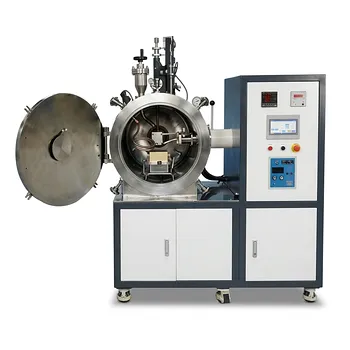
If you’re working with quaternary III-V semiconductors like GaInAsSb, the difference between a successful epitaxial layer and a phase-separated mess often comes down to two precise baking steps. The melt must first be homogenized at 680°C for 3 to 4 hours under a continuous flow of Pd-diffused ultrapure hydrogen. After the substrate is loaded, a secondary bake at 600°C completely re-dissolves the melt, ensuring a uniform liquid before cooling to the epitaxial growth window of 495°C–525°C. Both steps demand a high-temperature controlled-atmosphere furnace with exceptional thermal stability and gas purity.
The two-step high-temperature baking process is the foundational sequence that dictates melt homogeneity, substrate wetting, and crystal quality. The initial 680°C bake drives off impurities and forces multi-component sources into a single phase; the 600°C re-dissolution step primes the melt for uniform nucleation. Skipping or shortening either step invites phase separation and poor layer morphology.
Why High-Temperature Baking Defines LPE Success
Quaternary alloys such as GaInAsSb and GaAlAsSb are notoriously difficult to grow because their constituents have vastly different melting points, vapor pressures, and segregation coefficients. Without a carefully orchestrated thermal sequence, these differences lead to compositional inhomogeneity, constitutional supercooling, and macroscopic defects.
The Melt Homogenization Imperative
When 6N-purity source materials (Ga, In, Sb, Al, GaAs) are placed in a sliding boat, they exist as discrete solids or immiscible liquids. Heating the boat to 680°C for an extended period transforms this mixture into a single-phase liquid solution. The high temperature overcomes the diffusion barriers that would otherwise leave compositionally distinct pockets, which later manifest as unwanted phases in the solid.
Purging Impurities Through Controlled Atmosphere
The same 680°C bake serves as a purification step. Oxides and volatile contaminants trapped on the source surfaces are thermally desorbed and swept away by the flowing Pd-diffused ultrapure hydrogen. Without this gas, re-deposition or reaction with the melt would reintroduce impurities. The hydrogen also maintains a reducing environment that prevents re-oxidation as the boat cools.
The Substrate Loading Interruption
After the initial bake, the system must cool to room temperature or a low-handling temperature so the substrate can be introduced without thermal shock or surface degradation. This practical interruption, however, allows the melt to partially solidify or develop compositional striations. Simply reheating directly to the growth temperature is not enough.
The 600°C Re-Dissolution Step: Resetting the Melt
The secondary bake at 600°C is the critical bridge. It re-dissolves any phases that formed during cooldown and re-homogenizes the melt just prior to epitaxy. This temperature is deliberately lower than the initial bake to bring the melt into a metastable, supersaturated state that is primed for nucleation when the growth temperature (495–525°C) is reached. Without it, the melt may precipitate unwanted solid phases on the substrate, leading to poor adhesion and polycrystalline growth.
Understanding the Trade-offs
No thermal parameter is chosen in isolation. The baking steps balance multiple physical and chemical constraints that, if ignored, can silently degrade the final device.
The Volatility Risks of Over-Baking
Prolonged exposure at 680°C is not harmless. Group-V elements like antimony and arsenic have high vapor pressures. Excessively long bake times or temperatures beyond the recommended range can preferentially evaporate these elements, skewing the melt composition toward group-III richness. The 3–4 hour window is a compromise that achieves homogenization while limiting volatile loss. A furnace with tight temperature uniformity is essential to prevent hot spots from accelerating local depletion.
Furnace Stability as the Hidden Variable
Phase separation in quaternary melts is extremely sensitive to temperature gradients. If the furnace’s thermal control wavers during the 680°C soak or the 600°C re-dissolution, microscale density fluctuations can initiate spinodal decomposition. This makes sub-degree stability a non-negotiable requirement, not just for the growth step but for the entire high-temperature bake sequence.
The Purity Chain: Source Materials, Gas, and Boat
Even perfect baking cannot compensate for contaminated inputs. The reference specifies 6N source purity and Pd-diffused hydrogen. Any oxygen or water vapor in the gas stream will form oxides on the melt surface, hindering dissolution. Similarly, the sliding boat material (often graphite or BN) must not outgas or react with the melt at these temperatures. These elements are an integral part of the “baking parameters” because they define the environment in which the thermal steps operate.
Common Pitfalls to Avoid
Many LPE failures that appear as growth defects actually originate in the baking stage. Recognizing these patterns saves time and material.
Skipping or Shortening the Secondary Bake
A common temptation is to skip the 600°C step and go directly from substrate loading to growth temperature, believing the melt is still homogeneous. This almost always results in incomplete dissolution of resolidified phases, leading to rough growth fronts and severe compositional gradients across the wafer.
Misinterpreting “Cooling” as Passive
The cooldown between the initial bake and substrate loading must also be controlled. Rapid, uncontrolled cooling can freeze in compositional patterns that even the 600°C re-bake struggles to erase. While not a formal baking parameter, the ramp-down rate is a silent influencer of melt quality.
Assuming One Furnace Fits All
A furnace that works for binary III-V LPE may not be suitable for quaternaries. The long high-temperature soaks and the sensitivity to oxygen demand ultra-dry hydrogen and a leak-free system. Even small atmospheric leaks during the bake can oxidize aluminum in the melt, completely disrupting growth.
Making the Right Choice for Your LPE Process
The baking parameters must be tuned to your specific alloy and furnace configuration, but certain principles hold universally. Use these goal-oriented guidelines to anchor your process development.
- If your primary focus is maximizing melt purity: Insist on 6N source materials, Pd-diffused hydrogen with verified dew point below –100°C, and adhere to the 680°C/3–4 h bake. This combination purges oxides and homogenizes more reliably than any post-growth treatment.
- If your primary focus is preventing phase separation: Invest in a furnace with ±0.1°C stability across the boat length, and enforce both the 680°C homogenization and the 600°C re-dissolution. The secondary bake resets the liquid to a single, uniform phase just before nucleation.
- If your primary focus is reliable substrate wetting and interface quality: Never load the substrate until after the initial bake and cool-down. The 600°C step then provides a clean, oxide-free liquid that wets the substrate surface without the compositional surprises of a half-mixed melt.
- If your process uses high-vapor-pressure elements (Sb, As): Monitor bake time carefully. Stay within the 3–4 h window at 680°C, and consider a slightly longer soak at 600°C if melt re-dissolution appears sluggish, as this lower temperature minimizes group-V loss.
Mastering the thermal choreography of LPE means treating the high-temperature bake not as a simple cleaning step but as the moment when your melt’s destiny is written. With these parameters under control, you create the clean, homogeneous liquid that quaternary semiconductors demand.
Summary Table:
| LPE Process Stage | Temp (°C) | Duration | Atmosphere | Primary Function |
|---|---|---|---|---|
| Melt Homogenization | 680°C | 3–4 Hours | Pd-diffused Ultrapure H₂ | Desorbs surface impurities; creates single-phase liquid |
| Substrate Loading | Room / Low Temp | Intermittent | Controlled Atmosphere | Cools system safely to insert substrate without oxidation |
| Secondary Re-Dissolution | 600°C | Soak Time | Pd-diffused Ultrapure H₂ | Re-dissolves phase-separated solids; primes supersaturation |
| Epitaxial Growth | 495°C–525°C | Variable | Continuous H₂ Flow | Achieves uniform nucleation and defect-free layer growth |
Achieving defect-free crystal growth in III-V Liquid-Phase Epitaxy demands exact atmosphere control and exceptional thermal stability. At KINTEK, we specialize in high-performance laboratory equipment and high-temperature furnaces—including atmosphere, tube, vacuum, and fully customizable lab furnaces—engineered to deliver sub-degree temperature control and leak-free hydrogen operation.
Ready to eliminate phase separation and boost your epitaxial yields? Contact KINTEK today to discuss your high-temperature semiconductor processing needs with our furnace experts!
Related Products
- 1800℃ High Temperature Muffle Oven Furnace for Laboratory
- 1700℃ High Temperature Muffle Oven Furnace for Laboratory
- Laboratory Muffle Oven Furnace with Bottom Lifting
- High Temperature Muffle Oven Furnace for Laboratory Debinding and Pre Sintering
- 1400℃ Muffle Oven Furnace for Laboratory
People Also Ask
- How does a high-temperature laboratory muffle furnace affect material properties? Transform Anodic Oxide Films Fast
- What is the primary function of a high-temperature laboratory muffle furnace in chemical synthesis? Achieve Precision.
- What role does a muffle furnace play in plant bark mineral analysis? Essential for Precise Dry Ashing & Trace Extraction
- Why is a laboratory high-temperature muffle furnace used for BaTiO3? Achieve Optimal Tetragonal Crystalline Phases
- What is the critical role of a laboratory high-temperature muffle furnace in TiO2/LDH? Unlock Superior Crystallization