
At its core, a Vacuum Induction Melting (VIM) furnace is specialized equipment for producing exceptionally high-quality metals and alloys by melting materials inside a vacuum. It achieves this through a combination of a sealed, water-cooled furnace body, a powerful electromagnetic induction coil for heating, a sophisticated vacuum system to remove air and impurities, and precise PLC-based controls for managing the entire process.
The true value of a VIM furnace isn't simply melting metal. It is a highly controlled refining environment that uses a vacuum to remove dissolved gases and prevent oxidation, enabling the production of alloys with a level of purity and compositional accuracy that is impossible to achieve with conventional air-melting techniques.
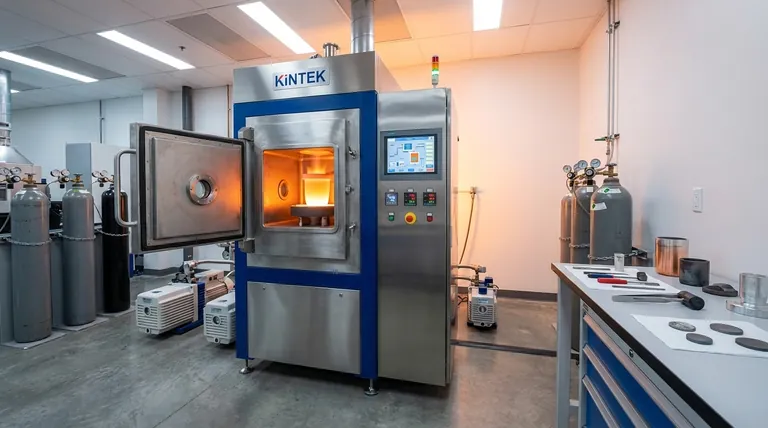
How a VIM Furnace Works: The Core Components
To understand the benefits of a VIM furnace, you must first understand its fundamental design. Each component plays a critical role in creating a controlled melting and refining environment.
The Furnace Body and Vacuum Chamber
The furnace body is a robust, sealed chamber, often with a water-cooled interlayer. This design contains the extreme heat while maintaining the integrity of the vacuum, which is the key to preventing atmospheric contamination.
The Induction Coil (Inductor)
An inductor, typically made of spiral copper tubing, surrounds the crucible holding the metal. A powerful medium-frequency current is passed through this coil, generating a strong electromagnetic field that heats and melts the metallic charge without direct contact.
The Electromagnetic Stirring Effect
A crucial side effect of induction heating is the natural, vigorous stirring of the molten metal. This electromagnetic stirring ensures the melt is perfectly homogenous, preventing element segregation and guaranteeing a uniform final composition.
The Vacuum System
This is the heart of the furnace's refining capability. A system of powerful pumps evacuates air and other gases from the chamber before and during melting. This removes oxygen to prevent oxidation and pulls dissolved impurities, like hydrogen and volatile elements, out of the molten metal.
The Control System
Modern VIM furnaces are governed by a Programmable Logic Controller (PLC) and a touch-screen interface. This allows operators to precisely monitor and control critical parameters like temperature, pressure, power input, and pouring, ensuring high process reliability and repeatability.
The Unmatched Benefits of Melting in a Vacuum
The unique architecture of a VIM furnace delivers benefits that are essential for high-performance applications, from aerospace to advanced materials science.
Achieving Ultimate Purity and Cleanliness
By melting in a vacuum, the furnace actively removes the root causes of metal defects. Oxygen is eliminated, preventing the formation of non-metallic oxide inclusions. Furthermore, the low-pressure environment effectively "boils off" harmful dissolved gases and unwanted trace elements.
Precision Control Over Alloy Composition
The combination of a sealed, inert environment and vigorous electromagnetic stirring gives metallurgists unparalleled control. Alloying elements can be added with confidence, knowing they won't be lost to oxidation. The result is an alloy with an extremely close and repeatable compositional tolerance.
Versatility and Efficiency
VIM furnaces are highly flexible regarding the type and size of the metal batches they can process. They are also essential for melting highly reactive alloys, such as those based on titanium and zirconium, which would be contaminated instantly if melted in air. The smooth, non-reactive crucible surfaces further prevent contamination of the melt.
Understanding the Trade-offs and Considerations
While powerful, a VIM furnace is a specialized tool with specific operational demands that must be understood.
High Initial Investment and Complexity
A VIM system represents a significant capital investment compared to standard atmospheric furnaces. Its operation and maintenance, particularly for the vacuum system, require highly trained and skilled personnel.
Strict Operational and Safety Protocols
The operating environment demands strict adherence to safety procedures. This includes wearing proper personal protective equipment (PPE), ensuring non-essential personnel are kept away, and preventing any liquids from coming near the furnace during operation. Proper handling of process gases is also critical.
Throughput vs. Quality
The process of evacuating the chamber, melting, refining, and casting under vacuum is inherently more time-consuming than open-air melting. The trade-off is a lower production volume in exchange for vastly superior material quality.
Is a VIM Furnace the Right Choice for Your Application?
Choosing a melting technology depends entirely on the required quality and performance of your final product.
- If your primary focus is producing mission-critical superalloys (e.g., for aerospace turbine blades): The VIM furnace is the definitive choice for its ability to guarantee purity, remove defects, and achieve precise composition.
- If your primary focus is developing novel materials or reactive metals (e.g., titanium aluminides): The inert vacuum environment is absolutely essential to prevent contamination and produce materials with the desired properties.
- If your primary focus is high-volume casting of standard-grade steel or aluminum: A VIM furnace is likely unnecessary and not cost-effective; conventional induction or arc furnaces are better suited for this goal.
Ultimately, investing in a VIM furnace is a decision to prioritize material integrity and performance above all else.
Summary Table:
| Feature | Benefit |
|---|---|
| Vacuum System | Removes gases and impurities for superior purity |
| Induction Coil | Provides efficient, contactless heating |
| Electromagnetic Stirring | Ensures uniform alloy composition |
| PLC Control System | Enables precise, repeatable process management |
| Sealed Chamber | Prevents oxidation and contamination |
Ready to elevate your metal production with high-purity solutions? KINTEK leverages exceptional R&D and in-house manufacturing to provide advanced high-temperature furnace solutions, including Vacuum & Atmosphere Furnaces. Our strong deep customization capability ensures we can precisely meet your unique experimental needs for reactive metals and superalloys. Contact us today to discuss how our tailored VIM furnaces can enhance your lab's performance and material quality!
Visual Guide

Related Products
- Vacuum Induction Melting Furnace
- 600T Vacuum Induction Hot Press Vacuum Heat Treat and Sintering Furnace
- Small Vacuum Heat Treat and Tungsten Wire Sintering Furnace
- Vacuum Heat Treat Sintering and Brazing Furnace
- Vacuum Heat Treat Sintering Furnace Molybdenum Wire Vacuum Sintering Furnace
People Also Ask
- What are the core functions of the High Vacuum Induction Melting (VIM) furnace? Optimize DD5 Superalloy Purification
- Why is a Vacuum Induction Melting furnace (VIM) used for Cu-Zn-Al-Sn alloys? Achieve Precision Composition Control
- What role does a Vacuum Induction Melting furnace play in the production of high-aluminum nickel-based superalloys?
- What is the role of VIM and directional solidification in aero-engine blade substrates? Engineering Extreme Durability
- What are the technical advantages of using a Vacuum Induction Melting furnace in the development of advanced packaging steel?



















