
At its core, vacuum heat treatment provides an unparalleled level of control over the material's environment, fundamentally distinguishing it from conventional atmosphere-based methods. This control prevents unwanted chemical reactions like oxidation and decarburization, resulting in components with a superior surface finish, enhanced mechanical properties, and greater dimensional stability.
The primary advantage is not merely cosmetic. By removing reactive gases, vacuum heat treatment allows for metallurgical transformations to occur in an ideal state, ensuring the final product's properties are a direct result of the thermal cycle, not a byproduct of environmental contamination.
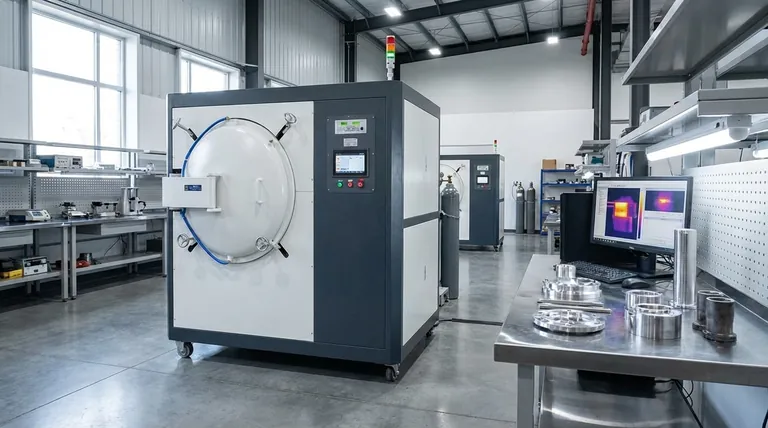
The Core Advantage: Absolute Environmental Control
The defining feature of vacuum heat treatment is the removal of the atmosphere from the furnace chamber. This simple act solves several problems inherent to heating metals in the presence of air or even controlled gas atmospheres.
Preventing Oxidation and Decarburization
When steel is heated in an oxygen-rich environment, it oxidizes, forming a layer of scale on the surface. This alters dimensions and requires costly and aggressive post-processing like sandblasting or acid pickling.
Furthermore, the carbon within the steel can react with the atmosphere, a process called decarburization. This softens the surface layer, compromising the hardness and wear resistance that the heat treatment was meant to achieve. A vacuum environment eliminates these reactions entirely.
Achieving a Pristine, Contaminant-Free Surface
Beyond preventing oxidation, the vacuum actively removes other contaminants. Trace amounts of water vapor, oils, and residual gases are pulled from the chamber and the parts themselves.
This results in a clean, bright, and often shiny surface finish right out of the furnace. This eliminates the need for secondary cleaning operations, saving time and resources while delivering a higher-value component.
Ensuring Uniform Heating
In a vacuum, heat is transferred primarily through radiation. This method promotes highly uniform heating across the entire part, regardless of its geometry.
This uniformity minimizes internal stresses that build up when different sections of a part heat or cool at different rates, which is a common issue in convection-based atmosphere furnaces.
Translating Control into Superior Material Properties
This precise environmental and thermal control directly translates to improved and more predictable mechanical characteristics in the final product.
Enhanced Hardness and Wear Resistance
By preventing decarburization, vacuum heat treatment ensures the part's surface achieves its full potential hardness. The integrity of the surface metallurgy is preserved, leading to significantly better wear resistance and a longer component life.
Improved Fatigue Strength
Conventional heat treatment can create microscopic surface imperfections from oxidation. These tiny flaws act as stress concentration points, becoming the origin sites for cracks under cyclical loading.
A smooth, clean surface from a vacuum process is free of these initiators, dramatically improving the material's fatigue strength and reliability in critical applications.
Minimized Distortion and Warping
The combination of uniform heating and controlled, often gas-quenched, cooling cycles possible in a vacuum furnace significantly reduces distortion. For complex or thin-walled parts, this can be the difference between a usable component and scrap, minimizing the need for expensive post-treatment straightening or machining.
Understanding the Trade-offs
While powerful, vacuum heat treatment is not a universal solution. An objective evaluation requires acknowledging its specific operational context.
Initial Investment and Cycle Times
Vacuum furnaces represent a higher capital investment compared to most conventional atmosphere furnaces. Furthermore, the time required to pump the chamber down to the required vacuum level can extend total cycle times, potentially impacting throughput for very high-volume production.
Not Always a Requirement
For simple, low-carbon steel components where surface finish is not a primary concern and slight decarburization is tolerable, a traditional atmosphere furnace can be a more cost-effective solution. The key is to match the process to the part's specific quality requirements.
Maintenance and Expertise
Vacuum systems involve sophisticated components like diffusion pumps, holding pumps, and high-integrity seals. They demand a higher level of technical expertise for operation and a more rigorous maintenance schedule to ensure performance and reliability.
Making the Right Choice for Your Application
Selecting the correct heat treatment method depends entirely on the required properties and value of the final component.
- If your primary focus is high-performance, critical components (aerospace, medical, high-end automotive): Vacuum treatment is often non-negotiable for its ability to deliver superior fatigue life, cleanliness, and process repeatability.
- If your primary focus is tool steels, dies, and molds: Vacuum treatment is highly advantageous for preventing decarburization, which preserves the tool's critical cutting edge and surface hardness, and for minimizing distortion.
- If your primary focus is high-volume, cost-sensitive parts with non-critical surface requirements: A conventional atmosphere furnace may be the more economical choice, provided the metallurgical trade-offs are acceptable.
Ultimately, choosing vacuum heat treatment is a decision to prioritize the metallurgical integrity and final quality of the component above all else.
Summary Table:
| Advantage | Key Benefit |
|---|---|
| Prevents Oxidation & Decarburization | Eliminates surface scale and carbon loss for better hardness |
| Contaminant-Free Surface | Delivers clean, bright finish without secondary cleaning |
| Uniform Heating | Reduces internal stresses and distortion via radiation |
| Enhanced Mechanical Properties | Improves wear resistance, fatigue strength, and dimensional stability |
| Ideal for Critical Applications | Ensures high reliability in aerospace, medical, and tooling industries |
Unlock the full potential of your materials with KINTEK's advanced high-temperature furnace solutions. Leveraging exceptional R&D and in-house manufacturing, we provide diverse laboratories with tailored vacuum and atmosphere furnaces, including Muffle, Tube, Rotary, and CVD/PECVD Systems. Our strong deep customization capability ensures precise alignment with your unique experimental needs, delivering superior heat treatment for enhanced performance and efficiency. Contact us today to discuss how our solutions can elevate your processes and achieve unparalleled results!
Visual Guide

Related Products
- Vacuum Heat Treat Furnace with Ceramic Fiber Liner
- 2200 ℃ Graphite Vacuum Heat Treat Furnace
- Molybdenum Vacuum Heat Treat Furnace
- Vacuum Heat Treat Sintering and Brazing Furnace
- Vacuum Heat Treat Sintering Furnace with Pressure for Vacuum Sintering
People Also Ask
- How does vacuum heat treating affect the grain structure of metal alloys? Achieve Precise Microstructure Control
- What are the benefits of using vacuum heat treating furnaces for metal alloys? Achieve Superior Metal Properties and Performance
- What is one of the most important uses of vacuum heat treating furnaces in aerospace? Achieve Superior Strength in Aircraft Alloys
- How does a vacuum heat treat furnace work? Achieve Pristine, High-Performance Results
- What is the difference between heat treat and vacuum heat treat? Achieve Superior Metal Properties with Pristine Finishes















